The West
Texas Shakespeare Festival
Kilgore, Tex.
The Texas Shakespeare Festival, located in the East Texas town of Kilgore, is in its 19th season. The audience comes from throughout the East Texas area, but, according to Producer-Artistic Director Raymond Caldwell, increasing numbers of people travel to the theatre from as far as Oklahoma and Arkansas, and many people drive in from Dallas, Fort Worth, and Houston.
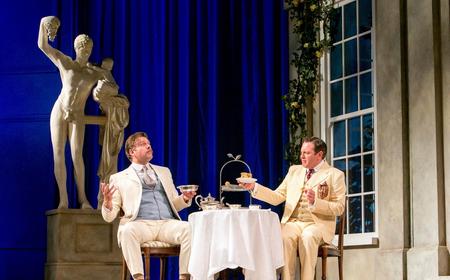
The festival is non-Equity and productions are performed at Kilgore College. There will be five shows this season: two Shakespeare productions, "The Tempest" and "The Merchant of Venice"; one non-Shakespearean classic, Sheridan's "The Rivals"; and, for the first time, a modern American classic, Tennessee Williams' "The Glass Menagerie." There will also be a children's show, "Jack and the Beanstalk."
For years the theatre produced a local history play, "The Daisy Bradford Three," which will be revived for the 20th anniversary season next year.
All of the summer season's plays are performed in repertory, with about 10 and a half hours a day devoted to rehearsal. Three shows rehearse each day for about three and a half hours. The actors arrive on May 16 and the season begins on June 24 (the first of four consecutive opening nights). The children's show opens on July 13. While, in other years, interns have performed this show, this year's children's show will be performed by the professional acting company. Rehearsals will begin for that show on June 29.
Auditions are held locally, and also in New York in December. In addition, Caldwell goes to the Unified Professional Theatre Auditions in Memphis in February, and reaches out to programs such as the University of Delaware, known for specializing in the classics. This year, the University of Illinois was also approached. In other seasons, NYU, UC Irvine, and Penn State were among the university theatre programs where non-Equity talent was sought.
The festival accepts videotaped auditions. "We don't cast from a photo and resume," says Caldwell.
The full production team consists of roughly 85 people, including designers, technicians, and performers. The theatre seats 238 people, and is about 30 years old. "We have new lighting, sound, and rigging systems," says Caldwell. "Everything is done on-site, including costumes."
This year two acting interns will be chosen, although in many other seasons more have been selected. The interns will only act. In addition, there will be roughly 10 technical interns who are assigned to specific departments, such as costumes, box office, props, and lighting. They receive six hours of college credit and are on scholarship while at the theatre. They receive free housing and meals. The professional actors also receive free housing (in the college's dormitories), meals, and stipends, as well as transportation. The interns do not get free transportation. They are often cast in small ensemble roles.
Students can attend classes, led by the festival's professionals and Kilgore College faculty, in Shakespearean acting skills and combat skills. The festival also sponsors events in which interested adults can attend discussions led by directors, performers, and others involved with the festival, as well as a children's day camp, where Shakespearean performance skills are taught.
—Esther Tolkoff
Music Theatre of Wichita
Wichita, Kans.
Music Theatre of Wichita (MTW) was founded in 1972 in response to what was perceived as the poor quality of touring productions that had been recently presented in the area. The founders' mission was to create a community-based theatre that would produce work that exceeded the quality of its touring competition. Thirty-three seasons later, the stage at the 2,100-seat Century II is filled with productions Producing Director Wayne Bryan describes as having "lavish sets and costumes, as well as Broadway guest stars."
As evidence of MTW's excellence, Bryan sites the fact that MTW is "the highest-subscribed nonprofit arts organization in Kansas." He also points to the theatre having received the 1997 Governor's Arts Award and the 2000 Pride of the City Award from the city of Wichita.
Nationally, the theatre's work has become known and recognized because of two original cast albums of its productions: a revised version of the 1927 musical "Good News" and the American cast album of the Olivier Award-winning musical "Honk!" This year, MTW has received an exceptional nod from the theatre community: Disney Theatricals has invited MTW to create its own version of Disney's "Beauty and the Beast."
The work seen on MTW's stage is created by a variety of professionals and nonprofessionals. Equity performers (working under a University/Resident Theatre Association contract) from New York return to the theatre season after season to perform in its productions. Recent appearances have been made at the theatre by Kristin Chenoweth, Matt Bogart, and Kelli O'Hara.
Alongside these performers are actors (mostly college students) just starting their careers who are hired from auditions held in cities around the country. As Bryan notes, "These members of MTW's summer resident company often can get college credits by completing paperwork through their own institutions or one of several local universities." Apprenticeships are available for high school students from the Wichita area, who have the opportunity to learn about all aspects of the theatre from their duties backstage and through seminars and workshops.
MTW produces in a city-owned facility with amenities and technical capabilities that rival theatres on the Great White Way. To enhance its physical productions, MTW often collaborates with other theatres, sharing expenses for sets and costumes. In 2004, MTW has expanded its own budget, as well as the number of theatres with which it works, to ensure that "Beast" receives, in Bryan's words, "a grander production than any we have done before."
While the audience directly experiences MTW's commitment to technical excellence, what it may not recognize is MTW's commitment to ensuring that its guest artists (actors, directors, choreographers, and musical directors) are comfortable during their stay in Wichita. From dressing rooms that can accommodate the theatre's sometimes mammoth companies (their production of "The King and I" included over 100 performers) to commodious living arrangements at hotels and apartments, MTW makes sure that life "on the road" becomes a home where first-class musical-theatre work can be created and enjoyed.
—Andy Propst
'The Medora Musical' at the Burning Hills Amphitheatre
Medora, N.D.
"The Medora Musical," now in its 40th year, is dedicated to Theodore Roosevelt, who lived in Medora, N.D., and "cleaned up the town in 1886," says Producer and Artistic Director Curt Wollan. The Western-flavored tuner intersperses songs and dance numbers, awash in historical characters (like Roosevelt, Custer, and Sitting Bull), with a series of specialty acts—comedy, variety, etc.—all tied together by a host. There are also cowboys and wranglers on hand. "It's a pageant musical revue and historical drama," says Wollan. "This year, because it's Lewis and Clark's bicentennial, there will be Lewis and Clark themes included in the show."
The show may change a bit from year to year, but its larger-than-life character remains constant. Consider the setting: "We have a 3,000-seat amphitheatre, with a 90-foot proscenium, and state-of-the-art technology," notes Wollan. "We have 75 to 100 costumes and all the sets are moved in and out across the stage on railroad tracks. The lighting, housed in large water towers, is computer-operated. We have two large dressing rooms that accommodate 12 performers each and eight dressing rooms for the stars."
It's not surprising, he points out, that the theatre is occasionally used by other acts, like country-western performances and cowboy poetry gatherings, of all things.
"The Medora Musical" runs from the first weekend in June until Labor Day, with three weeks of preparatory rehearsal, one and a half weeks in Minnesota and one and a half weeks in Medora. One performance is offered every evening and it runs two hours, from 8:30 to 10:30 pm.
Audiences cover a spectrum of demographics, Wollan reports. "We attract families, senior citizens, and foreign bus tours. I don't know why, but we seem to attract many tourists from Germany, Norway, and Italy."
The theatre is a commercial operation, but the Theodore Roosevelt Medora Foundation, which produces the show, is a not-for-profit group. Performers are non-Equity, although the company is thinking of using an Equity Guest Artist contract that would cover the hosts. Although no household-name performers have appeared in Medora recently, Wollan notes that actors David Soul ("Starsky and Hutch") and Tom Netherton (from "The Lawrence Welk Show") got their starts at Medora.
Housing (in a local motel) and transportation are provided to performers, and so is food. "At three [prepaid] restaurants in the area, performers have their choice of buffets, pizza, hamburgers, and submarine sandwiches."
The musical employs 12 singer-dancers, two co-hosts, and a live six-piece band. "We ask people who audition for us to be prepared to sing an uptempo and a ballad," says Wollan. "Having a flair for clog dancing is good, and performers should be prepared with a short comic monologue. This year we're also looking for sound technicians and stage managers. Nonperforming staff should send us a resume. We will also be conducting interviews along with auditions at the Unified Professional Theatre Auditions in Memphis and then at the Southeastern Theatre Conference, in addition to holding auditions in Minneapolis. We see well over 1,000 performers. Paid internships are available for technical backstage work—specifically, assistant stage managers and assistant sound technicians. Those who are interested should contact the foundation in Bismarck, N.D."
—Simi Horwitz
Coeur d'Alene Summer Theatre
Coeur d'Alene, Ida.
"There are quite a few reasons our theatre is special. One is the location, Coeur d'Alene, Ida., an incredibly beautiful setting. Another thing I'm proud of is that we always have a full orchestra of professional musicians, with original Broadway arrangements. For a performer, there's nothing like singing with a 24-piece orchestra. Finally," says Roger Welch, producing artistic director, "it's a very professional company, but there is a real family feeling in the company."
The theatre is not-for-profit and non-Equity, but employs two or three Equity Guest Artists in each show. This will be its 37th summer season of musical theatre, opening in June with "Seven Brides for Seven Brothers," followed by "42nd Street," "Little Shop of Horrors," and closing with the Northwest premiere of "Cats." Coeur d'Alene does four shows, and each show rehearses for two weeks and runs three weekends. New shows have been produced, but rarely.
The house is a 1,200-seat proscenium theatre, a modern facility that employs full sets and has some fly space. All the performers have body mikes. The theatre has its own scene shop and costume shop off-site.
"We actually rent the theatre space from North Idaho College. We may have some crossover with some of their students in internships, but we're really our own operation," says Welch. "The company is housed in apartments about a block from the theatre, and there are two-bedroom staff apartments. They're a few blocks from the lake."
Anyone who comes in from out of town and doesn't have a car is put up in the apartments. Some people who come with their cars may be put up in one of the lake cabins.
Welch holds auditions in several different cities. "I go to Seattle every year, and to Portland, Ore., and I do New York. And sometimes I go to L.A. and San Francisco and Chicago. A lot of people send video submissions if they can't make the auditions, which is perfectly fine with me."
His stage manager has been with him four years, but the staff usually changes—nobody is guaranteed a job for next summer. He has a musical director, as well as directors for the shows.
"Were still developing our apprenticeship program," says Welch. "Because we're not a full Equity company, we can't offer our apprentices points toward their Equity membership. But we do offer paid internships, and we arrange with the colleges that they're from to get credit for their work here."
People who want to work at the theatre can send their pictures and resumes to Welch at the theatre. Potential acting or staff candidates can also check out the theatre's website at www.nic.edu/summertheatre.
The audiences for Coeur d'Alene Summer Theatre are local, as well as visitors from the whole Northwest area around them. Coeur d'Alene is a resort town that attracts many summer visitors.
—Ira J. Bilowit
Old Lyric Repertory Company
Logan, Utah
The Old Lyric Repertory Company in Logan, Utah is affiliated with Utah State University and views itself as a university training program. It is a non-Equity house, but it does bring in Equity artists working under either University/Resident Theatre Association or Guest Artist contracts for principal roles. The 37-year-old company presents a variety of genres. Four plays are presented in rolling-repertory format.
"We do a comedy or farce, one musical, a mystery or more serious drama, and a light classic," says Producing Artistic Director Colin B. Johnson.
Utah State faculty serve as the directors and designers. Guest directors and designers are sometimes invited in as well.
This year's productions will be "Moon Over Buffalo," "Enchanted April," "Song of Singapore," and Agatha Christie's "The Hollow."
The 11-week season runs from June 17-Aug. 7. The actors and staff must be present by May 22. Rehearsal time is about 55 or 60 hours per production. There are two rehearsal periods each day. Each play gets the equivalent of about three and a half hours per day rehearsal, although not every play is rehearsed every day. The plays open separately, with one opening each week, after which they overlap.
The audience consists of the local community, the university community of students and faculty, and "about 1,000 retirees who come up from Sun City, Ariz., to take advantage of the university's summer programs."
"Most of our cast members are advanced theatre students and alumni who come back and are now professionals. The theatre students are selected through auditions. Last year we had four Equity Guest Artists," says Johnson. Equity stage managers are also hired.
Johnson seeks advanced student talent (upper-division undergraduates and M.F.A. students) at the Northwest and Southwest regional divisions of the American College Theatre Festival. He also plans to go to Chicago to audition Equity actors on March 9.
Pictures and resumes from advanced drama students are also welcome.
Apprenticeships are available through a program for high school juniors or seniors. The apprentices produce and appear in a showcase production for a small, invited audience at the end of the season. Applications can be found on the company's website at www.usu.edu/lyric.
Roughly five technical interns are chosen as well, one of whom is a stage management intern. The interns are generally college undergraduates. They receive a stipend.
Housing and transportation, plus stipends, are given to the Equity Guest Artists. Student performers must find their own housing, but are given a small transportation stipend.
The 388-seat house, the Caine Lyric Theatre, has been renovated and is listed in the Utah State Register of Historic Sites. An effort is made to keep the historical feel. While lighting and sound systems are modern, the hemp rope flying system has been maintained.
Logan is also the home of the Utah Festival Opera Company, which also provides performers and technical staff with potential opportunities. The opera company auditions nationally; its website is www.ufoc.org.
—Esther Tolkoff
Sacramento Music Circus
Sacramento, Calif.
"For 50 years, we were in a canvas tent doing theatre-in-the-round. Last summer we got a new permanent theatre facility on the same location. From the outside, it looks like a canvas tent. But on the inside," Artistic Director Scott Eckern proudly tells us, "it is a beautiful performing space, with 2,200 comfortable theatre seats, and air conditioning. When we were in the tent, we stretched and grew and tested our limits—and had great productions. And now the facility supports the quality of our performers and productions."
The Music Circus does seven shows for its summer season, opening July 6 with "The Wizard of Oz," which runs for two weeks. The next five shows run for one week each: "The Fantasticks," "Oklahoma!," "The Pirates of Penzance," "Footloose," and "The Scarlet Pimpernel." The season closer will be "Jesus Christ Superstar," which runs for two weeks. Each show rehearses for two weeks.
"We are an Equity company, and work under the Resident Musical Theatre contract," says Eckern. "I audition actors in New York, Los Angeles, and Sacramento. I go through the complete process of Actors' Equity EPAs and chorus calls, and proceed on to agents' submissions and individual appointments, and the process of callbacks, and recommendations from directors, choreographers, and musical directors. I also audition nonunion people, and if they are what we're looking for, they are offered contracts."
All members of the chorus are Equity, and the theatre doesn't have acting apprenticeships. The ensemble is mostly a resident company, but since the most they can do is four shows (because of the two-week rehearsal periods), they job in a number of performers. Some principal actors have some residency, too, maybe doing two or three shows, but they also job in quite a few principals.
There is an internship for high school seniors and college freshmen to get experience in all areas of production—stage management, scenery, props, wardrobe, and sound. There is also a paid assistantship program for more advanced students to focus on one specific technical area.
Housing for the actors is generally in a hotel directly across the street from the theatre. For the longer resident players, there are apartments that are within walking distance. Members of the tech crew, if not from the local area, are housed in apartments.
"Our primary audience," says Eckern, "is from Sacramento, although they come from all over the state. We have about 10,000 subscribers for the summer, and the balance of our ticket sales is individual buyers. We are a not-for-profit operation, and run outreach educational programs."
The theatre is very high-tech. It has two turntables and five lifts on the deck, a lighting grid, full fly space to fly scenery above the grid, and a state-of-the-art sound system. The roof is a Teflon-coated fiberglass, and there are no supports or obstructed views.
"A young actor who has spent a summer here has certainly gotten the experience of mounting a production quickly, performing in one show while rehearsing for another," says Eckern. "It really tests their stamina and the range of their abilities. As they go from show to show, they've run the gamut of musical theatre.
"It's a real test of their desire to stay in the business and to work hard. If this has been their first Equity job, their careers really begin here. And they can decide whether to have a career making a living as a performer, or to decide that theatre isn't really a business for them."
—Ira J. Bilowit