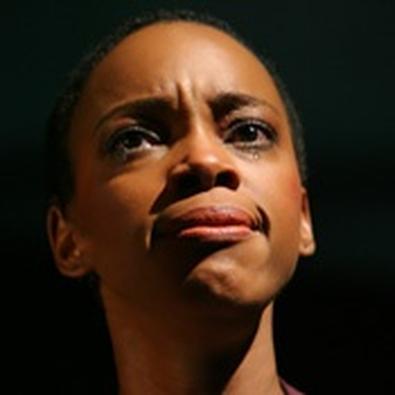
April Yvette Thompson has played Lady Macbeth, originated roles in world premieres of plays such as Kia Corthron's Light Raise the Roof, appeared on film and TV opposite Bill Pullman and Susan Sarandon, and acted in Zimbabwe and Edinburgh, Scotland.
These days, though, she's closer to home -- her current one and that of her childhood -- in Liberty City, an autobiographical solo show at Off-Broadway's New York Theatre Workshop. It focuses on her experiences in the late 1970s and early '80s in her Miami neighborhood, which was torn by riots after an unpopular verdict in a murder trial involving four white policemen and an African-American man. It also concerns her father and mother, a galaxy of colorful characters, and her life just before the turbulence. She co-wrote the play with her director, Jessica Blank.
Thompson's path to Liberty City began in a very different direction. She'd been working on a play based on slave narratives but had come to see many of them as "tainted," with former slaves making statements like "It really wasn't that bad." Ultimately she realized she couldn't use what she was finding, that she was "running up against a wall," she says.
Around the same time, Thompson was also working on The Exonerated, a play by Blank and Erik Jensen based on interviews with former death-row prisoners. During the play's development period, Thompson saw that Blank and Jensen's process "had a lot of integrity, particularly the way they allowed the writing to breathe." Yet she didn't approach Blank about collaborating; in the end, in fact, it was Blank who offered to help Thompson turn to solo performance.
The genesis of Liberty City came after a party Blank attended at Thompson's home. At a certain point that night, Blank says, "I realized that April had been talking for about 45 minutes or so and everybody was totally rapt." Thinking that Thompson might be a terrific solo performer, Blank asked her about creating a one-person show. Her reply, Thompson says, was, "I've wanted to do a solo show forever."
At first, neither knew where their collaboration would go. Blank knew she wanted to start from a "documentary place," so they began meeting on a regular basis, with Blank conducting taped interviews with Thompson. "Soon it became clear," Blank says, "that April comes from an incredible family." After about a year, the interviews were transcribed and they "started identifying which stories [were] potentially theatrical," she says.
Thompson began doing some imaginative work of her own, based on her process as an actor. For instance, Blank would interview her in character, with Thompson playing many of the people she'd discussed in the interviews. Blank would also ask those characters to discuss one another. These exercises were recorded and transcribed, and from there the collaborators began fashioning monologues and script passages, allowing them to develop an outline for the show and identify gaps in plot and structure. Ultimately, Blank says, they created "a piece that's based in truth but one that also has imagination involved. In other words, it's not strictly documentary theatre."
One of the things that Thompson talks most passionately about was the opportunity, in creating these characters, to address a pet peeve of hers as an actor: "I go and audition for these wonderful plays, but they are not about people that I know." Often, she says, African-American characters are simply archetypes: "They're so noble or so victimized that they aren't as real as I'd like them to be."
Thompson continues, "I'm interested in creating social change in the work that I do. If you put real people on stage, the audience has compassion, not resentment, pity, or guilt. That's where the power of theatre lives. I didn't feel as if I was playing enough characters like this." The characters in Liberty City "aren't superheroes or felons," she says. "They're not perfect or really fucked up. They're real, frail, dreamy, and complicated. And that's where real humanity lives."
Such humanity comes with certain embellishments, however. For the character of her aunt, Thompson says, the accent she uses is thicker than that of her real aunt: "I wanted to capture the flavor of Miami, so I've used a combination of rhythms and sounds from the Bahamas, Africa, and Ghana. That's a decision I made in creating the character, and it opened something for me that I could explore as I've created the character." For her father, Saul, Thompson used Richard Pryor as a model. "I wanted to find one person who captured the fiery person of the period. His comedy is so sad, funny, angry, and brilliant."
Discussing her work with Blank, Thompson refers to capturing the "poetry of the characters." Practically, this means that as Thompson improvised during the interview process, Blank listened for where sentences broke off. Those gaps became line breaks in the script.
As satisfying as the writing process has been for her, Thompson notes the difficulties of solo performance: "The challenge is that I'm playing scenes with myself. In traditional theatre, one character drives the scene and another responds or receives. Here I'm always driving. I always have to keep the ball up in the air. I find that exhausting some nights. It requires being present for four different people all the same time. I can't check out."
A visit to a tech rehearsal reveals that although she's alone on stage, Thompson has a lot of backstage support. For example, when she transforms herself from the narrator of the play into Lamarr, a 6-foot-6 gay man, carefully choreographed light and sound cues ensure that all is clear to the audience.
Thompson and Blank hope they've written a solo piece that stands on its own as a play, not just a showcase for Thompson's obvious talents. Thompson hopes it will leave theatregoers with a sense that everyone must "be brave, keep trying, and not give in to cynicism. As long as I can keep telling stories like that, I'm a happy girl."
Liberty City runs through March 16 at New York Theatre Workshop, 79 E. Fourth St., NYC. Tickets: (212) 239-6200 or (800) 432-7250 or www.telecharge.com.