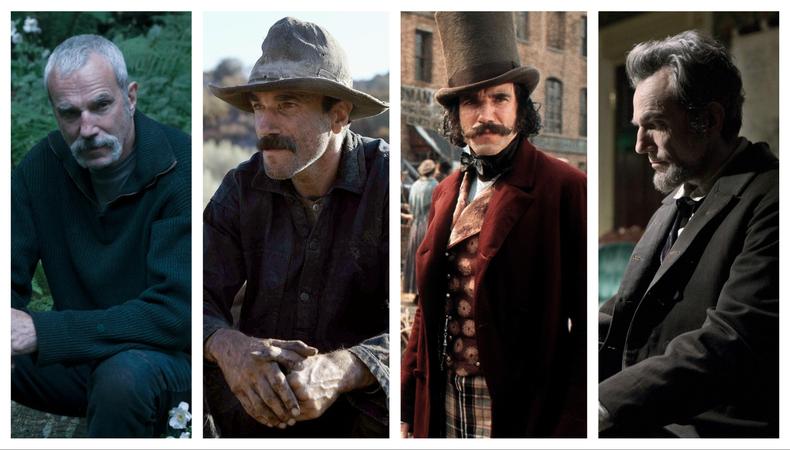
Few modern actors have legends built around them like Daniel Day-Lewis, for better or worse. He’s known for his immersive preparation, for retiring from the limelight for lengthy periods, and for the pronounced supratemporal veins that make his forehead a versatile canvas. Now, the British-Irish virtuoso is returning to the silver screen after an eight-year absence with the nerve-wracking “Anemone,” a drama fittingly about a hermit in self-exile, directed by and co-written with his son Ronan Day-Lewis.
The actor’s comeback brings both lofty expectations and renewed discourse surrounding Method acting. Despite its history as a tool of emotional recall — rooted in the mid-century techniques of Lee Strasberg, Stella Adler, and Sanford Meisner — the Method has, for many viewers, come to mean staying in character for a harrowingly long time. For decades, tales of the three-time Oscar winner’s antics have leaked out despite his secrecy, resulting in both an unparalleled onscreen repertoire and a simultaneous re-orienting of acting as sadomasochistic mischief.
Whether subjecting himself to verbal and physical abuse to play an innocent prisoner, or demanding crew members feed him by hand to better embody a man with cerebral palsy, Day-Lewis has long seemed like both a pain and a curiosity to work with. There is, however, no denying that he gets results. For most actors, a mere 30 screen performances ought to be easy to collate, but his sheer variety and rigor make re-visiting and ranking his finest hours logistically difficult. Then again, it’s also an emotionally rewarding process — a fitting dichotomy for one of the most exasperating yet enthralling performers in all of cinema.
These are 15 of his greatest roles.
15. “A Room With a View” (1985)
In James Ivory’s exquisite period piece, Day-Lewis plays Cecil Vyse, an appropriately uptight socialite who gets in between the film’s romantic leads by pursuing the feisty, talented Lucy Honeychurch (Helena Bonham Carter). Although he creates a comically snobbish dandy through his enunciation and posture — he quite literally looks down at everyone through pince-nez glasses — Day-Lewis also imbues Cecil, in quiet moments, with a beating humanity and a withheld loneliness, despite dripping with pretension.
14. “Stars and Bars” (1988)
While arguably the weakest film in Day-Lewis’ career, Pat O’Connor’s fish-out-of-water saga is also a marvelous peek at the actor’s seldom-deployed talents as a pratfalling jester. As Henderson Dores, a British art dealer on assignment in rural Georgia, the seasoned thespian veers between the confounded observations of culture clash and rubber-faced goofiness when this comedy-of-errors veers into mobster territory. It’s hard not to wonder what might’ve been had he followed this path, perhaps ending up a sitcom mainstay or a peer to Jim Carrey.
13. “My Left Foot” (1989)
Although the role might be cast differently today, Day-Lewis’ performance as the real quadriplegic author and painter Christy Brown nabbed him Oscar No. 1. His first of three collaborations with director Jim Sheridan, “My Left Foot” sees the actor quite literally contorting himself in service of authenticity. The performance isn’t so much about Brown’s physical limitations as it is the way his talent, intellect, dignity, and desires shone through every moment.
12. “The Age of Innocence” (1993)
In his first film with Martin Scorsese, Day-Lewis plays author Edith Wharton’s suave Gilded Age protagonist Newland Archer with a quiet flair beset by equally subtle frustration. Differentiating it from his other romantic roles (especially in the restrained costume-romance department), Day-Lewis embodies time and place by crafting an emotionally potent charmer torn between his love for two women yet constrained in movement and speech by society’s norms, as though his body were telling its own tale of wildly opposing forces.
11. “The Crucible” (1996)
Based on the play by Arthur Miller—Day-Lewis’ eventual father-in-law, who also penned the screenplay—Salem Witch Trials drama “The Crucible” sees him playing John Proctor, a farmer accused of adultery. Day-Lewis deftly splits the difference between stage and screen, offering a soft-spoken, highly naturalistic version of theater mainstay Proctor, albeit one who slowly sheds his emotional shackles the more he’s confined by real ones. Eventually, he explodes with perhaps the most underrated weapon in his arsenal: shame.
10. “In the Name of the Father” (1993)
As Gerry Conlon, a provisional IRA recruit mistaken for a sniper, Day-Lewis—in his second film with Sheridan—enters the frame with unapologetic bravado. But his swagger is slowly stripped away by unjust British systems, until all that’s left is fear and unfiltered anguish. Few onscreen figures have been so charming and yet so pitied, a journey Day-Lewis guides us along by embodying the effects of state cruelty on a man’s psyche and sense of being.
9. “Gangs of New York” (2002)
After a five-year absence, Day-Lewis re-teamed with Scorsese for a grandiose pivot toward caricature grounded in exposed and festering feelings. Playing the staunch 19th century nativist William Cutting, aka Bill the Butcher, he provides the enormous period production with a fiery centerpiece. For his mustachioed villain, survival—whether through violent bloodshed or crass humor as a coping mechanism—is a guiding instinct, one so primal that he’s willing to turn the world inside out through war if it means defeating his enemies.
8. “The Unbearable Lightness of Being” (1988)
Based on the novel by Czech author Milan Kundera, Philip Kaufman’s romance drama is arguably the apex of Day-Lewis’ run as a striking romantic lead (alongside Michael Mann’s “The Last of the Mohicans,” which also deserves a mention). As sharp-tongued brain surgeon Tomas, Day-Lewis moves with a panther-like saunter, sleeping his way through the 1968 Prague Spring, until his escapades become a gateway to genuine intimacy with the curious waitress Tereza (Juliette Binoche). It’s a magnetic performance, in which a smolder masks hidden vulnerabilities.
7. “Lincoln” (2012)
A clash between idealism and the pragmatic, Steven Spielberg’s period biopic (and backroom political saga) frames Abraham Lincoln as an ecclesiastical figure but finds within him human doubts and struggles. It may as well be a deconstructed Gospel, centering on a weary but graceful performance that grounds the president’s mythical stature in surprising historical details (like the slain leader’s shrill, high-pitched voice). The role frequently tempts Day-Lewis toward his usual place of desperate and exasperated outburst, but doing so would derail his character’s carefully-laid plan to abolish America’s original sin. The result, a careful tightrope walk of tone and intention, made Day-Lewis the first and thus far only three-time best actor winner at the Academy Awards.
6. “My Beautiful Laundrette” (1985)
Appearing like a mysterious angel in the distance, Day-Lewis’ playfully punk Johnny Burfoot captures the frustrations and broken promises of Margaret Thatcher’s England, in a tale of enterprising Pakistani Britons confronted by white supremacy. Johnny’s illicit queer romance with industrious Muslim businessman Omar (Gordon Warnecke) becomes a flashpoint for racial tensions and family woes, but his seductive presence is utterly enrapturing, whether through wry smiles or the movement of his slender fingers as he plays with scissors and other household objects. It’s hard to take your eyes off Day-Lewis, even as he graciously cedes space to his co-stars.
5. “The Boxer” (1997)
Day-Lewis’ third and most underrated handshake with Sheridan, the romantic sports drama about IRA factionalism feels like the arrival of a would-be Hollywood A-lister on the precipice of stardom (though it would also be his final role before his first “retirement”). As Danny Flynn, a former fighter released from prison in Belfast, Day-Lewis brings a brooding intensity and lanky physicality befitting a classic leading man with chiseled good looks. However, as is always the case with his screen presence, what hides just beneath the surface is far more engrossing than the familiar. His melancholy, uncharacteristically centered performance builds rhythmically toward release, both in and outside the ring, for a role in which violence and gentleness feel constantly at war.
4. “The Ballad of Jack and Rose” (2005)
Written and directed by the actor’s wife, Rebecca Miller, the indie drama about an ailing, possessive middle-aged father, Jack Slavin (Day-Lewis), and his teenage daughter, Rose (Camilla Belle), is one of his most emotionally challenging parts — not to mention, one of his most naturalistically performed. On their isolated commune, Jack’s already complicated and often inappropriate relationship with Rose is thrown further into disarray when his girlfriend and her two sons move in with them. This discomforting rigmarole yields a tale of jealousy and immense self-loathing. Day-Lewis once again taps into the well of shame and remorse that has informed some of his most emotionally raw cinematic work. The nauseating guilt running through Jack’s veins ends up right behind his eyes, forcing a confrontation of complex desire simply by meeting his enthralling gaze.
3. “Anemone” (2025)
Self-loathing remains a family affair in Ronan Day-Lewis’ directorial debut, which meanders thematically but becomes intriguing by casting his legendary father as a man living alone in the woods. As Ray Stoker, a former English soldier once tasked with violent suppression in Northern Ireland, Day-Lewis keeps the character’s reasons for his painful exile under wraps. The mystery gradually unspools through fiery monologues brimming with twisted humor, revealing a long-buried past in which Ray’s been both subject and purveyor of unspeakable brutality. Playing a lost man who may never find himself, Day-Lewis’ return is tragic and triumphant, and one of the darkest incarnations of the gruff and volatile men he’s become famous for portraying.
2. “Phantom Thread” (2017)
Few directors have so fully utilized Day-Lewis’ talents as Paul Thomas Anderson, whose “Phantom Thread” was, for many years, the actor’s swan song. As the meticulous garment designer Reynolds Woodcock — a man whose piercing voice demands authority — Day-Lewis makes structure and routine his north star, with any interruption becoming cause for both concern and all-out paranoia. When Reynolds meets his match in the form of waitress Alma (Vicky Krieps), her challenging disruptions leave him dislodged from himself, unable to command the room as he once did. It’s a film about the warped allure of ceding control, a process by which Reynolds is broken and remade, and through which Day-Lewis finds new dimensions to his own toolkit, from his charming smirks to belligerent outbursts. It’s a performance that makes even the familiar seem uncanny, as it builds to cathartic denouements.
1. “There Will Be Blood” (2007)
Day-Lewis and Anderson’s first collaboration has rightly been canonized as a modern masterpiece, in part because of the actor’s Oscar-winning turn as one of cinema’s most barbarous villains. Daniel Plainview may not spend the movie butchering people, but his untamable savagery emanates from within. He’s an early 20th century oil tycoon for whom sincerity is a mask and wealth is the ultimate sacrament. With his hunched posture and raspy whispers that lure unassuming congregations, Day-Lewis masterfully weaves indignation and discontent, creating the ultimate, morose vision of American ingenuity: a huckster willing to sell his soul (and perhaps even his son) for a drop of black gold. Watching Day-Lewis slip further into the madness of greed is as terrifying as it is imminently relatable, as well as a stark reminder that none of us are immune to base temptations. It’s an act of cinema conjured through dark magic, and one of the greatest performances ever committed to the screen.