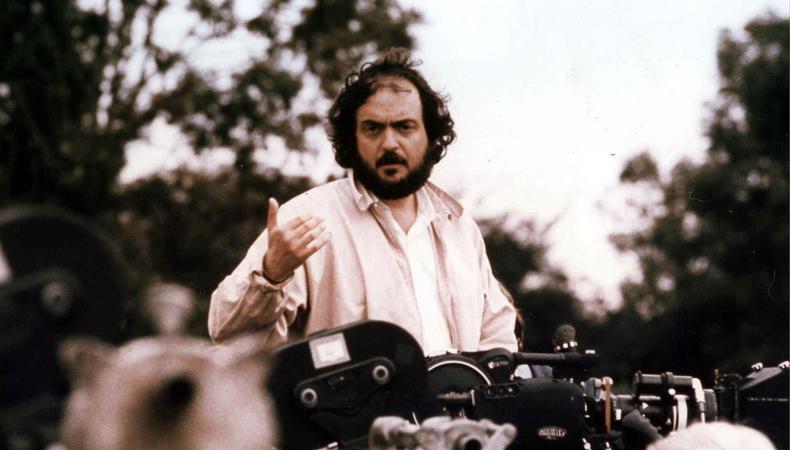
The words “meticulous” and “perfectionism” tend to come stapled to Stanley Kubrick’s résumé. But what does that mean in practice? Most directors labor in preproduction to make sure their vision comes to life. Few would be satisfied with anything less than its ideal execution—even if resources and compromises prevent such perfection.
To look at the best Kubrick films (and there’s an argument to be made that he never misfired) is to see such planning onscreen, but done in a way as to upend conventions. The bizarre purity of his work is how he created pictures like 1968’s “2001: A Space Odyssey” and 1980’s “The Shining”—movies that didn’t fit neatly into any mold, but they still arrived fully formed. Looking across his filmography, we can see how Kubrick was able to craft a series of distinct masterpieces through his thoughtfulness, persistence, and dedication.
If you’re an aspiring director—or just a filmmaker who understands the learning process never ends—here are a few major takeaways from Kubrick’s movies.
Know your cameras.
Kubrick got his start as a photography wunderkind. He had a submission accepted into the prestigious Look magazine at only 16 and was hired soon after as a full-time photographer. This work not only taught Kubrick visual language and how to tell a story without words, but also what different lenses and focal lengths will get you.
RELATED: How to Be a Good Director
For his 1956 crime noir “The Killing,” Kubrick envisioned an elaborate dolly shot (seen below) with a 25 mm lens. Cinematographer Lucien Ballard tried to convince Kubrick to move the camera back and use a 50 mm lens, which would make everyone’s jobs easier while still capturing the action. However, because Kubrick knew such a distance would ruin the perspective of the shot, he insisted the setup remain at its original placement. This deep knowledge of camera technology would carry over to films such as “2001” and “Barry Lyndon” (1975) as Kubrick wanted to capture images that had never been seen before, and sometimes needed new technology and techniques to accomplish the task.
Do your homework.
While preproduction is an essential part of any film, Kubrick would bury himself in research before taking on a project. He could spend years prepping for a film, not only learning the material, but mapping out the shots and technology he would need far in advance. On “The Shining,” for example, Kubrick worked for months with production designer Roy Walker to meticulously construct a layout for the Overlook Hotel that would emphasize the mood even more than the horror-filled story.
“We spent weeks going through [Walker’s] photographs making selections for the different rooms. Using the details in the photographs, our draughtsmen did proper working drawings. From these, small models of all the sets were built,” Kubrick said in an interview with film critic Michel Ciment. “We wanted the hotel to look authentic rather than like a traditionally spooky movie hotel. The hotel’s labyrinthine layout and huge rooms, I believed, would alone provide an eerie enough atmosphere.”
Many film scholars and critics over the years have pointed out the corollary between Kubrick’s love of chess and his patient, painstaking approach to filmmaking.
“Among a great many other things that chess teaches you is to control the initial excitement you feel when you see something that looks good,” the man himself told Playboy in 1968. “It trains you to think before grabbing, and to think just as objectively when you’re in trouble. When you’re making a film you have to make most of your decisions on the run…. It takes more discipline than you might imagine to think, even for 30 seconds, in the noisy, confusing, high-pressure atmosphere of a film set. But a few seconds’ thought can often prevent a serious mistake being made about something that looks good at first glance.”
Perhaps more importantly, he wasn’t one to let the work go to waste. He famously spent years working on a film about Napoleon Bonaparte only for the project to fall apart when the financers pulled out. Rather than cast his hard work off to the side, Kubrick applied much of the research and 18th century visual language to the period piece “Barry Lyndon.”
Say it with your whole voice.
Kubrick’s uncompromising vision led to films with hard-line messages, especially where war was concerned. “Paths of Glory” (1957), “Dr. Strangelove or: How I Learned to Stop Worrying and Love the Bomb” (1964), and “Full Metal Jacket” (1987) are all anti-war tales that lean into the dark absurdity of their situations. But it never feels like Kubrick is repeating himself. While some may wish to pigeonhole Kubrickian films into a style that’s cold and sterile—like the look of the space station in “2001” or the hallways of the Overlook in “The Shining”—you can’t miss the fury coming off his anti-war movies. The three films are distinct, but they share the commonality of buffoonish superiors chasing glory through violence. You can skewer these ideas by leaving your audience both amused and shaken.
To put it another way, just because you take a clinical approach to filmmaking, that doesn’t necessarily mean the resulting film will be passionless or inert. You need to ensure there’s still an emotional texture to the story you’re telling.
Love the source material—and then leave it behind if necessary.
Every Kubrick film made after “The Killing” is based on pre-existing material. Sometimes, Kubrick made fairly faithful adaptations, as was the case with 1971’s “A Clockwork Orange” or “2001.” He tried to stay faithful to “Lolita,” but the mores of the Production Code forced compromises in bringing Vladimir Nabokov’s 1955 novel to the screen.
Other times, Kubrick used the material as a jumping-off point for his own view of where to take the story. This famously caused friction with Stephen King over “The Shining.” But in the decades since that film’s release, it’s become clear that both the book and the movie can stand on their own merits. King’s novel is more specifically about a man fighting against his generational trauma fueled by alcoholism, while Kubrick opted for a more ethereal, unspeakable horror that terrifies in part because of how it defies easy categorization. As a filmmaker, you need to know when to stay close to the material and when it serves best as a starting point.
Earn your big budgets.
Considering 1999’s “Eyes Wide Shut” holds the world record for longest continuous production and “2001” ballooned past its original price tag, it’s easy to peg Kubrick as someone who always worked with inflated budgets. But he cut his teeth working within tight constraints, while sacrificing none of his inventiveness. His first feature, the war-thriller “Fear and Desire,” cost $100,000, and Kubrick served not only as director but also as producer, cinematographer, and editor. Even deeper into his career, he knew how to follow up the at-the-time exorbitant $10.5 million budgeted “2001” with the far cheaper, but no less influential, “A Clockwork Orange.”
This goes back to meticulous planning. If you know the exact people you need and precisely what you want them to do, you reduce costs to the essentials. Granted, Kubrick had a unique relationship with Warner Bros., which distributed his challenging material and granted him a large amount of creative control on every film after “2001.” But there were never stories about runaway productions despite the length of the filming schedules. With so much other planning in place, Kubrick had far more time to work with his actors and find the performances he wanted. Studio economics and filmmaking have certainly changed since Kubrick passed away in 1999, but there’s still a lesson in how, despite his grandiose visions that took viewers to places they had never seen before, he never acted like he had a blank check.
In the end, Kubrick is the visionary who thought to encompass the whole of human history, from a falling femur to a space station, and that takes a certain kind of genius I’m not sure you can teach. But you’ll never know until you pick up a camera yourself.