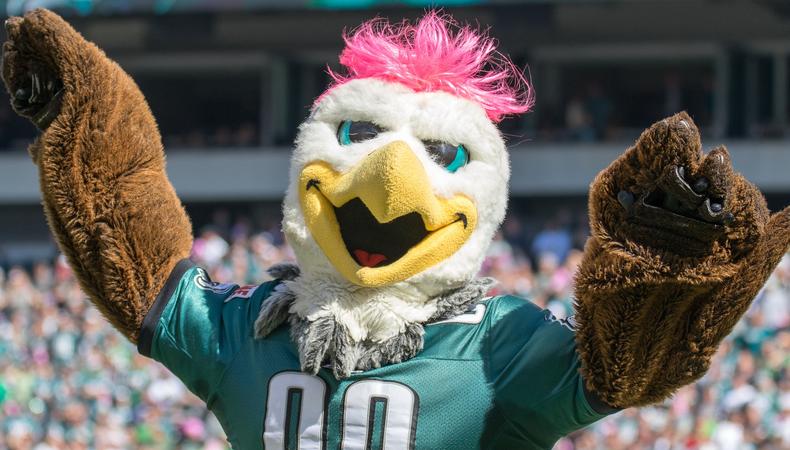
The gut-busting goofballs that are mascot performers bring an extra layer of entertainment to theme parks, parades, and sports events. Becoming a mascot performer isn’t for everyone, but it can be a fun and rewarding experience for eager actors that love to entertain the young and the young at heart.
JUMP TO
A mascot is any character (human, animal, or otherwise) that represents a group, team, or brand. When someone wants to bring that character to life, they need a mascot performer to play the part—whether that’s the guy dressed as a bird selling insurance on the street or one of the many mascots making bank representing sports teams worldwide.
These wacky characters have been a staple of the sports scene for decades, with their origin dating back over a century to a batboy named Chic. Many other early mascots were animals, such as the bulldog that started it all, Handsome Dan of Yale University’s class of 1892. Eventually, though, these children and live animals gave way to the modern era of mascot performers as spearheaded by such famous figures as the baseball-headed Mr. Met, the San Diego Padres’ Famous Chicken, and the fuzzy green Phillie Phanatic.
The mascot performer is a vital thread in the fabric of live events, providing consistent laughs and thrills to keep audiences engaged. Since each sports team has their own mascot, sporting events are likely the place most of us encounter these performers regularly. And, unlike the mascot performers at theme parks, these mascots typically have a dedicated actor playing them, meaning they have a more consistent character personality that audiences adore. Similar and equally popular with fans are the beloved Japanese mascots known as yuru-kyara. These adorable, costumed characters represent brands and teams, but also different regions of the country.
Entry-level mascot performer roles don’t require much in the way of education or experience typically, but that doesn’t mean these roles will take just anyone off the street. If you want to land a solid mascot job, here are some steps toward making that great, big, fuzzy dream a reality.
1. Gain experience with small roles. While some mascot gigs might take any performer with a pulse, most will want at least some level of professionalism from you lest they leave themselves liable. If you’re just starting out your mascot career, focus on building up experience in entertaining and performance, and look for low-level roles where you can learn more on the job.
2. Develop relevant skills. Mascot training should include refining:
- Physical stamina: Being a mascot is an extremely physical job, so you should be prepared for exhaustion and lots and lots of sweat.
- Dance: The best mascots aren’t just able to carry themselves in costume, though; they also entertain with dancing and stunts, so performers should practice different routines in and out of the suit.
- Audience interaction: Perhaps most importantly, mascots always want their fan interactions to be a slam dunk, so aspiring ones should hone their improvisational and social skills, too.
3. Build a network. Anyone who wants to become a mascot needs to find those jobs, and there’s no better way to do that than to network with industry professionals. Thanks to the internet and social media specifically, would-be mascots can connect with others around the country to share their unique performance style.
4. Find gigs. Search for mascot jobs using our comprehensive casting call database. You can even set up a search agent using the keyword “mascot” to keep updated with new gigs near you.
ZipRecruiter estimates that mascots in the U.S. earn between $10 and $25 per hour, with an average of just below $17. This means that the average yearly pay for a mascot equals around $34,000 a year, with the best earners topping out around $50,000 a year.
For the mascots who take their game to the next level and get the highest paying work with professional sports teams, the pay can be in the hundred thousands. In 2022, it was revealed that Denver Nuggets mascot Rocky the Mountain Lion made over $625K per year. These cases are the outliers, though, with most mascots working those less-prestigious, lower-paying roles. Mascot work is far from the best paying role out there, but it’s a fun gig that lets performers go wild and pay the bills as they’re working toward better paying, more sustainable jobs.
Some mascots are so iconic, they’ve transcended their home turf to become internet sensations. Let’s meet a few of the greats.
- Gritty (Philadelphia Flyers): Imagine if a Muppet mated with a traffic cone and their child was raised by chaos gremlins. That’s Gritty. Introduced in 2018, this googly-eyed orange nightmare became an instant meme and unlikely sex symbol (don’t ask).
- The Phillie Phanatic (Philadelphia Phillies): A green, flightless bird with an extendable tongue and a waistline that screams “too many cheesesteaks.” Fun fact: The design team behind Gritty consulted with the original actor behind the Phanatic, David Raymond, a titan in the mascot industry who also founded the Mascot Hall of Fame.
- Youppi! (Montreal Canadiens): This fuzzy orange... thing... has the distinction of being, according to his official NHL website, “North America’s first dual-sport major-league mascot, and Canada’s first member of the Mascot Hall of Fame.” The character cemented his notoriety in the sports world in 1989, when Youppi! became the first and only mascot thrown out of a Major League Baseball game following a couple of particularly rowdy stunts. Thanks to his wild antics and larger-than-life personality, Youppi!’s fame has gone beyond many of his mascot brethren, earning him a spot as one of only three mascots represented in the Baseball Hall of Fame.
- Kumamon (Kumamoto Prefecture, Japan): In Japan, mascots don’t only represent sports teams and corporate brands; they also represent the vast number of regions that make up the tiny country. While there are over 1,500 of these official and unofficial yuru-kyara, there are definitely those who have broken into larger fame beyond their regional bounds, such as Kumamon, the pitch-black bear with cherry-red cheeks and a stare that pierces straight through your soul. Kumamon was created to draw tourists to the Kumamoto Prefecture in 2010.
- Funassyi (Funabashi, Chiba, Japan): A “pear fairy” meant to promote and represent the city of Funabashi, the oversized fruit is an unofficial mascot, but that hasn’t kept this silly creature any less busy. To date, Funassyi has featured on four albums and six singles, headlined a concert, and starred in a live-action special and anime series, in addition to a plethora of merchandise and TV appearances.
- Chiitan (Susaki, Japan): Perhaps the wildest of these Japanese mascot performers is Chiitan, the unofficial mascot of the city of Susaki. The self-described “0-year-old fairy baby” was dreamed up in 2017 as a response to Susaki’s official mascot, the adorable river otter Shinjo-kun. Chiitan’s popularity skyrocketed after the delightful deviant made waves online before making an appearance on HBO’s “Last Week Tonight With John Oliver.” The character’s chaotic ways may be too much for some fans, with her online accounts getting frozen for various transgressions over the years, but she still proves to be a hot commodity—an anime series starring Chiitan premiered on Tokyo TV’s children’s block, Kinder TV.