Slasher films have been much-maligned since they first carved their way into cinemas. (The Hollywood Reporter famously called “Friday the 13th” both “sick and sickening” and “blatant exploitation of the lowest order” in 1980.) But the curious, open-minded artist can find acting inspiration anywhere, even if it’s covered in blood and guts—especially an actor who’s looking to blend more classical training with contemporary genre thrills.
Besides the final girl, the biggest hallmark of the slasher is a masked killer. Mask work also happens to be one of the earliest, most foundational building blocks of acting. So, what can you learn about the art form from the genre’s machete-wielding maniacs? Let’s dig in.
Mask work is when an actor places a covering over their face as an essential part of their performance. What this constriction can paradoxically uncover has been powerful for centuries.
- In ancient Greek theater, performers wore masks to exaggerate and amplify emotions, make points about their society, and show fealty to the gods.
- In Italian commedia dell’arte, fools, clowns, and comic-minded performers played into familiar archetypes and stock characters via the power of the mask. Because these masks presented instant comfort to their audiences, the performers could improvise within them.
- In Japanese noh theater, masks are blended with dance-laden physical movements to express commentaries on gender and status, and to depict the forces of nature and the supernatural.
- In our contemporary space, clowns like Philippe Gaulier teach the spirit behind mask work without, necessarily, a literal mask, resulting in anarchic, boundary-pushing pieces of comedy and theater.
Art continues to evolve—and make no mistake, slashers are art. Let’s look at the 20th and 21st century and see what those weapon-wielding villains can teach us.
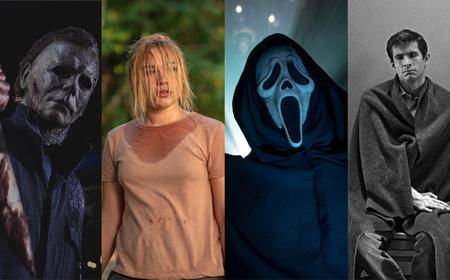 The Best Horror Movies for Actors to Study
 Leatherface, “The Texas Chain Saw Massacre” (1974)
Masks have often been used to access and comment on broad archetypes of society, making the familiar unfamiliar in translation.
In Tobe Hooper’s “The Texas Chain Saw Massacre,” Gunnar Hansen’s Leatherface (whose mask, it must be said, is made of human skin) tries desperately to be a normal human in a normal human family. Thus, his physical performance is almost comical. The actor remains adaptable to whatever facet of civil society he’s perversely imitating, zooming in on and satirizing what we bourgeois viewers take for granted despite the world’s horrors.
Hansen also, very consciously, lets his body lose control, especially in the film’s iconic ending. Leatherface is not a calculated killer but an untempered blast of unchecked energy and impotent desire. Since Hansen’s mask remains the same, his body goes into overdrive.
The Killer, “Alice, Sweet Alice” (1976)
Alfred Sole’s underseen “Alice, Sweet Alice” comments on the horrors of religion’s rigidity. But just by the nature of the killer’s mask, the film is also a commentary on femininity.
The mask in question is an exaggerated version of a made-up woman’s face, distorted into something resembling a porcelain doll more than a human being. Grotesquely, you can also occasionally see glimpses of real human features through the semi-translucent covering. Pay attention to the way Sole and the performer beneath the mask—no spoilers, “Alice, Sweet Alice” is a whodunit—use that duality. Sometimes, the actor plays directly to the meaning of the mask; other times, they play against it (e.g., with more masculine actions like sharp stabbing).
Michael Myers, “Halloween” (1978)
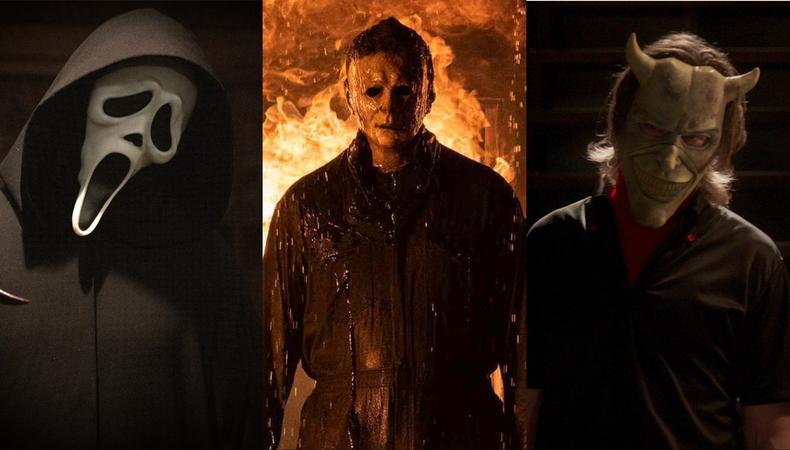
Nick Castle is credited as “The Shape” in John Carpenter’s original “Halloween” film, which tells you everything you need to know about this masked performance’s intentions.
The mask is blank (well, technically it’s William Shatner painted white, but same diff). The clothes are blank. And the character’s actions, like standing still near a car, feel blank as well.
What does an actor do with such a severe lack of recognizable humanity? They recognize that they are not playing a human but a force of nature. The mask strips them down to a functional symbol of unknowable evil. In this way, the mask tells the entire story, and the actor is the story, not a character within.
Jason Voorhees, “Friday the 13th: The Final Chapter” (1984)
There’s an inherent duality to the character of Jason Voorhees. He is the reanimated corpse of a young child, drowned for the sake of sin. But he’s also a hulking, indestructible bruiser with a machete. We’ve all got layers, y’know?
Of the 10 actors who have played the role, nobody has demonstrated that underlying push-pull better than Ted White in Joseph Zito’s “Friday the 13th: The Final Chapter.” With that iconic hockey mask covering his face, White’s body tells the story. When Jason is in predator mode, he has a horrible, inhuman stillness—a slow-motion take on the purity of evil. But when Jason’s getting his shit rocked, his body goes (somewhat hilariously) out of control. We’re reminded that there’s the soul of a kid inside that hulking frame, a kid who’s trying his best to live a life of retribution originally spurred on by his mother, a kid who is flailing.
In that sense, there is a tragedy to the tale of Jason Voorhees. A smart actor will realize that something that heavy will affect your physicality; tell your character’s story through action, not words.
Ghostface, “Scream” (1996)
In Wes Craven’s metatextual masterpiece, the mask is a commentary on masks and what we do with them.
Inspired by Edvard Munch’s painting “The Scream,” Ghostface’s mask is beyond contorted—the eyes, cheekbones, and mouth corrupted into a grotesque pantomime of “screaming in terror.” (Sort of like the traditional tragedy mask on PCP.)
It is, in other words, trying to be a scary slasher mask, trying to represent all these highfalutin things we’ve talked about—just like the character under the mask is trying to reenact their favorite horror films of yore. So, Ghostface’s body motions play into that by, frankly, being really bad at being a slasher villain. Sometimes he gets lucky and stabs who he needs to, but usually as the result of a visceral, stumbling chase where he gets clobbered more than a few times.
Ghostface is a fool trying to be a tragic hero, a piece of horror clowning. Lean into the foolishness a mask gives you; use it as a shield.
The Grabber, “The Black Phone” (2022)
In many ways, Ethan Hawke’s performance as serial child-killer the Grabber in Scott Derrickson’s “The Black Phone” feels like it’s harkening back to the foundations of mask work.
There isn’t one, fixed covering for Hawke to play into or against. Instead, like the theatrical performers of yore, he mixes and matches several mask components to symbolize his changing moods. The mask’s smile turns into a frown, or its eyebrows flip from anxious to menacing. It’s a commedia dell’arte performance, where the changing of masks quickly represents the broad strokes of emotion to the audience.
And boy, does Hawke relish this opportunity. Sometimes, when he’s fully giving into the mood of the mask—clownish, operatic movements to match a wide smile, for example—Hawke is revealing the character as a kind of “actor” himself. In other, scarier moments, Hawke plays against the mask to heighten tension; there might be a grin over his face, but his body is tense in anticipation of violence. It’s a thrilling take on horror mask work, one we can’t wait to see inspire the next generation of performers.