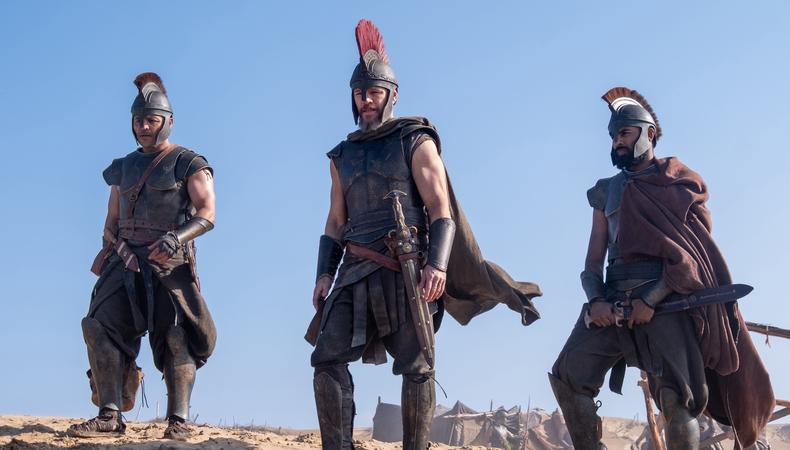
Behind every Christopher Nolan epic lies a masterclass in casting—and his new mythic action feature “The Odyssey” is no exception. An adaptation of Homer’s classic saga, the film follows Odysseus (Matt Damon) on a perilous voyage home from the Trojan War while his son Telemachus (Tom Holland) and wife, Penelope (Anne Hathaway), fight off a ruthless onslaught of suitors. To bring this blockbuster to life, Nolan’s longtime casting director, John Papsidera, has once again assembled a knockout ensemble. The film, which hits theaters July 17, also stars Zendaya, Robert Pattinson, Lupita Nyong’o, Charlize Theron, and Jon Bernthal.
In this exclusive interview, Papsidera gives us a look inside Nolan's audition room. From their creative shorthand to balancing a massive, star-studded call sheet, Papsidera reveals exactly what it takes to cast larger-than-life characters on a mythic scale and the one trait an actor needs to truly capture the visionary filmmaker’s eye.
You’re Christopher Nolan’s go-to casting director, as you’ve been with him on ten movies since “Memento.” What is it like working with him?
It's a real honor to work with Chris, and especially for this long. It's what I've always valued in my career and in life. Relationships are just so much more important than almost anything else. Because those are the things that I'm going to look back on and remember.
I've certainly had a long, fruitful collaboration with Chris over the years. Whether it's getting to know somebody's taste, getting to know what they like and don't like, or a shorthand for how we talk about characters or the kind of actors that he wants. It usually starts with an idea after I read the script, and we spitball and just talk about generalities and how he sees things. He'll ask me what I think about certain roles, and then it kind of expands from that.
Quite quickly, it turns into a really lovely process of Chris going, “Bring me who you want me to see.” And while the stakes seem really high most of the time, there's also a real freedom to it. It is not micromanaged. The trust that we have between us, and that he allows me, is a really lovely gift—and I try not to abuse it too much.
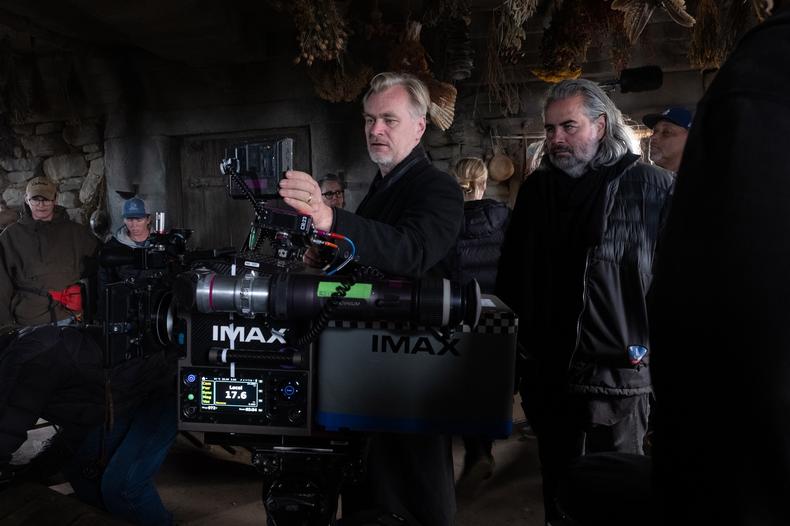
(L to R) Director Christopher Nolan with Cinematographer Hoyte van Hoytema on the set of “The Odyssey” Credit: Melinda Sue Gordon/Universal Pictures
Having that established trust makes for a great working partnership.
It does come down to that. And within that, if he doesn't like something that I brought, he'll let me know. Or conversely, I'll let him know that he's missing out on someone. There's an ease to our working relationship that I really treasure.
In your experience, what makes an actor stand out to Christopher Nolan? What traits does he like?
Chris values professionalism and precision. He is not the kind of director who looks for messy actors. While reading for him can seem like a whirlwind—you come in, do your piece, and you are out the door—it is incredibly efficient, just like he is.
I try to keep the process that way, as preparedness and professionalism override everything else. He responds to that approach because it is how he carries himself. It is not a room where we do a lot of improv or mucking about. It is a matter of coming in, getting down to work, doing it, and moving on.
These casting sessions are very different from the ones I have with other directors, showrunners, and creators. Chris’s eye is incredibly specific. He is never wondering what might fit the mold; he already knows the shape. He just wants to see who it ultimately ends up being.
In “The Odyssey,” you're balancing a lot of veteran Nolan talent, like Matt Damon, with actors he’s never worked with, like Zendaya. When you're in the room, what are you looking for to ensure these different energies mesh into one believable world?
In “The Odyssey,” in particular—and I talked about this in interviews for “Oppenheimer”—we worked on filling these roles with actors who gave respect to the history and the place that their characters held in that timeframe. For “Oppenheimer,” scientists were the rock stars of their generation, so we worked hard not to make them faceless characters but to give them the dignity of a soul.
With “The Odyssey,” the stakes were raised even higher because these are epic characters of epic proportions. While people might look at it and say, “Oh, it's a star-studded cast,” we absolutely needed people of that magnitude to match the magnitude of this story and the sheer scale of these characters, not only in literary history but in what they do. I recently saw Chris say that Homer essentially wrote the Marvel superheroes of his time. That is very much the case. We needed superstars to fill that largeness of character. Once it started, it felt like putting all-pro athletes on the field all day long. The meshing happened because they were all titans in their own way.
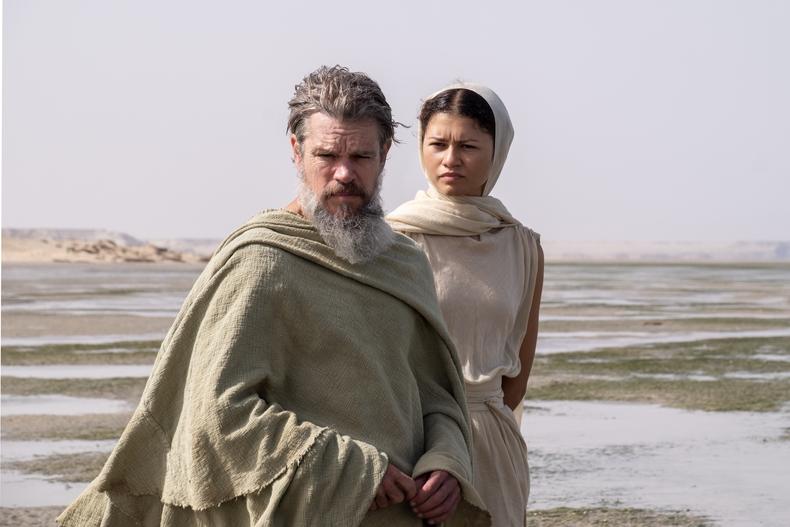
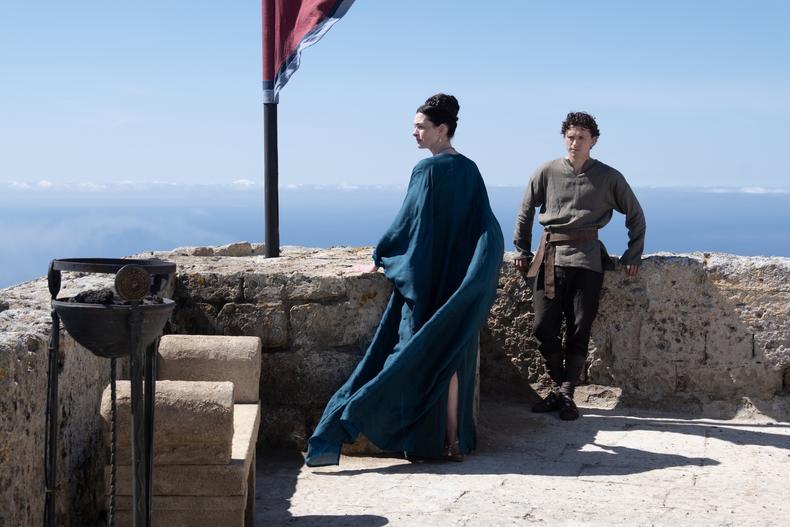
Matt Damon, Tom Holland, and Anne Hathaway are obviously all massive stars, but what did you see that made you think they could convincingly play that father, mother, and son dynamic?
Tom is a chameleon. I think he has such a range within him, and he shape-shifts into characters that are nuanced, youthful, and incredibly bright. It's a combination of things that you don't see often in young actors, especially of that skill.
With Matt, Tom felt like a young leading man who could not only follow in his father's footsteps, but also match him intellectually and physically. All of those elements came together beautifully. At the same time, he still possesses the sensitivity and acting nuance that Anne Hathaway brings as his mother. Tom was the perfect fit for that triangle of relationships.
Was there an audition from “The Odyssey” that still sticks with you?
There were a bunch. Jovan Adepo’s audition really stuck with me, and so did Corey Hawkins'. I said to Corey after he left, "You're a really special talent. Never doubt that when you walk in the room. I could watch you read anything and be entranced by it.”
People come in, and they give their best in those rooms. I have compassion for it, because actors have a very brief window to share a bit of who they are, and especially with somebody as storied and important of a filmmaker as Chris is. It's a scary thing for actors to walk into a room, and it's myself, Chris, and Emma, and that's it. It's an intimidating thing.
I give all the credit to the actors who can walk in and pull that off with grace, skill, and professionalism, leaving the room feeling like they delivered exactly what they wanted to.
The room has definitely gone more virtual. In a self-tape, what makes you want to see more of an actor rather than just moving on? Or make you go, “I need to show this to Christopher Nolan”?
It comes down to choices. In a lot of ways, actors interpret something on the page, and by putting it into their own machinery, it changes. That kind of individualism sticks out when you're watching it on tapes. To watch somebody play a moment differently than the other 40 auditions that you've watched, you go, “Oh, that is special. Oh, that made it their own.”
I was just talking about a callback session I had yesterday on a project, and I said all four actresses that came in were fantastic—I was talking to one of the producers—but with one of them, there was electricity in those moments. What she did compelled you to watch it more than the others. At the end of the day, that's what you're looking for. You're looking for something that is compelling, different, exciting, and not predictable. That's what separates the wheat from the chaff. A lot of that has to do with choices. Somebody might turn a phrase just a little bit differently, which then changes the meaning of what the line even meant, or gives it a different backstory. All those little tiny things add up to impressing you beyond the norm.
Do you have a story of seeing or auditioning an actor before they broke out, and they weren't right for that part, but you just knew they would become a star?
There are probably too many damn ones to remember. I'm reminded, whether it's Charlize in “2 Days in the Valley,” or Margot Robbie, who read for me for her very first reading in the States. She was reading for “Charlie's Angels,” and the studio said she wasn't right for that, but then put her in “Pan Am.”
There are so many people that I have been blessed to get to know early on, or to see their work early on, and then watch them turn into stars. I'm blessed to be able to be in the presence of artists, and that is my stock and trade, day to day.
Do you have an actor who maybe wasn't right for a role, but you brought them back for another project?
Oh, I’m sure there’s 10,000; just trying to think of somebody that sticks out in my mind that wasn’t right for something, but then they fell into something else. I’m also in the process of doing Netflix’s live-action “Scooby Doo,” and there were a lot of actors that weren’t necessarily right for Shaggy but could have been right for Fred. So we moved them from one character to the other, going, “Well, he’s not that, but maybe he’s that.” I remember when we were doing “The Prestige,” Chris Nolan and I were looking for a character, and I finally got a tape of Rebecca Hall before Rebecca had really done anything. I called Chris immediately and said, “OK, I found her.” And it turned out that Rebecca was brilliant in [the role of Sarah Borden] and a brilliant actress. There are so many of those people that I look back on and go, I was lucky to be in the right moment at the right time and recognize their specialness.
You’re also the casting director for all of the James Gunn “Superman” movies. What are the pressures of casting a new “Superman” actor?
Making James Gunn happy, that's the pressure of it. Look, you certainly always want to make a filmmaker happy. Especially with James' creative imagination, you want to fulfill that vision that he has—that skewed vision at times—of what he has of a character. You want to be able to fulfill that notion of it.
Beyond that, in a business sense, DC [Studios] is doing something incredibly different. With Peter [Safran] and James running DC, it's a huge, huge mantle, and so that's added pressure that I take personally. You want them to succeed. You want these films to be great, and you want to give them everything you can in order to make that happen.
Initially, creativity is about being with somebody that thinks differently and thinks in such a creative way, like James does—both visually and universally. You want to satisfy that, but also on the other levels, you want them to succeed because it's a tough marketplace, and it's a big banner to hold up. But I couldn't be happier trying to help them do that.
This interview has been edited for clarity and length.