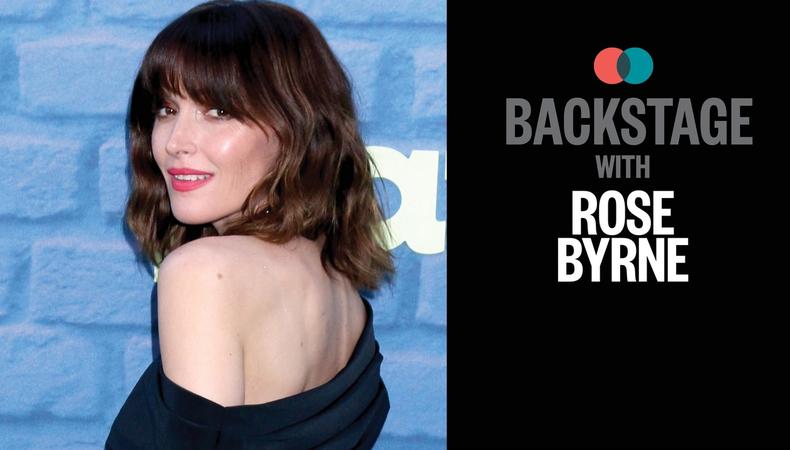
It’s hard to think of a performance that feels more personal than the one delivered by Rose Byrne in the psychological drama “If I Had Legs I’d Kick You”—partially because director Mary Bronstein captures much of it in extreme, claustrophobic close-ups. But even from a mile away, you’d be able to track Byrne’s remarkable turn as Linda, a therapist spiraling over the combination of an absent husband (Christian Slater), a critically ill daughter (Delaney Quinn), a missing patient (Danielle Macdonald), her own combative therapist (Conan O’Brien), and a gaping hole in her apartment ceiling that forces her to retreat to a motel.
We sat down with Byrne to dig into the complexities of the role, the importance of breath work in acting and in life, and the secrets to performing with a camera directly in your face. Check out the full interview in the video below.
The Spirit Award nominations were announced this morning. Congrats on your nomination!
Thanks! I was texting with Mary Bronstein. I was actually doing an interview, and she was updating me in real time. I could see my text messages coming in. It’s such an honor. I’m so proud. It’s all very surreal.
I want to start off by talking about breathing, which is so important to “If I Had Legs I’d Kick You.” It’s such an integral part of the character, and of life, obviously. I’ve also seen you say you’ve read James Nestor’s book on the importance of breathing, “Breath.” So, how has proper breathing affected you as a person and as an actor?
I love that book, which came to me via a friend who recommended it. I’m really into it. I tape my mouth at night; I’m one of those crazy people who do that. It’s honestly strange—when I don’t do it, I feel it. As soon as I don’t tape my mouth, in the morning I feel groggy, I feel a lot more tired. It takes me a long time to start. I’m dehydrated. The benefits of breathing through the nose are extraordinary.
In the film, it’s wonderful, because it’s Linda trying to escape through breath, which is a very ancient thing and a ritual that’s been around for years. In the work that we do in the movie, it’s very much about healing and transcending pain and figuring out through your body. We actually did do that breath work. I went and saw this wonderful woman [breath work coach Eva Kornet], who’s in the movie, and did it.
It’s one of those things, my entire life, I didn’t even know you could be breathing wrong.
It’s true. It’s extraordinarily powerful, and it’s right at our fingertips. But it just takes patience—putting down your phone, not texting somebody, not looking at a social media app, or whatever.

Credit: Logan White/A24
We talk to a lot of actors, and the idea of acting as a form of therapy comes up a lot. That can be true, but at the same time, it should probably not be a one-to-one replacement. For you, where does acting overlap with therapy, and where does it not?
I’m gonna be controversial. For me, acting is not therapy. [Laughs] I think it’s an escape. It’s escapism because you get to lift off and be another character and embody another person’s experience. There’s a catharsis, I suppose, to some things that are inherently dramatic or physically demanding—like screaming. But I don’t equate it to actual, traditional sitting-down-and-talking-to-someone therapy. For me, it requires a different part of my brain.
I don’t think that’s controversial.
I recoil a bit, because then it feels so self-indulgent. I’m far less interested in my own experience; I’m more interested in this character and who they are and how they behave and how they respond. Everybody’s so different, and everyone’s life is a novel. And that is an innate curiosity in me, I think, of looking out. But of course, it all comes from inside you anyway. Subconsciously, it’s all your own experiences, unless you’re just sort of imitating somebody. But yeah, I think probably there’s a part of me that recoils from [saying acting is therapy] because it feels like “self-indulgent actor.”
Mary Bronstein told the New Yorker about filming the scene where Linda breaks down and tells her therapist “I just want somebody to tell me what to do.” She said you wrapped the scene, and you told her you felt you hadn’t quite nailed it. As an actor, tell me about that feeling, and what it’s like to move on afterward.
That scene was technically pretty tricky and obviously had very huge emotional stakes. I felt like that after most of the scenes in the movie. I was always checking with Mary at the end of the day. Did we get this? Did we do that? Did we do this? Like, going through my checklist.
I feel like every actor is their worst critic. You just wish you’d done this or this or this. But the extraordinary thing with film is, you anticipate a scene—and I find this more with comedy—you do a scene and you think, God, that was fun. Gosh, I couldn’t wait to do that. And then you see it and it’s flat. But another scene that didn’t feel that way [gets a response]. It’s that exchange with the camera that is unknowable. It’s just unknowable until you see it, and it’s a bit mystical. It’s so out of our control, in a way.
So I’ve given up trying to predict what’s going to work and what’s not going to work and what’s going to land. Film is also, obviously, a director’s medium. They’re going to stitch together something that is beyond your anticipation or your conceived idea of your performance. It’s a tapestry that’s happening around you.
You mentioned the exchange with the camera, and throughout this film, that camera is very close. What are some things you’ve found helpful when acting in such extreme close-ups?
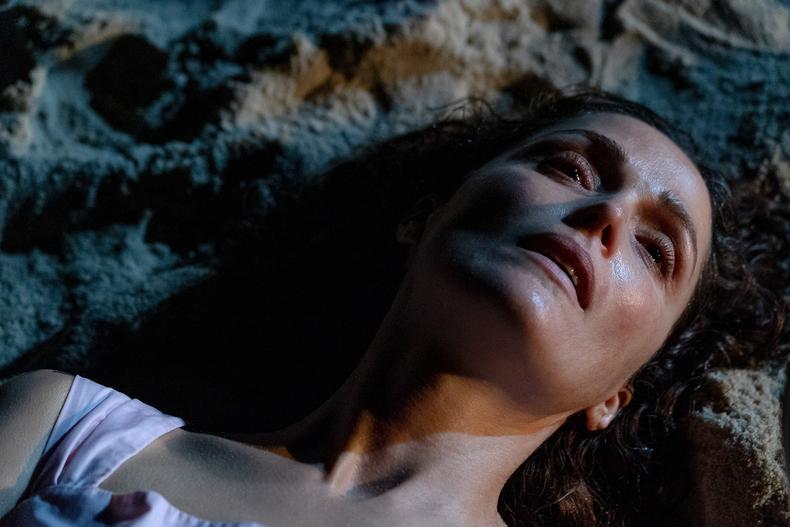
“If I Had Legs I’d Kick You” stretched me, technically, to a place that I’ve never been before. It really has sort of changed me as an actor, because of that language with the camera and how I had to adjust and figure out what Mary needed. But really, more importantly, what she didn’t need in certain close-ups, because it was so, so, so, so close to my face.
I started out in Australia, very early on, doing a soap opera, which is extraordinary technical training because you are in front of the camera all week for 15 hours a day doing so many pages a week. It’s like a crash course in acting for the camera. I look back on that and think what a schooling that was in many ways. Like anything, it’s just the hours you put in. It’s like how the Beatles played all those gigs in Germany. They say you put in 10,000 hours and you become an expert, right? It should be the same with any profession. I feel like, looking back, all those experiences led to “If I Had Legs I’d Kick You.”
I also did a TV show called “Physical” where I had to look at the matte box the whole time, never at the actor. My eyeline was always for the matte box. That, again, was this technical stretching point for me. It’s a tightrope of being hyperaware of every single thing around you and also lifting off as a performance—[having] the power to dissociate.
Credit: Logan White/A24
Before filming, you and Mary did a ton of prep, going through each scene line by line and really breaking it all down. What is the balance between having all that preparation in your head and letting it go in the moment?
That’s all it is; after preparation, it’s free fall. You could prepare as much as you want, but God, you don’t want to see an actor’s homework. You want it to feel lived in and like a real person. You have to throw it all out the window.
The truth is, there can be no anticipation for performance, in that it is entirely informed by what the other actor is doing. I trained in Meisner technique, which is just “acting is reacting,” and that’s so true. That is the most grounding, anchoring thing. The gift of the prep is that we didn’t have to have the conversations when we got to set. We’d had every conversation back to front, around, upside down, inside out about each scene and character and backstory, so we could get there and just do it. And, hopefully, not mess it up too much.
I saw that Mary has a degree in psychology herself, which I have to imagine is a very helpful background for a director to have. Was there a particularly insightful or helpful piece of directing she gave you?
She was so protective of the performance, and so was I. But she was [protective] of me and making sure that’s just what I had to do, and not worrying about the machinations and complications of making an independent film and the roller coaster of that. In terms of specificity, we would meet at the beginning of the day and go through everything of where we had to get to, where [Linda] had been and where she would go. We would have this huddle, almost like before the surgery began, huddling together in the hallway. And then we would start the day. Those little meetings I always remember, because it was like meeting before the game and talking to my coach. That was so specific to her and I and how we worked.
Is there another performance from this year that you found inspiring?
There’s a few. I’ve seen “Blue Moon” twice, and I think my husband [Bobby Cannavale] is really wonderful in that. But Ethan Hawke’s performance is so beautiful and immersive. You really forget it’s Ethan. Ethan is one of our great cinematic and stage actors, who has given so much of his career to independent film. He is just so fantastic as Lorenz Hart. You really forget it’s him. He does not stop talking in that film; it’s almost like the character is going to die if he stops. It is extraordinary. He holds the whole piece together.
I also thought Tessa Thompson was really, really beautiful in “Hedda.” She was just extraordinary. She balances this theatricality with complete specificity. She inhabited that world so beautifully.
This interview has been edited for clarity and length.