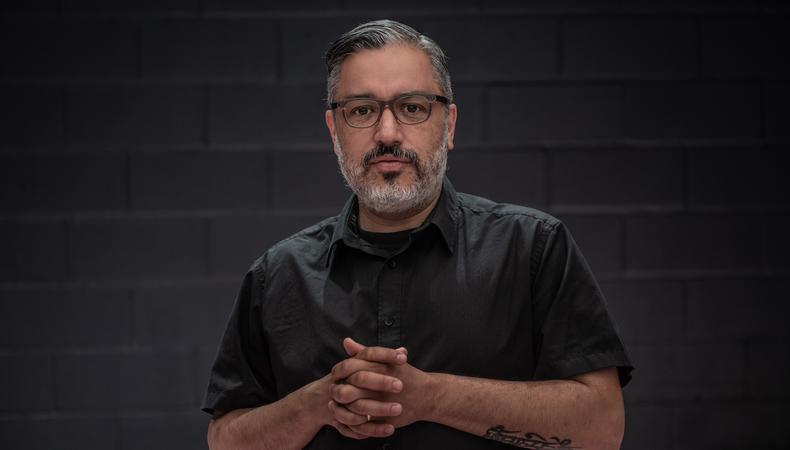
This past August, Rubén Polendo was named dean of New York University’s influential Tisch School of the Arts. Tisch comprises 17 departments, including acting and directing programs that deliberately instruct diverse approaches to performance.
As the founding artistic director of the highly technological Theater Mitu in Brooklyn, the first director of NYU Abu Dhabi’s theater program, and a 2025 Guggenheim Fellow, Polendo is a global authority on interdisciplinary innovation in the arts. His roots in experimentation go back to his education: He received an MFA in directing from UCLA, an M.A. in global performance from Lancaster University in the U.K., and a B.A. in biochemistry from Trinity University in Texas.
Here, he discusses his views on acting training, artificial intelligence, and how he sees technology as a tool for enhancing, rather than threatening, artistic and imaginative strength.
Higher education is under financial pressures and cultural scrutiny. What remains essential for training the next generation of theater artists?
What you’re naming as challenges really becomes a calling that will shape our work—not from a purely reactive stance, but by leading the conversation as an art school committed to innovation and future building. Art is vital to human existence. It creates culture, fosters discourse, and insists on our shared humanity. What has guided my teaching and art making is the potency of artists, students, and teachers to be resilient and nimble.
I tell students I’m not interested in them as students—I’m interested in them as future colleagues. I get the privilege of engaging them early in their trajectory. I want remarkable collaborators in the field.
What skills or qualities should actors prioritize now that maybe they didn’t need to a decade ago?
This applies to actors, directors, designers, and the arts at large. At Tisch, we are not only preparing artists to enter the industry, we’re preparing them to enter the field. An actor should certainly be able to do Broadway and receive recognition, but we also hope they’re trained to collaborate globally, teach, publish, and return to the stage anew.
That navigation fosters sustainability. Young artists recognize they have agency; this isn’t the 1930s, when you wait by the phone [for an opportunity]. Alongside technique, we emphasize leadership and the ability to navigate a complex field.
Your work embraces experimentation. How can actors cultivate that spirit, even in more traditional contexts?
There is far less “traditional” everywhere. The actor’s role is to reconcile challenges—living truthfully in emotion, collaboration, and imagination. Success today requires nimbleness, an ability to shape and mold. When you wrap your head and heart around the traditional and center your mission in the contemporary, it becomes fuel rather than a challenge.
What are your thoughts on generative AI and theater?
Art can generate culture and discourse around AI. The great masters create culture around subjects of love and death, mothers and fathers, and all of our strengths and weaknesses as humans.
We must identify the relationship we want with AI. Acting students trained solely on today’s platforms will find them outdated in five years. So it’s not about the platform; it’s about how we engage. Can AI serve as a collaborator, research partner, or feedback loop? As an art school within a research university, we’re ready to take on this work.
Could AI train actors?
When I was in graduate school, I collected articles from the 1800s, when many feared electricity would kill theater and acting, that it would kill the ghosts in the theaters. There were impassioned pleas to ban lighting. The response? We built premier lighting design programs. That’s what we do as artists—we build ways of using and thinking about tools.
AI is more potent and complex, fraught with problems. But the equation is the same: something disrupts the status quo, and we shape culture around it. So, yes, AI must take a role. Should it displace something else? Not necessarily. We’ve always been an additive field. We didn’t have electric lights; then, we did.
For actors weighing graduate study or specialized programs, what should they look for?
Above all, alignment with your own artistic mission and the school’s culture. Training is relational, not transactional. You’re not saying, “Give me the tools; see you later.” You’re joining a space of feedback, learning, and growth. If you select a program purely on brand recognition, the experience could counteract your growth.
What advice do you have for theater-makers balancing career ambitions with sustaining imagination?
I have three guiding principles. First, seek auditions and interviews in the “opportunity space.” But if that’s all you do, your landscape is predicated on yes or no, which can wear you down.
Second, after formal training, artists must take ownership of their growth through classes, workshops, or the company they keep. What keeps you in the conversation, in the discourse, so your energy isn’t consumed by the opportunity space?
Third, what are you building? You’re no longer sitting and waiting, but you’re actually doing something. It’s no longer a reactive space; each step becomes part of a longer journey. This creates an artistic immune system in your mind, heart, and physical space that sustains you and doesn’t wear you down
This interview has been edited for clarity and length.
This story originally appeared in the October 20 issue of Backstage Magazine.