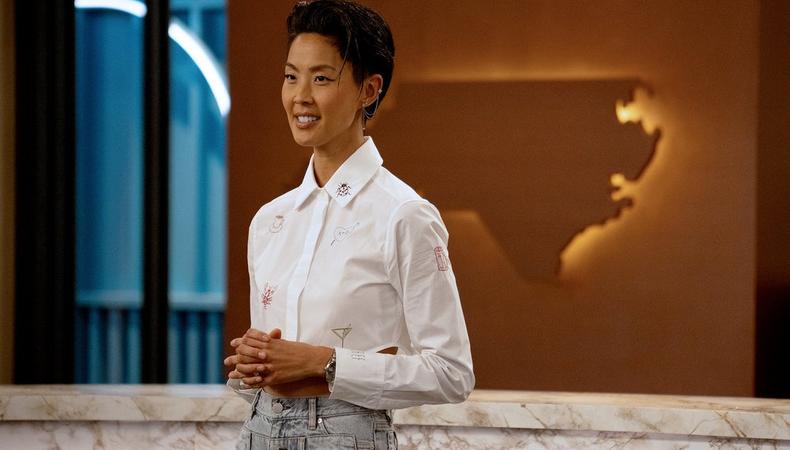
Long before she was captivating viewers as a reality show contestant on Bravo’s “Top Chef”—and now as that very show’s host—Kristen Kish built a career as an imaginative, instinctive award-winning chef. Was stepping in front of the camera part of a carefully crafted plan? No. It was a leap rooted in instinct, curiosity, and the belief that incredible growth can happen when you’re willing to take a risk.
Kish’s journey from acclaimed chef and “Top Chef” Season 10 winner to onscreen personality—as “Top Chef” host since 2024 and as a contestant on Season 4 of Peacock’s “The Traitors”—is proof that ambition doesn’t have to follow a straight line. Pursuing a dream can begin from anywhere. You just have to believe in yourself and take a chance.
What advice do you have for someone who wants to transition from one career path to another?
I think it depends on who you are and what you’re looking for—and the stage you are in life. I hear so many people say, “You just gotta go for it.” In some circumstances, just doing it right then and there is not an option. There are other responsibilities. There are things that you have to handle. [But] there are ways that you can dabble a little bit. Try things out. Experiment. Do it with a little less pressure than just automatically switching careers. There’s always time to do something you love.
I think sometimes even if it’s five minutes or five months, you just have to start sprinkling it in ever so gently. Do what makes sense for you. And it will all start to take shape.
What kitchen skills have helped you master being a TV host and reality show contestant?
Knowing who I am, managing and being emotionally aware of my surroundings. [Knowing] how I want to operate, how I want to show up for people. There is a sense of efficiency that I like to work by. I think there is a calm confidence, fully knowing that sometimes I might not know the answer. Or having the confidence to ask the question. Being confident and being good at your job doesn’t always mean that you are the most right or that you know everything. It’s about saying, “You know what, I don’t know how to cook that. Can you please show me how to do that?” Or on “Top Chef,” “I’ve never heard of that ingredient. Can you tell me more about that?” It’s [about] remaining curious.
What was it like to transition to a space where you were taking feedback on you as a person versus a dish you created?
Feedback, as long as it’s given correctly, is just a conversation. Whether it’s in the kitchen, on television, or opinions about me, feedback is really just an open dialogue, and that’s what it should be. It’s not meant to [be], “This is wrong, do this next time” or “You suck at that,” blah, blah, blah. It’s, “Hey, why did you do that?” Again, it’s remaining curious and open to hearing a different point of view.
Giving feedback can be done gently, but honestly. And that translates through all parts of life, whether I’m doing my job or even in my personal life.
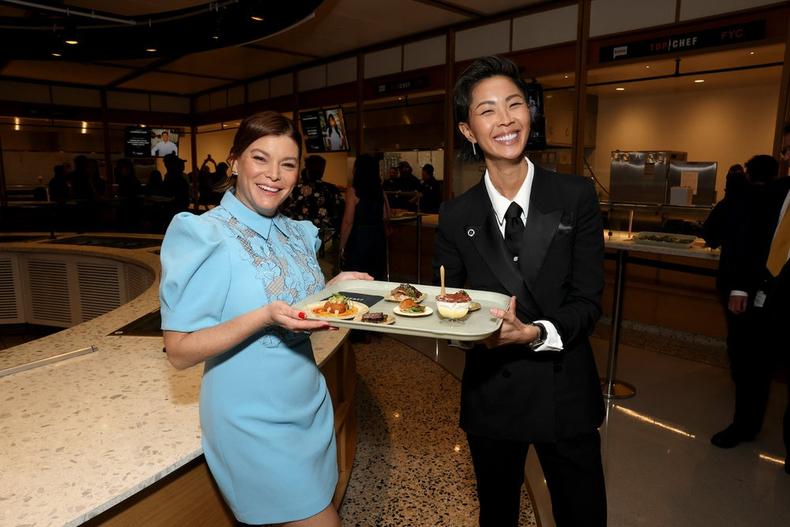
Gail Simmons and Kristen Kish Credit: Todd Williamson/Bravo
Did you find that there was anything that you had to unlearn when you first stood in front of the camera?
I had to stop saying “fuck” so much. So that’s one thing.
My very first season when I watched it back, I noticed things like when I’m standing in heels. Heels are not normal for me; I’m shifting my weight a lot. After standing there for five hours, they hurt! And so I realized I have to remain still. And so [I] kind of push through that pain now.
[I also noticed] small mannerisms. Like if I don’t have anything to do with my hands, I get a little bit anxious. I can’t always put them in my pockets because that doesn’t look right on television. [Standing with my hands in front of me] is my natural stance now, but after a certain while, this starts to feel unnatural. So you have to loosen it up. You’re constantly moving, but don’t move too much. Otherwise you’re just gonna make people seasick. It’s just a lot.
After jumping into the “Top Chef” hosting role, you pivoted back to being a reality show contestant on “The Traitors.” What was that experience like?
You know, you go on a show like that, you have to lean into the silliness of it all. I’m OK being a contestant. I can live the sequestered life. I’ve done it. I think the thing that was hardest for me was adjusting to, not the competition, but realizing I was not in control of [the competition]. Meaning, when I’m cooking and on “Top Chef,” I’m in control of everything I’m making. There might be outside circumstances that make it very difficult, but I know what I’m doing, and ultimately it’s gonna come down to the food. On “The Traitors,” it’s perceptions of others. It’s the opinion of others. I’m not in control. Just because I play the game well doesn’t necessarily mean I’m gonna do a good job.
Is there anything that you’re watching, reading, listening to now? Is there anything you’re binge-watching?
I watch a lot of documentaries in different categories. It could be anything from a sports documentary to a murder documentary. We just finished “Paradise” recently. My God, it is outstanding. Absolutely. The first season was so good; the second season was just outstanding.
I hope we get nominated [for an Emmy] again so that I can go to the [ceremony], and then maybe I can say hi to some of those people. Sterling K. Brown, I ran into him at an elevator. This was in Queensland, Australia. He was coming out of the elevator onto the floor. My wife and I were there and I was like, “What’s happening?” And I was too chickenshit to say hi. But, you know, if I see him at the Emmys, I [will].
This interview has been edited for clarity and length.