Batman and Robin; Sherlock and Watson; Salt and Pepper (kidding, kind of): For as long as there have been main characters, there have been sidekicks. But when it comes down to it, what exactly does it mean to be the Watson to a Sherlock? And how do you stand out in a role whose sole purpose is to boost the leading actor? We’ll answer these questions and more in this guide to becoming a kickass sidekick.
A sidekick is a type of stock character whose primary role is to accompany and assist another character. While that’s about where the hard-and-fast rules about this archetype end, sidekicks often have the following characteristics:
- They’re part of a (usually) platonic pair, sometimes introduced as a duo, and other times meeting during the events of the story.
- Some are purely yes-men, there to aid and support the protagonist.
- Others are wacky or goofy, or serve as a comedic foil to the straight man hero, while still working together toward the same goal.
- They’re often (but not always) drastically different from their main character counterparts, making them both at odds with each other and balancing each other out. From a plot perspective, they may mainly exist to give the hero someone to bounce off of. Sure, the protagonist could go on an adventure alone, but who would he chat with?
There are a lot of notorious sidekicks—here are a few favorites.
Sancho Panza from “Man of La Mancha” (1965; music by Mitch Leigh, lyrics by Joe Darion, book by Dale Wasserman)
One of the older examples to continue to capture our imaginations is Sancho Panza, right hand man to the titular Don Quixote in Miguel de Cervantes’ 15th-century novel and its centuries-later musical adaptation. Though more lowly and pedestrian than his knight-errant companion, Panza proves a loyal friend, never wavering in his support even as Quixote slips further and further into delusion. In the play, viewers understand his role the moment he’s introduced. Quixote’s heroic introductory ballad is quickly interrupted by Panza’s much less sophisticated refrain, announcing, “I’m his squire, I’m his friend.”
Rhoda Morgenstern from “The Mary Tyler Moore Show” (1970-1977)
Like many good sidekicks, Rhoda (played by Valerie Harper) is half of an odd couple. She and Mary first meet when Rhoda tries to claim that Mary’s new apartment is actually hers. Though Rhoda is a bit more brash and unapologetic than her counterpart, she and Mary still ended up able to bond over almost anything, from career frustrations to dating woes. And for what it’s worth, Rhoda was finally upgraded when she was made the title character of her own spinoff in 1974.
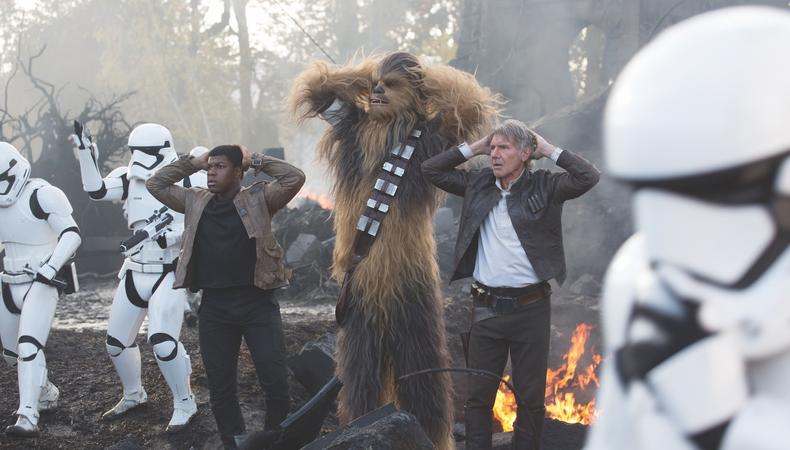
Chewbacca from “Star Wars” (1977; dir. by George Lucas)
It’s hard to think about this character type without conjuring up an image of Han Solo’s loyal, hairy, gurgling Wookiee companion. Played in the original trilogy by Peter Mayhew, Chewbacca’s (technically) nonverbal nature means he’s along for the ride and there to provide support when needed. Chewie also feels like a must-have for this list as a representative member of the animal companion trope, of which there are too many members to name (nearly every Disney movie has at least one). And this is no accident: Chewie was inspired by director George Lucas’ dog.
Patrick Star from “Spongebob Squarepants” (1999-)
Patrick Star (voiced on the long-running Nickelodeon cartoon by Bill Fagerbakke, originally played by Danny Skinner in the 2017 Broadway musical) is the perfect example of a sidekick who’s the complete opposite of his main counterpart. While Spongebob is chipper, jovial, and a ball of explosive energy, Patrick Star is laziness personified. Slow in every sense of the word, his laidback energy is at once the perfect foil and the perfect complement to his best friend, Spongebob.
Donkey from “Shrek” (2001; dir. by Andrew Adamson and Vicky Jenson)
One of the best examples of the comic relief sidekick, the character of Donkey is voiced by Eddie Murphy in the original film and subsequent sequels, and was originally played on Broadway by Daniel Breaker. Despite being Shrek’s best friend, Donkey spends most of his time wise-cracking and bothering the irritable ogre. From a plot perspective, he fills the stereotypical niche, accompanying the heroic Shrek on his journey. However, he’s anything but a side character— Murphy’s performance is among the most memorable in the film, and Donkey seems to transcend the role when it comes to audience impact.
Elder Cunningham from “The Book of Mormon” (2011; music, lyrics, and book by Trey Parker, Robert Lopez, and Matt Stone)
In this hilarious Broadway musical by the creators of “South Park,” the childlike Elder Cunningham and more confident Elder Price are thrust together not by friendship but by circumstance, forming an unlikely duo forced to serve a mission together. Despite technically being equals, the distinction between the main and supporting roles is blatantly clear. In the song “You and Me (but Mostly Me),” Elder Price sings “I can do most anything,” with Cunningham emphatically following up with “and I can stand next to you and watch!” In a bit of a twist on the usual trope, it’s Elder Cunningham who (spoiler alert!) ends up saving the day at the end of the show.
Nigel Bottom from “Something Rotten!” (2015; music and lyrics by Karey and Wayne Kirkpatrick, book by Karey and John O’Farrell)
In “Something Rotten,” protagonist Nick Bottom (first played on Broadway by Brian D’Arcy James) is a fed-up playwright working with his nerdy, introspective brother Nigel (John Cariani). Despite being siblings, the two have very little in common when it comes to their temperaments. In an opportunity not everyone gets, however, Nigel rises above his subservient position as the younger brother and calls the stubborn Nick out on his questionable behavior. Nigel reminds us that sidekicks aren’t always friends—sometimes they’re family, who can scold-sing you to a better place.
So you’re about to be someone’s right hand man—now what? Read on for some things to keep in mind as you step into the part.
1. Strive for balance. Most of this is in the text, but it’s important to find a way to both offset and support the main actor. Ultimately, though your role is technically as an accessory, work with the lead to maintain a rapport that highlights the nuance and complexity of both characters.
2. Spot the difference. Find out what makes you different from your main-character counterpart. While this is often obvious with two characters who are different to a fault, sometimes it requires some digging on the part of the actor. David Hyde Pierce, who played Dr. Frasier Crane’s brother and constant companion Niles on the hit sitcom “Frasier,” once recalled: “When I got the script, I read it and thought, ‘This is terrible—they’ve written two of the same character.’ It wasn’t until the table read when I saw how two peas in a pod were an asset and not a shortcoming.” While Niles and Frasier may have been extremely similar on paper, Hyde Pierce’s portrayal was distinct, bringing a unique neuroticism and broad physical comedy to the role. He would go on to win the Emmy Award for Outstanding Supporting Actor four times during the show’s run.
3. Tickle some funny bones. While not every role will take place in a comedy, the character type usually involves some element of comic relief. Brush up on your comedic acting skills to help infuse your character with Donkey’s comedic timing and Elder Cunningham’s slapstick physicality.
4. Fully flesh out the part. Just because the sidekick isn’t the main character in this story, that doesn’t mean they aren’t every bit as real as the protagonist. Treat the part like your own spinoff is imminent, and give them as much depth as you can, even if that means filling in details the more protagonist-focused script doesn’t give you.
5. Seek the sidekick inside. Despite life not being as trope-filled as the arts, art does imitate life, and it’s likely we’ve all been the de facto sidekick in a friendship from time to time. It’s OK to draw from that experience! In an interview with Playbill, Cariani mused about looking within when portraying little brother Nigel in “Something Rotten!” “It made it really easy because Nigel looks up to his brother, and I look up to Brian,” he said, “but I hope not in a weird way, just in a healthy way.”