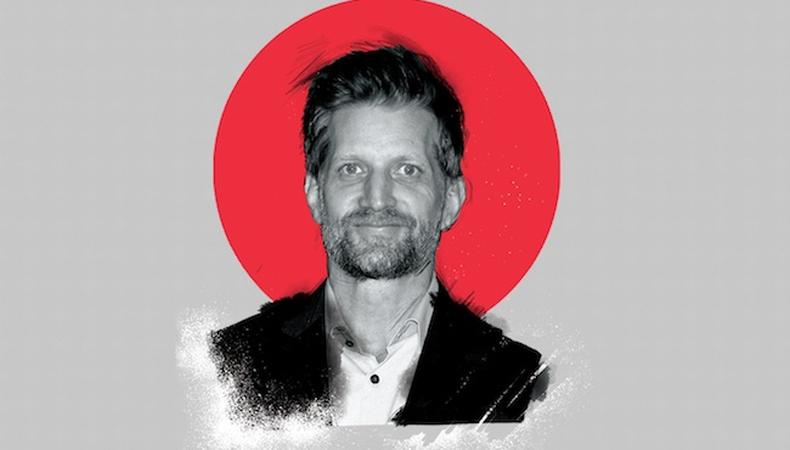
All it took was getting fired for Paul Sparks to get past his fear of it. Early in his film and TV career, which includes roles on “Boardwalk Empire,” “House of Cards,” the Paramount Network’s miniseries “Waco” and the upcoming Starz drama “Sweetbitter,” Sparks questioned his character’s motives. “I was being inquisitive and willing to fail,” he says. “It really became clear to me [that] I’m here to create a character regardless of what the circumstances are. In this particular case it didn’t work out for me, but it was a watershed moment. The motivation is no longer, ‘Don’t get fired from this show’ but to analyze the characters.”
What has working on ‘Waco’ added to your acting skills?
I’m a script person, and I always start with the script. There may be enticing people involved or enticing money, but the main thing I look for is “Can I do something with this? Does this role speak to me?” Occasionally, things come across my desk that I know are probably really good parts but I can’t figure out what to do with them, so I’ll pass. With “Waco,” I thought Steve Schneider [David Koresh’s right-hand man] was one of the most interesting people. The more information I found, the more I found out what an interesting and complicated person he was.
How do you typically prepare for an audition?
It’s a hard and unnatural thing to audition. You have a limited amount of time to show people what it’s going to really be like. I have to read the script, I have to understand what’s going on, then I try to fill in as much color as I can. But I like to audition. I like people to know what they’re getting. You have this dream as the actor: “Just trust me. Don’t make me audition.” Occasionally, you get offered things, and that’s totally great, but sometimes, as an actor who takes some chances in terms of the type of characterizations I do, I like people to know what they’re getting.
What’s your worst audition story?
It’s not really a nightmare audition because I got the part, but it was a confusing audition: When I auditioned for “Boardwalk Empire” [for] Martin Scorsese, Terry Winter, and Ellen Lewis, who was the casting director, I went in and I did a crazy character on that show with a crazy voice and a weird laugh, and I brought what I would do into the room. As I was walking out, Ellen Lewis came out and said, “Hey Paul, can you come back and do the scene again but as yourself?” Which I thought was an awful idea, but I’ll do whatever Martin Scorsese tells me to do. I called [my wife] Annie and said, “Wow, I didn’t get that.” And then an hour later, I got a call saying I did get it. But nobody told me which character got the part; whether it was me, Paul, just being myself, or whether it was me doing the Mickey Doyle that I brought in. So I show up to the read-through and no one’s told me. I was too nervous to ask, so I did the one that I originally wanted to do and no one said anything.
READ: CD Ellen Lewis Looks Back on Her Legendary Career
You’ve been on a lot of TV shows recently, but now you’re back on stage in “At Home at the Zoo.” Do you feel like you’re flexing different muscles?
I miss the stage, it’s my favorite place. If all things were equal, it might be the place I’d reside the most. I get to do a lot of different things, and I’ve gotten to where I appreciate all aspects of it. Mostly, if the writing is good and the people that are collaborating are serious and really trying to make something, then I’ve found that it’s all pretty satisfying to work on. But theater’s the best.
Theater is a totally different beast.
There’s something unique about it, because it can kind of stay small and you have input from everybody about all aspects. You have so much control over the performance. But you have to go out and string together something that lasts unbroken for a long time and interact with not only the people on stage but the people in the audience. When you film a TV show or a movie, there’s a wall that is actively put up between you and the people that are watching. They’re trying not to interfere with what you’re discovering in the scene, which is the opposite of what happens in theater. People direct their energy, their dislike of what you’re doing. You feel all that in theater. In television and film, the directors, they don’t share how they’re feeling about what you’re doing while you’re doing it.
What advice do you have for multimedium actors?
I think going through theater is a good way to start. Those ideas of how to create a character and how to read a script and how to understand what you’re doing are all the same, whether you’re doing a TV show or a play. One of the things you have to learn, because there’s so much spectacle and hubbub to shooting a TV show or a film, there are a lot of things pointed at you while you’re trying to have a moment. A lot of times, those things can become very distracting. You have to figure out a way to take up space and play the part in the circumstances.
For a long time, my objective, if I were to have one, in the scene would be, “Don’t get fired from this movie,” as opposed to playing the actual scene. That caused me to shrink a little as a person. It caused me to be a little less creative, less risky about how I would play the character. There’s a feeling in film and television that you don’t want to have failure, that everything has to be perfect on the day they turn on the cameras, whereas in theater, we spend a lot of time on failure: You fail a lot until you get it right where you want it, and hopefully by the end you’re doing the show. You have to give yourself the permission to do failure in television, to do things that don’t work.
Was there a breaking moment where you had that epiphany?
Somewhat young in my film and television career, I had the luxury of rehearsing a movie. I was with people who maybe hadn’t rehearsed a lot before. I think a lot of them hadn’t done theater and were not used to it being bad. I got a lot of pressure to shut up and get along. I ended up getting fired from this job. It was interesting, because I never got a full answer as to why, but I suspected a lot of the reason was I was trying to do the way I work on a part: really look at the given circumstances and look at my motivations. A lot of the time, people don’t necessarily understand what that is.
I remember I had a discussion with my wife [actress Annie Parisse], and she was like, “You know, I think you have to make a decision of whether or not you want to just get along or whether you want to actually try and do what you do. If you do that, there’s a chance you may get fired.” It changed how I read scripts. I really want to do stuff that I believe in. It was a really big moment for me in terms of my philosophy, in terms of the parts that I took.
What advice would you give your younger self?
To take up space, to be a little bit selfish. I would tell my younger, more amenable, Silly Putty self to bring my own ideas into things because ultimately it is a collaboration. If you spend all your time trying to think about what you think other people want you to be, I think you will really struggle.
Have you ever used Backstage in the past?
When I was starting out, Backstage was our connection to everything professional. I remember they were doing the Beat Generation, it was a Jack Kerouac thing. There were thousands of us outside waiting in the cold rain. I remember doing these sort of events where we all went and converged on places.
Check out Backstage’s TV audition listings!