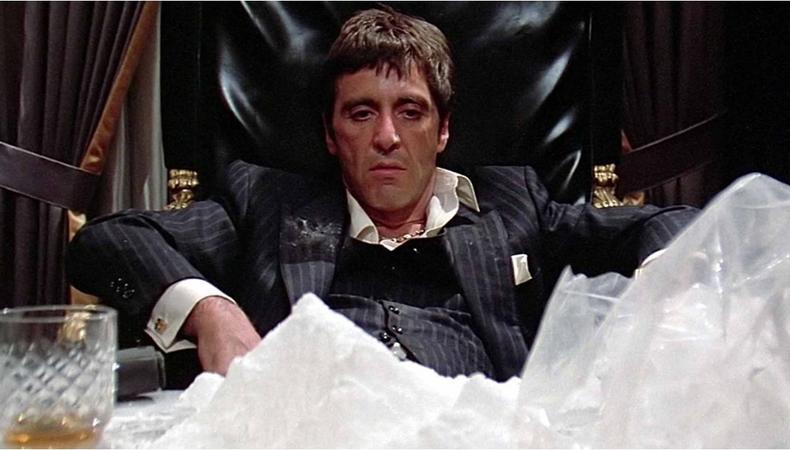
It's one of Hollywood's defining images (and a staple of dorm room wall art): Al Pacino in “Scarface” in front of a table’s worth of cocaine. Drugs, most specifically that white powder, have long played a part in film and TV narratives. Think of “The Wolf of Wall Street,” “Boogie Nights,” “Pulp Fiction,” “Blow”—the sound of snorting is half the soundtrack.
But, the actors aren’t actually doing drugs in scenes…right? Of course not! So what exactly are they using? From cocaine to marijuana to meth, here’s how productions create knock-off narcotics.
JUMP TO
One of the most powerful things about entertainment is that it’s all smoke and mirrors. For over a century, prop masters have gone to great lengths to trick us into thinking that what we see on screen is real—and that includes cocaine and other drugs.
So, then, what is substituted for cocaine? Well, a few things.
Back in the “Scarface” days, those giant mounds of cocaine were actually just mountains of powdered baby laxative. Baby powder is still used today, often mixed with a little corn starch. However, this is more for scenes that depict cutting packaging, and distribution. That’s because some actors have suffered injuries from snorting too much baby powder. Yes, the actors actually snort the stuff. “For years after, I have had things up in there,” Pacino said in 2015. “I don’t know what happened to my nose, but it’s changed. My breathing apparatus has been altered a little.”
To avoid injury, prop masters have turned to alternatives. The three most commonly used substitutes for snorting are powdered lactose, vitamin D powder, and inositol (a sugar produced by the body).
Powdered lactose is essentially just a milk product that is safe to snort without side effects or burning sensation. If an actor is lactose intolerant, they'll use vitamin D powder or inositol. Both of these items are easy to find at health stores and are safe to take. That being said, too much of anything can affect your health. “If you ingest that much matter into your lungs, you get very sick,” Jonah Hill said of filming “The Wolf of Wall Street,” after which he ended up with a bout of bronchitis. “We were literally doing fake coke for seven months every day. I never had more vitamin D in my entire life.”
If you don’t want to actually snort the fake cocaine, get creative with your props. One simple trick is to line a straw or dollar bill with something adhesive like Vaseline. This way, when the actor snorts the fake cocaine, it's caught on the sides of the straw.
Cocaine isn’t the only drug that prop masters have figured out how to fake. Marijuana, heroin, and meth are also often seen onscreen. Here’s how they do it:
- Marijuana: As is the case with any smoking done onscreen, productions will most often turn to herbal cigarettes, which contain elements like marshmallow root, passion flower, cloves, or jasmine instead of nicotine or tobacco. To produce an even more accurate marijuana smoke—slightly thicker than cigarettes—productions will have actors smoke cannabis with zero THC in it. This produces accurate-looking smoke, but no high. “I don’t think you can fake inhaling,” said actor Anna Chancellor. “I don’t know how you actually act smoking because if you’ve never smoked, it’s quite a hard thing to fake.”
- Heroin: This depends on the context of the scene. If heroin is supposed to be snorted, sets will use a mix of pancake mixture and cocoa powder or mannitol (sugar alcohol) to give off that brownish heroin color. For scenes that require heating heroin in a spoon, it’s often brown sugar and water or sugar and baking soda, mixes that imitate the drug bubbling in a spoon.
As for actual injections, all props go to the, well, props department. Retractable needles collapse into themselves as they’re pushed against the actor’s skin—along with any liquid in the needle itself—giving off the illusion that it’s breaking the surface.
- Meth: Meth is pretty straightforward. The two major substitutes for fake meth are rock candy or dyed resin. Both have similar properties that make it appear as if you’re breaking glass when smashing it.

“The Beach Bum” Courtesy Neon
It’s no secret that Hollywood has a history of vice, with drug use taking a prominent role. As for substances actually being used onscreen, the majority of confirmed instances revolve around marijuana. The Beatles, famously, remarked that they were “smoking marijuana for breakfast” while filming “Help!” More recently, Matthew McConaughey revealed Snoop Dogg replaced prop weed with the real thing before cameras rolled on a scene in “The Beach Bum.” Perhaps the most well-known example comes from Jack Nicholson, who admitted an iconic scene in 1969’s “Easy Rider” heavily involved THC—a practice Bruce Campbell later tried to replicate on the set of Sam Raimi’s “Evil Dead” in 1981.
"We did, in fact, smoke marijuana because we had heard, in the famous Jack Nicholson [movie]…‘Easy Rider’ that he smoked like 47 joints before he shot that scene,” Campbell recalled. “We thought, if he can go on to become a very famous, notable actor, we can do the same thing. I had never smoked before. I was 21, and...we also found out that the weed in Tennessee was pretty good, apparently. And so we did not really film the scene successfully."
However, it’s exceedingly rare that a movie would depict anything harder than marijuana onscreen for a whole host of reasons, from safety to logistics. Most confirmed stories of cocaine and heroin use during production took place between filming by actors who were struggling and regret their actions in hindsight. Carrie Fisher once revealed she did cocaine on the set of “Stars Wars: The Empire Strikes Back,” writing of the time period: "Slowly, I realized I was doing a bit more drugs than other people and losing my choice in the matter. If I'd been addicted to booze I'd be dead now, because you just go out and get it.”
Robert Downey Jr., now one of the most successful movie stars in history, has also recounted his early struggles with addiction tied to the industry.
“That whole world, it gets tied into creativity,” Downey Jr. said in the documentary “Sr.” about his father, Robert Downey Sr. “We were all altering our consciousness with substances. I was just kinda playing a game of just wanting to self-soothe or just stay loaded rather than deal with the fact that things had gone off the tracks a little bit.… Honestly, more than anything, I look back and go, ‘It’s shocking that a single movie came out finished.’”