It’s a tough time for actors right now, but The Slate – Backstage’s live series of classes, seminars, and digital exercises – will help turn time on your hands to your advantage.
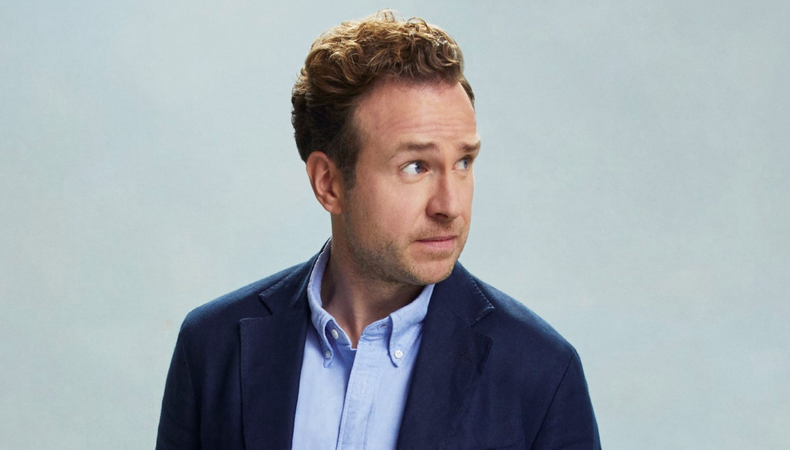
There’s a lot of helpful advice for actors in the chat between actor Rafe Spall and Backstage’s Hannah Williams. The star of Trying, The Salisbury Poisonings, and The Big Short, Spall spoke about finding confidence, making the best of your nerves, why Al Pacino still needs positive feedback, and how “other people make you better.” Here are just some of the tips and takeaways from their chat.
Finding your tribe and raising your game
“The first thing to say is my dad’s a successful, famous actor, so I always grew up around actors and knew it was what I wanted to do. I thought: ‘I’ll be as successful as him’ because that was my role model. The ignorance and naivety of youth! I didn’t tell him because I was embarrassed. But he overheard me say it to someone and asked if I wanted to audition for the National Youth Theatre (NYT), because that’s what he did. He gave me a speech from Julius Caesar and said: ‘learn it, do it for me.’ After, he said he was nervous, because if I was no good he’d have to tell me, in order to save me from a life of misery. But he saw something in me, and from that point on was very encouraging.
When I joined the NYT it was totally life-changing. Although my dad was an actor, and actors came round the house, I went to a state school in southeast London where no one was really into acting. So, I got to NYT and I felt like I’d found my tribe, my people. And then you see how good everyone is, and raise your game. That’s important – to find other people that you connect with and who make you raise your game. Other people make you better at acting.
Even now, I think Esther Smith [Spall’s co-star in Trying] is really good, and when I’m with her I’m just trying to keep up! That takes you out of yourself. You have to get out of your own head when you’re acting. Concentrate on what’s opposite you.”
On reading for roles
“You need to build instinct. As an actor, you’re sort of a professional reader. It’s a big part of your career, even if you’re just getting into it. You should have read all the great plays. I know that’s a boring thing to say, but you need to know the theatrical landscape you’re stepping into. Read a lot, and over that process start to work out what you relate to and gain an instinct of whether a character is in your wheelhouse. And if it’s not, how you can create that, how you can get to a place where you can play anything.
When I read Trying, I knew this character would come easily to me. For instance, I didn’t have to do an accent. That’s appealing, that the words would fit in my mouth. But I did a film called Just Mercy where I played the District Attorney of Alabama and that scared the life out of me. I knew I’d have to go on set in front of 200 extras from Alabama and with Jamie Foxx, who’s the king of The South, and do it. But that appeals to me in a different way – it’s a challenge. Sometimes it’s scary and sometimes you know it’s going to fit you like a cosy blanket.”
On almost being cast
“I’ve had thousands of bad auditions, the ones where you feel it isn’t going your way and the sweat pours down you. But it’s positive, you need to know what that feels like because this industry is all rejection. You need to know if you can take that. For every job I’ve got there’s been 500 I haven’t. Part of being successful is realising how much rejection you can take.
I’ve only ever not got two jobs, ones that I got very close to, that made me wonder ‘what would have happened…’ I was nearly Dr Who; I didn’t get it, it was Matt Smith. And then, I was close to being Dr Watson in Sherlock. And I do wonder what would have happened if I’d got those shows. I’m very lucky to have had a great career but there are some things that get away. You have to have the mindset that everything happens for a reason. Martin Freeman and Matt Smith got those parts. They’re terrific actors, they were right for the part, but I might have messed them up and ended my career. So, every job you don’t get, go: ‘Oh, there’s a reason for that.’ Otherwise, you’ll go nuts.”
Why theatre is the great equaliser
“I did a play, Betrayal, on Broadway a few years ago, which was a three-hander – it was me, Rachel Weisz, and Daniel Craig. I’m 30 at this point and I’m in the middle of a play with these two movie stars. One is James Bond and the other has won an Oscar. And they’re married. I was vulnerable and insecure – the whole time I was like: ‘Why am I here? How did I get this?’
And then, on the opening night, the first time we’re in front of an audience, I looked in their eyes and it was a great equalizer because they were just actors, and I could see they felt exactly the same as me. The levels of success, the Oscars – it didn’t matter. We were all the same. That bond you get when you act with people sustains forever because you know they’re as vulnerable as you are.”
Using nerves
“Use nerves as a tailwind, not a headwind. Nerves can push against you or push behind you. When you fall over, you get this rush of adrenaline that makes your arms come out quicker. It makes you more alert. It makes you faster of thought. Your body is going: ‘Quick, be superhuman for a second.’
That’s what nerves are doing when you’re getting into a pressurised situation, like going auditioning or getting up on stage. They can help you, they can make you a cleaner, faster, more concentrated version of yourself. That’s what nerves are for. They’re not there to impede you; they’re there to help you.”
On the only thing actors can control
“Remember: ‘I do this because other people can’t.’ If everyone could do it then they would. So, keep hold of this instinct that says: ‘I believe I can do this.’ It’s like a light, and you’ve got to hang onto it.
You will get bad reviews, or people saying you should pursue another career. And most of the time you will fail, most of the time you won’t hit it, most of the takes you do won’t work. You’ll spend ages doing a film that means so much to you, then it comes out and everyone goes: ‘Yeah, it was all right.’ Very few of the things that you do will hit. That’s a fact of life. You don’t have any control over success or whether people will like things, that’s by the by. The only thing that you can do is get better. The only thing you have any control over is improving.”
Why even Al Pacino needs positive feedback
“Most of the time, actors aren’t telling each other how great we are, we’re talking about how shit we think we are or recounting the millions of times we’ve humiliated ourselves. Embarrassing auditions, whatever – that’s something that bonds us – we constantly operate from a place of fear. That’s one of the reasons actors have always called each other love, darling, sweetie, etc. It’s an immediate intimacy – we’re all scared.
I’ll do a big name-drop now. I once worked with Al Pacino. And I was with another actor called Bobby, who’d done a film with Al before. And Bobby said: ‘Hey, Al, I saw some of the film we did. You’re terrific in it!’ And Al said: ‘Oh, really, Bobby? Oh, that’s such good news, I was good?’ So that’s Al Pacino, still worried about being good in a film. Still looking for affirmation. So, it never ends. That’s why we’re a tribe – you know what it’s like and you’re in the club.”
On starting your career in a pandemic
“If you just started, now’s a good time to reflect on what you want out of life. And be confident – if you’re insecure and uncertain, remember that everyone’s sat at home watching telly, so we’ve never been more needed, us actors and storytellers. We need entertainment and escapism so much right now. And that’s where we come in.”
More for UK actors? Check out Backstage.