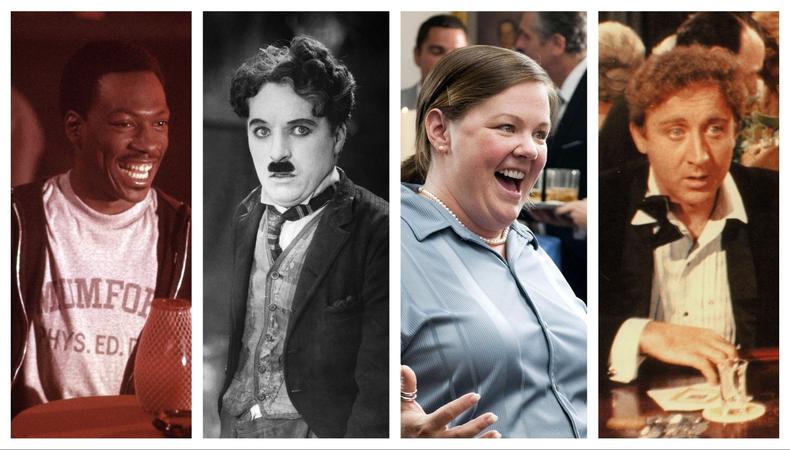
Comedy is difficult, because it’s typically so wedded to culture. What can be uproariously funny in a certain place or time can easily seem passé or even offensive in a different locale or another era. And yet, there are performances that endure, able to get audiences laughing at any time. Part of the humor comes from the content, but a far more valuable element is the performer who brings the jokes to life and gives them an eternal fire.
These seven performances helped crystalize the comedy genre as it transformed. While this is far from a definitive list (you’ll note these are all American comedies, as I wouldn’t presume to know what plays in other countries—like the French loving Jerry Lewis, which is already beyond my understanding), it should help to illustrate why these examples loom large in the development of the art form and why they continue to endure.
Charlie Chaplin as the Lone Prospector in “The Gold Rush” (1925)
There’s a serious debate to be had about the funniest actor of the silent era. Buster Keaton’s stunts and deadpan face were comic gold, and you can’t ignore the visual gags played out by Harold Lloyd. But if we’re talking pure comic construction, the mix of comedy and pathos inherent in Chaplin’s the Tramp character makes him the best overall performer. You could quibble over which of Chaplin’s silent movies contains his best performance, but “The Gold Rush”—which he also wrote and directed—lets his comic gifts take center stage in the icy wilderness, showing how he can tap dance on the line between humor and tragedy as his Lone Prospector nearly starves while looking to strike it rich.
Groucho Marx as Rufus T. Firefly in “Duck Soup” (1933)
Like Chaplin, it’s tough to pin the brilliance of Groucho Marx down to a single movie (“Animal Crackers,” “A Night at the Opera,” and many more are all viable contenders). Plus, Groucho arguably succeeds because he’s got Harpo, Chico, Gummo, and Zeppo. But if you think of a Marx brothers’ comedy, the first face that comes to mind is usually Julius Henry “Groucho” Marx. While there were numerous funny actors in Hollywood’s Golden Age, no one could throw a zinger or let a line land quite like Groucho. It could be easy to dismiss his performances as cartoonish, but those images only come because he could be so distinctive and silly, like he is in Leo McCarey’s “Duck Soup,” playing the leader of the fictional, financially drained Freedonia.
Donald O’Connor as Cosmo Brown in “Singin’ in the Rain” (1952)
In an age flush with musicals, O’Connor’s comic relief as Cosmo Brown stands head and shoulders above everyone else. He’s not only funnier than everyone in a movie filled with funny performances; he delivers a showstopping number about the power of comedy with “Make ’Em Laugh.” All of O’Connor’s gifts are on display in this four-minute number as he pulls faces, delivers jokes, and does some of the best slapstick you’ll ever see. Countless great comic actors have made audiences laugh, but few have approached the stunning physical commitment to the craft on display in this sequence.
Gene Wilder as Leo Bloom in “The Producers” (1967)
Part of Wilder’s genius is in the way he comes right up to the line, where you think his character might be dangerously insane. There are plenty of put-upon schlemiels in comedy, but Wilder’s ability to go from mild-mannered to broad without skipping a beat is unrivaled. His Oscar-nominated breakthrough role as Leo Bloom in Mel Brooks’ “The Producers” still towers over the rest of his comic work, which is all worth watching. In the film, Bloom convinces down-on-his-luck producer Max Bialystock (Zero Mostel) to purposely put on a play about Adolf Hitler that’s destined to fail so they can reap the benefits of the oversold interests. As Bloom, Wilder not only manages to hold his own against the staggering talent of Mostel, but steals scene after scene as Bloom cracks in hilarious, unexpected ways during the duo’s criminal endeavors. He’s just as believable clutching his blankie as he is casually disposing of a swastika armband.
Eddie Murphy as Axel Foley in “Beverly Hills Cop” (1984)
Action-comedies existed before “Beverly Hills Cop,” but nothing quite clicked the combination into place as firmly as Martin Brest’s film, which exemplifies both the blockbuster attitude of ’80s cinema and the dazzling movie star charisma of Murphy. While other standup comics and “Saturday Night Live” performers made successful transitions to the big screen, none until Murphy really felt so in tune with the moment, and had the ability to hold the screen rather than serving as a supporting, memorable performer (a la John Belushi in 1978’s “Animal House” or Bill Murray in 1980’s “Caddyshack”). Although you could argue that Murphy has been better in other movies, no performance is as essential to the genre as Murphy’s wise-cracking turn as Axel Foley, a smart-ass Detroit cop who travels to Beverly Hills to solve the murder of a friend.
Will Ferrell as Ron Burgundy in “Anchorman: The Legend of Ron Burgundy” (2004)
Despite the fact Ferrell was lumped in with the “Frat Pack” comic actors of the early 2000s, thanks to his role in 2003’s “Old School,” his most memorable turn remains the lovable blowhard news anchor Ron Burgundy in Adam McKay’s “Anchorman: The Legend of Ron Burgundy.” The “SNL” alum’s comic talents are undeniable, and watching him build such a memorable figure from the ground up remains a marvel. He has a character that grabs you from the opening credits, even though it’s clearly just Ferrell riffing with vocal warmup exercises like “The Human Torch was denied a bank loan.” Of course, movies had been quotable before “Anchorman,” but the success of Ferrell’s creation turned comedy-quoting into something of its own language in the internet age.
Melissa McCarthy as Megan Price in “Bridesmaids” (2011)
Women have occupied a curious place in theatrical comedies. As writers typically required a male compatriot, film audiences were introduced to lovely duets like Katharine Hepburn and Cary Grant in 1938’s “Bringing Up Baby,” or Elaine May and Walter Matthau in 1971’s “A New Leaf.” It was on television where women got to shine as comic forces (think “I Love Lucy,” “The Carol Burnett Show,” “30 Rock,” etc.). But McCarthy broke out of that mold by announcing herself as a comic force of nature in Paul Feig’s “Bridesmaids.” It’d be understandable to pinpoint her best scene as the cavalcade of gastrointestinal distress during the dress fitting. But it’s actually when she comes to rally Kristen Wiig’s depressed protagonist that McCarthy shines brightest. It’s a scene that highlights her gift for finding beautiful emotions while never losing sight of the comedy. It’s a performance that takes a character who, in past decades, would be a target for mockery and makes her the most powerful and memorable role in the film.