So you’ve mastered the art of communicating comedic ideas, but want to level up. Where do you go from here? How about trying the same joke again?
Callbacks in comedy are a simple way to make a piece feel connected, treat your audience like they’re geniuses, and provide invention by way of necessity. If you want to figure out how to pull off the best callbacks in comedy, look no further.
JUMP TO
A callback is a reference to a previous piece of material presented within the same story or project, whether it’s a full-on joke, a particular piece of syntax, a contextual setup, or anything at all previously mentioned.
The callback functions as a kind of slow-motion joke or a comedic use of foreshadowing. It’s a laugh-inducing Chekhov’s gun, where the setup and punchline are kept apart by time and space, until the callback reveals that both elements were, in fact, setups and punchlines.
To approach it from an etymological standpoint, think of a callback as if you’re calling someone back on the telephone—in this case, that “someone” just happens to be a previous idea.
 How To Become a Standup Comedian
 A history of callbacks
The idea of calling back previous ideas and jokes has existed in writing and performance since the beginnings of those art forms. Writers of theatrical farces such as William Shakespeare and Oscar Wilde wrote lines and climaxes that expanded upon plot points previously communicated without laughter. For example, in Act 3, Scene 1 of Shakesepeare’s “A Midsummer Night’s Dream,” the character Nick Bottom has his head turned into that of a donkey. In Act 5, Scene 1, Shakespeare calls back to the event with this exchange:
Theseus: I wonder if the lion be to speak.
Demetrius: No wonder, my lord: One lion may, when many asses do.
Seminal works of vaudeville comedy, such as Bud Abbott and Lou Costello’s “Who’s on First?,” were constructed upon the idea that “you need to remember previous information so when we revisit it, you’ll laugh again.”
In the world of standup comedy, as artists moved further away from self-contained one-liners or TV-ready tight fives into storytelling and experimentation, callbacks within a comedian’s act became more standard. Folks such as Tig Notaro, Mike Birbiglia, and John Mulaney garner huge laughs and applause just by recalling information, even divorced from its original comedic context. In his 2012 “New in Town” special, for example, Mulaney likens babysitting to hiring “a horse to watch your dog.” Then, many unrelated jokes later, the comic remembers a high school party: “We were like dogs without horses.”
As sketch and improv theaters become more and more widespread, so, too, do their vocabularies. In particular, the Upright Citizens Brigade’s ethos centers on finding a comedic “game” that performers return to time and time again, effectively creating comedy pieces that are callback machines. As comedians trained at these theaters continue to filter through the television and film industry, we will undoubtedly see callbacks become more widespread and understood.
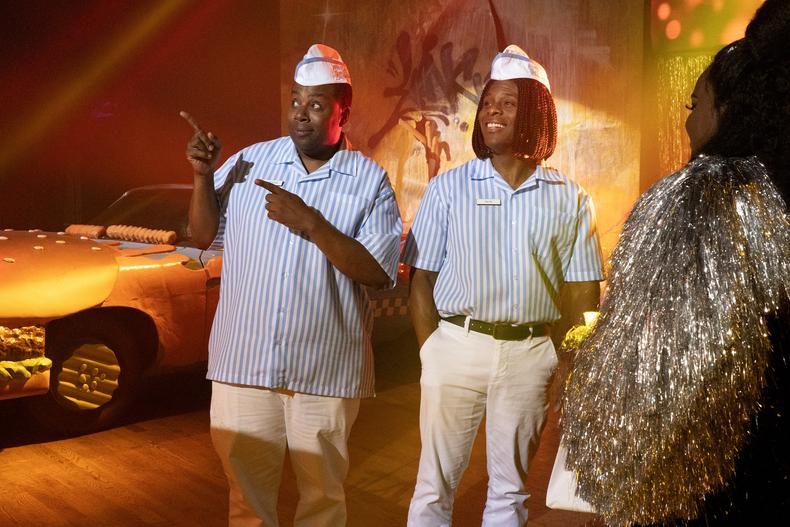
“Good Burger” Credit: Vanessa Clifton/Nickelodeon/Paramount+
Give it time
A joke that comes back one page after it’s first written won’t work well, because it’s missing the element of surprise. Trust that your audience is dumb enough to forget a joke, but smart enough to eventually remember it when you confidently refit it many pages later.
Heighten the moment
Comedy is founded on surprise, so you don’t want to rest on your laurels when revisiting an idea. Figure out how to expand upon the world of your idea when calling back to it; avoid the microwaved rehash. When in doubt, try this handy question: “If this is true, what else is true?” Or, give what you’re calling back another context—for example, if it was introduced in a negative light, try it in a positive light. This will make sure that the first mention still feels fresh.
 How to Use Dry Humor In Your Comedy
 Be clear
Ensure that your audience understands what material you’re calling back to. Don’t be needlessly esoteric or holier-than-thou. Give your callback an identifiable turn of phrase, physicalization, or other signpost that tells an audience, “Yes, we’re here again.”
Put it up
There’s no greater comedy litmus test than an audience. Whether that’s performing live for people or giving pages to trusted friends for feedback, you will learn quickly whether or not your callbacks pay off and how to sharpen them if needed.
“Monty Python and the Holy Grail”
Spoilers ahead: In the sketch comedy troupe’s medieval work of lunacy, one visual subplot involves a contemporary-looking detective investigating the in-universe murders committed by the knights. It seems like a non-sequitur—until the entire film ends on a callback, with these same detectives shutting down the production.
“Airplane!”
We’re introduced to the hero of this classic spoof, played by Robert Hays, as a cab driver who asks his passenger to wait a moment so he can try and win his lost love, played by Julie Hagerty, back. Then, the entirety of the film plays out, and we completely forget about this setup until this delicious post-credits stinger.
“Arrested Development”
During its original three-season run, this cult classic sitcom was designed as a callback machine, rewarding studious viewers with layers of complicated comedy. Of particular joy is Maeby’s (Alia Shawkat) constant use of the inane phrase “Marry me!” to get out of sticky situations, culminating in her accidentally using it against her uncle (Jason Bateman)—which is, in and of itself, a callback to the show’s predilection for what we might call “light incest.” (Which, itself, is a callback to this phrasing! Layers!)
“Step Brothers”
Throughout Adam McKay’s absurdist masterpiece, Will Ferrell and John C. Reilly constantly pine after redeeming themselves at the “fucking Catalina wine mixer,” an event that’s exactly as it sounds. Every time a character calls back this particular phrase, it gets funnier and funnier, culminating in this rapidfire climax.
Gary Gulman’s “State Abbreviations”
Showing just how far the “late-night comedy set” has come, comedian’s comedian Gary Gulman centers his entire time on just one premise: How did they come up with the two-letter abbreviations for U.S. states? Gulman’s work is filled with callbacks, all of which hit you by surprise yet are inevitable. “Everybody cool with AL?”
“The Eric Andre Show”
In this iconic episode of the talk show deconstruction, Lance Reddick performs a chaotic piece of slam poetry wishing he could be LeVar Burton. Then, episodes and even seasons later, Burton appears on the show in a callback, performing a piece wishing that he was, of course, Lance Reddick.