Chicago theatre credits are the gold standard for many directors and casting directors on both coasts. They know Chicago is an actors' town where the chops are good, the cost of living remains reasonable, and the whole is greater than the sum of its parts. Chicago actors who land roles in New York or Los Angeles often explain the difference between the cities in terms of competition, claiming that in New York and Los Angeles, everyone is desperate to look good at auditions. But in Chicago, they say, actors are interested in the work and in making each other look good. No wonder that at the city's annual Joseph Jefferson Awards, the most coveted category is called "ensemble."
If Chicago casting is less cutthroat, there are good reasons for it. For starters, you don't need an agent—not for theatre, anyway. From Steppenwolf and the Goodman down to the smallest theatres, casting directors emphasize that agents are neither necessary nor an advantage. And salaries don't fluctuate much when you don't have stars, perks, and percentages to fuss over. A handful of agents—literally four or five—do represent clients for theatre, but they do so because they love the form, not because it makes them money. Says Cree Rankin, casting director for Court Theatre, "A lot of theatres don't deal with agents and a lot of agents don't deal with theatre."
If you're an Equity actor, your odds of working are statistically better in Chicago than in many other places. According to Actors' Equity, its Central region was home to 8.5 percent of all Equity members yet provided 16.4 percent of all Equity workweeks during the 2005-06 theatre season. And while the Midwest's large nonprofit theatres—such as Minneapolis' Guthrie Theater, the Milwaukee Repertory Theater, and Actors Theatre of Louisville—as well as dinner and summer theatres periodically hold casting calls in Chicago, the bulk of the action is in Chicago itself, whose metro area is home to more than 200 producing companies, according to the League of Chicago Theatres. Forty-five to 50 of these theatres produce under Equity contracts, ranging from the Broadway Production Contract to the LORT Agreement to the Chicago Area Theatres pact. Of these, the highly flexible CAT contract is by far the most widely used.
Here's another difference between Chicago and its larger siblings: So-called "Equity waiver" theatre is almost nonexistent. Union production costs are reasonable, especially at the lower levels of the six-tier CAT contract. CAT's entry-level tier, for example, requires no more than four Equity members, and the entry-level pay—$162.50 a week per actor—may not be much, but it's more lucrative than working for carfare under the 99-Seat Plan or Showcase Code.
If you're non-Equity, your odds of working—and being paid for it—may be even better in Chicago, with a number of outstanding local companies remaining nonunion for economic reasons or to maintain the ensemble process upon which their work is based. These dedicated, professionally managed enterprises are recognized as such by local critics, who give them the same attention they give to all the top-flight Equity companies.
Actor and Columbia College Chicago acting teacher Tom Mula, an Equity member for 30 years, observes, "In this town, there's so much terrific nonunion work that you can really establish yourself as an artist in non-Equity theatre." Many Equity troupes hold nonunion general calls once a year, some more frequently, with many casting their understudies entirely from the nonunion ranks.
"I probably do more generals than most people," says P.J. Powers, artistic director of the award-winning (and nonunion) TimeLine Theatre Company, who is also an actor. "Just in June, I did a week of generals and saw 440 people. I'm not required to do it, but I think it's a good thing to do. We focus a lot on trying to get new blood in the door." Last season, he says, "at least 50 percent of the faces on our stage were new." For TimeLine's four-production 2007-08 season, he expects to hire 55 actors, paying a flat rate of $100 per five-performance week.
While the theatre opportunities in Chicago are enormous, the casting process is standard: Actors need to prepare two contrasting monologues, or, for musicals, perhaps a monologue and 16 bars of a song. For some general auditions, you'll need a piece in classical verse. As always, do your homework. When you're auditioning for Chicago Shakespeare Theater, for example, the theatre's name says it all—except when Associate Artistic Director Gary Griffin stages a Sondheim musical or a Feydeau farce. The Court Theatre, by contrast, hasn't done a Shakespeare play in five years, yet its casting director prefers to hear Shakespeare monologues. Theatres post their audition notices on BackStage.com, on ChicagoPlays.com, and in the print and online editions of Chicago's industry trade paper, PerformInk.
With so many Chicago theatres, it's impossible to list every company's casting guidelines. But here are some examples.
The Goodman Theatre, says casting director Adam Belcuore, annually holds a two-day Equity general call in Chicago and a one-day general call in New York—plus a nonunion general call each March or April, but only by invitation. Show-by-show calls are also strictly invitational. Like most theatres, the Goodman does its best to make sides or complete scripts available to actors up to two weeks before the audition for a specific show. Belcuore welcomes headshots and résumés at any time.
At Steppenwolf Theatre Company, the casting is handled by Erica Daniels, who also consults for Chicago's About Face and Lookingglass theatre companies. Steppenwolf's complex has three stages, which operate under the VI, V, and III tiers of the CAT contract. Equity general calls are held in April (bring contrasting contemporary pieces, not classical), with show-specific calls held by invitation or through agent submissions (largely for out-of-town actors). As sides or scripts are available at least two weeks beforehand, Daniels says, "there truly is no reason not to be prepared for a Steppenwolf audition," though she acknowledges that some actors are intimidated by the company's weighty reputation—after all, how would you feel in a callback with John Malkovich? The company also holds auditions in L.A. and New York "if we can't find it in Chicago," Daniels says, "but it's rarer and rarer." She looks for "in-the-moment, authentic, real actors," though she admits that can mean different things given the diverse directors Steppenwolf works with—Frank Galati, Amy Morton, Tina Landau, Rick Snyder, and others. Actors may also submit a photo and résumé at any time: "I open all my mail," Daniels says. Nonunion actors earn between $300 and $500 a week.
In 2001, Victory Gardens Theater became the third Chicago winner of a Regional Theatre Tony; the Goodman won in 1992, Steppenwolf in 1985. Yet Victory Gardens is much smaller than those theatres and driven almost exclusively by new work, much of it derived from its 12-member Playwrights Ensemble. Artistic Director Dennis Zacek says he welcomes photos and résumés at any time; the company also holds a three-day Equity general call in July followed by a three-day nonunion general. Show-specific callbacks are by invitation. With rare exceptions, Victory Gardens does not cast out of New York or L.A., and the occasional name actors it brings in usually have Chicago connections. "If we're doing a show by an Ensemble playwright," Zacek says, "they have a core of actors they often like to work with." If Zacek is stumped over casting, he asks other local directors and casters for suggestions. Victory Gardens operates under a CAT IV contract, performing seven shows a week. Nonunion actors receive the equivalent of Equity minimum.
The mainstage of Chicago Shakespeare Theater has a CAT VI contract. Casting director Bob Mason tries to cast most roles in Chicago before auditioning out of town. New York is usually the first stop, but the company has also cast out of Minneapolis, Toronto (it's affiliated with the Stratford Festival), Los Angeles, and the Oregon Shakespeare Festival. Mason's current New York casting partner is Liz Woodman. The Equity general call is typically held in January, with non-Equity generals—important, given the large casts needed for Shakespeare—in January and April, the latter by invitation. For the company's 2007-08 season, Mason expects to cast 75 to 80 Equity roles, plus at least 20 nonunion roles paying $400–$450 per eight-show week.
Northlight Theatre, in suburban Skokie, is a LORT C house paying actors a minimum of $676 per seven-show week. For its 2007-08 season, artistic administrator Lynn Baber expects to cast 20 to 25 Equity actors. Northlight and four other Equity theatres in the northern Chicago suburbs—Apple Tree Theatre in Highland Park, Writers' Theatre in Glencoe, Next Theatre Company in Evanston, and the Piven Theatre Workshop in Evanston (founded by the parents of actor Jeremy Piven)—have created a consortium under the banner "North Shore Live." They not only market their shows collectively, but hold unified non-Equity general auditions each June. Baber is also one of several local casting directors who are enthusiastic about college theatre showcases, citing DePaul, Northwestern, Roosevelt, and Loyola universities, plus Columbia College Chicago, the University of Illinois at Chicago, and North Central College.
The region's dominant musical house is the Marriott Theatre in northwest suburban Lincolnshire. Producing five shows a year for more than 40,000 subscribers in an in-the-round, 882-seat house, Marriott uses a modified Dinner Theatre contract that pays actors a minimum of $623 for an eight-show week—although Artistic Director Andy Hite says, "I can't remember the last time we paid just $623." Hite holds two annual Equity general calls, typically in the spring and fall, squeezing in nonunion auditions around the Equity dates; he also holds a general dance call each spring. "We go to New York for three or four of the five shows we do a season," he adds. Next year Marriott will offer at least 85 Equity contracts and average two to three nonunion performers per show, who will earn weekly minimums of $450–$500. Hite assumes that anyone auditioning for him can sing and move, but given the intimacy of his house, "I look for good solid actors, not just musical laurels," he says. "Acting is paramount."
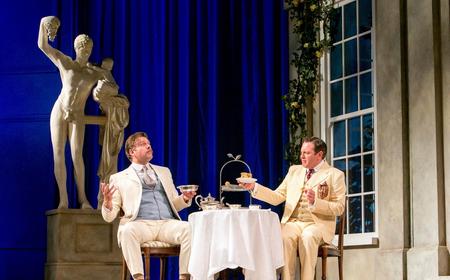
Finally, the award-winning—and non-Equity—Circle Theatre, located in west suburban Forest Park (where playwright Rebecca Gilman launched her career), breaks the mold by eliminating general auditions entirely. "We do per-show auditions," says Artistic Director Kevin Bellie. "Company members get preferential treatment in audition slots, but they aren't cast simply because they're company members." Indeed, the 23-member troupe includes only seven actors. And the 12-member cast of Circle's current show, Oscar Wilde's An Ideal Husband, features just one company member. "We love to see new people," Bellie says. "We want to see them do their best. We want you to be amazing even more than you want to be amazing." He expects to cast 70 to 85 roles next season, paying something over $200 per week—the exact figure hasn't been set—for six shows running six weeks each.
So what's it like to be an actor in Chicago? Tall, handsome Chris Cantelmi, 31, has been in Chicago for three years and has rarely been out of work; his credits include Victory Gardens, Writers' Theatre, Chicago Shakespeare Theater, the Illinois Shakespeare Festival, and Lifeline Theatre. He is also an Equity membership candidate who says he isn't quite ready to push his points over the top. "I feel membership is a vindication after years of working for little or no money, [but] I don't have confidence yet in my career—confidence that I'll get work if I cross over," he says. Because he gets so much work now, he adds, he can be selective about which open auditions he attends—and he definitely doesn't like to crash Equity calls. Cantelmi is also part of a small nonunion ensemble that recently mounted its first show. "You can make something happen on your own," he says, echoing a sentiment offered by many Chicago actors.
Alison Halstead, a veteran actor of some 20 years, is one of them. After performing at nearly all the leading nonmusical venues in Chicago, she joined Equity three years ago, and things have been slow, she says. "I am a 4-foot-6 black woman who grew up in England for the first 14 years of my life, so I'm very specific…. I didn't think it would be this tough when I turned Equity. After all, there's just one of me and I'm still the same actor." To take up the slack, she created The Invisible Man, a solo show she has toured to arts festivals around the nation. Halstead also hits all the general calls she can and reads for major Midwestern theatres when they audition in Chicago. She advises actors coming to Chicago to "slog your way, don't give up, find different ways to satisfy your artistry." And "keep on doing the mailing thing," she adds, "and be respectful of everyone. That assistant to the director is in the room for a reason."
Tom Mula has been even more successful at creating work for himself: He is a produced playwright and a successful author. His seasonal tale Jacob Marley's Christmas Carol was first published as a book, then he adapted it into a solo show for himself and into a play for four actors. In 2004 he played George W. Bush in a mocking musical revue, W, which he co-authored. And his co-adaptation of the Sylvia comic strip, Sylvia's Real Good Advice, has been widely produced. But after 33 years in the business, Mula—who also teaches at Columbia College Chicago—rarely auditions anymore. "People call me in to read," he says. "I used to like to audition. I don't like it anymore. I'm trying to like it again." Mula advises his acting students not to take the process personally, even if "it's hard not to do that." Remember, he says, "it's a job interview and you're there to fill a need. Be an intelligent actor and prepare suitable audition material."