In the Envelope: The Actor’s Podcast features in-depth conversations with today’s most noteworthy actors and creators. Join host and senior editor Vinnie Mancuso for this guide to living the creative life from those who are doing it every day.
John Bradley’s very first audition out of the Manchester School of Theatre just happened to be for “Game of Thrones,” the hit HBO series based on George R.R. Martin’s epic fantasy novels. For eight seasons, Bradley played Samwell Tarly, the most timid member of the ancient order known as the Night’s Watch. The show quickly built a rabid fandom and went on to define an era of prestige television.
Bradley is taking the lessons he learned from that whirlwind experience to Netflix’s “3 Body Problem,” the latest project from “Game of Thrones” creators David Benioff and D.B. Weiss, as well as Alexander Woo. The sprawling sci-fi series is based on author Liu Cixin’s landmark sci-fi trilogy “Remembrance of Earth’s Past.”
“If I’m striving for anything in acting now, it’s to make it look easy,” Bradley tells us. “It’s a bit of a highfalutin way of saying it—if my parents could hear me now, I don’t know what they’d say—but the art is in the concealment of the art. I think I’m relaxed enough that I can be relaxed on camera, and I think it’s showing in more recent performances.”
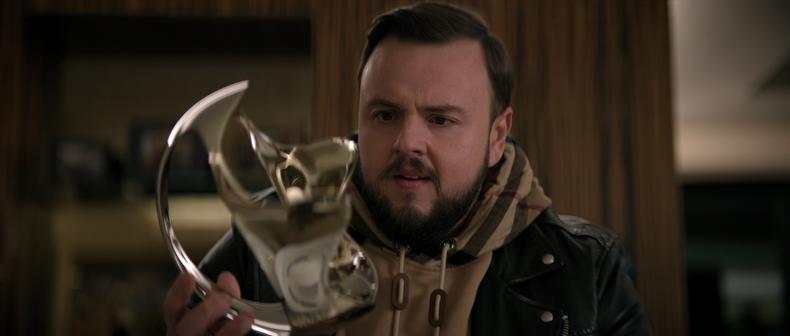
On this episode of In the Envelope: The Actor’s Podcast, Bradley looks back on “Game of Thrones” and gets candid about the differences between Sam and his character in “3 Body Problem,” brash snack-food magnate Jack Rooney.
Bradley grew increasingly anxious over the course of his run on “Game of Thrones.”
“I don’t think I was that nervous when I started off because I didn’t really know the rules; I didn’t know too much about marks and camera sizes. So I just kind of took my theatrical training to the set and just acted…. [But] I got nervous as it went on.
I developed this really weird thing. I always played Sam with a slight stammer; I just think it fit a character that never quite knew whether to speak or not, never knew whether to act or not. What happened was, when I was playing that character after a while, the stammer would take over; I wasn’t in control of it anymore. There’d be times where I’d have the first line in a take and the director would call action, and I’d be standing there just trying to get the words out for 30 seconds of silence.
You’ve got no idea how long that feels when there are [other] actors waiting for you to speak. It’s almost like you’re locked [inside] yourself, and you’re just thinking, Why can’t I speak? That was never something that happened at the start; I’m still not sure why it happened. It was something like a minor panic attack. That happened for a couple of seasons, and I never quite got out of it. I used to have to time my breaths so that I breathed out before I started speaking, because if I breathed in, I wouldn’t be able to let the air out.”
Courtesy Netflix
Bradley’s character on “3 Body Problem” feels much closer to who he is as a person.
“It’s almost as if, well, anybody can fluke one good performance. [But] how do you show that you’re not just that [character]? How do you show that you can apply that same process and those same techniques…to a different character? That’s the hardship of being known for something. Unless you want your career to end there and not progress, you have to find a way of showing a different side of yourself. That can be quite tricky.
It’s interesting—with…David and Dan’s new show, ‘3 Body Problem,’ they’ve written me this character because they realized, while shooting ‘Game of Thrones,’ that I was nothing like Sam at all. Dan Weiss said in an interview the other day, ‘John was diametrically opposed to the character he was playing.’ That’s all very well and good until you realize Sam was quite a nice character and was really kind. [Laughs.]
But a weird thing has happened to me now. Because the first character I played was this guy who was down on confidence, nervy, and didn’t think much of himself, people think I’m like that, because it was the first time they saw me. So they might be forgiven now for thinking Jack Rooney, the new character I play in ‘3 Body Problem,’ is this transformative acting [experience for me], playing somebody confident…. You sort of think you play characters closer to you at the start and then branch out; I kind of did it in reverse.”
He’s learned to take self-punishment out of his acting practice.
“Nowadays, people seem to have become fascinated with the process. You get actors talking about the extremes they went to; but it’s all about the result. [You might feel that] your process isn’t the same as somebody else’s or feel that you’re not working as hard as other people; [but] if your results are the same as other people’s results, then nobody cares.
Sometimes if you get an actor talking about their process, it’s because they want you to view the final product through the filter of how hard they worked—whereas in actual fact, if you just believe that the product and result is enough to stand on its own merit, then that’s all you need. If you’re an actor who thinks they don’t have a process just because they’re not Method—and ‘Method’ is the most misused and least-understood term in existence at the moment…don’t feel that your results suffer because of it. Just plow your own furrow. Be the actor that you want to be.”
The most challenging moment for Bradley to shoot on “Game of Thrones” was a small one.
“It feels like a tiny thing, but I was so determined to get it right: There’s a scene in the end of Season 2 where Sam’s out beyond the Wall with Dolorous Edd and Grenn. They know that three blasts on the horn signals White Walkers. They hear two blasts, and then they hear a third. All the shot was, was the camera pulling in tight on my face. We didn’t do the rest of the scene; it was just this special shot. I knew that I wanted to get this thing without any change of expression, really; the life just drains out of [Sam’s] face. You can’t really see what’s changed, but there’s something in the eyes that’s changed, and the fear has really set in.
When it comes to that kind of thing, you don’t necessarily feel in control of it; you’re not as in control of your face as you are the words and even the rest of your body. You’re just hoping that these tiny little muscles in your face kick into the right [expression] at the right split second. I remember just hoping that I could get that across, because that moment [shows] a threat that we’ve only ever heard about as being a myth, and people now know it’s a real thing. So it’s a huge moment in the show. It wasn’t a big stunt, it wasn’t a big speech—it was just me thinking, I hope the muscles in my eyes and my face do their job in the next three seconds.”
Listen and subscribe to In the Envelope to hear our full conversation with Bradley.