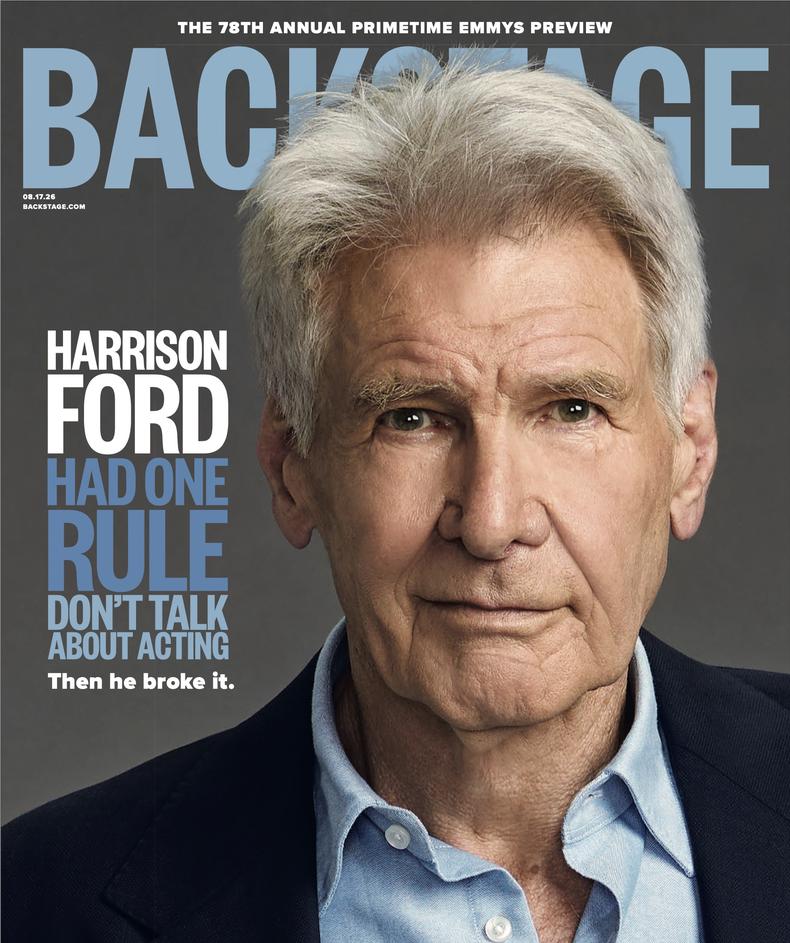
Nothing can prepare you for the experience of Harrison Ford joining your Zoom. Some actors loom so large in the pop-culture zeitgeist that they seem to transcend human concepts like laptops, headphones, and glitchy Wi-Fi. This is Han damn Solo; this is Indiana Jones, Jack Ryan, Rick Deckard, Richard Kimble on the line, muttering, “I don’t know this shit,” as he tries to find the button to turn on his camera, his voice more gravelly with age but still the sound of New Hollywood nostalgia.
Luckily, we’re sitting down to discuss something he does know quite well: the art of acting, which he’s parlayed into a 62-year career and just around $6 billion at the domestic box office. (To this day, he and Sylvester Stallone are the only two actors in history to open a film at No. 1 in six consecutive decades.) At this point, the origin story of one of the industry’s most bankable names is the stuff of legend. Frustrated with unsatisfying bit parts and antagonistic execs while under contract at Columbia Pictures, Ford pivoted to carpentry in the late 1960s. He happened to be installing doors at the production offices where his onetime “American Graffiti” director, George Lucas, was casting “Star Wars.” Lucas asked Ford to read lines during auditions, and the rest is history.
From that film on, Ford set the template for a new type of male lead, imbuing a classic, cocksure confidence with the all-too-human sense that he’s making this all up as he goes along. It’s a screen presence he’s used to create two of cinema’s greatest heroes in “Star Wars” and “Raiders of the Lost Ark,” subverted to portray charming sociopaths in features like “The Mosquito Coast” and “What Lies Beneath,” and in recent years utilized to explore the realities of aging in legacy sequels like “Star Wars: The Force Awakens” and “Indiana Jones and the Dial of Destiny.”
Many fans, audience members, and critics have spilled a lot of ink analyzing the work of Harrison Ford, which is—if you believe him, at least—more than you can say for the man himself. “I don’t think that fucking much about acting,” he tells us, before adding with a laugh: “Oh no, I shouldn’t say that sort of thing.”
It’s funny, because he says that sort of thing a lot. The famously aloof Ford is often hesitant to give himself too much credit, which is at odds with the fact that one of our most consistent stars is still delivering compelling, surprising work. This July, he earned his second Emmy nomination for Bill Lawrence’s Apple TV comedy, “Shrinking.” It’s a well-earned nod; Ford has never been more openhearted onscreen than in the role of Paul Rhoades, a cantankerous therapist dealing with the early stages of Parkinson’s disease.
Here, the 84-year-old icon gets candid about the challenges and triumphs of his “Shrinking” part, his most formative roles, the realities of modern-day Hollywood—including the looming threat of AI—and why, at the end of the day, actors just “have to fucking be nice” to each other.
I was just listening to you on Ted Danson and Woody Harrelson’s podcast, and I didn’t know you could do such a great English accent.
I don’t remember anything about that. I was speaking in tongues.
You were telling the story of the first interview you did for “Star Wars.”
Ah, yeah. [English accent] “What is ‘Star Wars’ about, Harrison?” And I had no idea, of course.
You’ve done accents in movies before. Scottish in “The Last Crusade,” Russian in “K-19: The Widowmaker”…
And I take a lashing every time. The audience likes me just plain. They lambasted my Russian accent in the press. I didn’t think the accent was that bad. But, you know, I wash and wear. Leave the folding to other people.
This might be a strange way to start this conversation about acting, but I’ve seen you say that “the first rule of acting club is don’t talk about acting.” Why is that?
Whatever we say about it doesn’t really matter. It’s not really what’s happening, usually. Acting is a matter of taking advantage of a situation, whatever that situation is, and trying to concentrate on the task at hand, which is telling the story through character. It’s different every time because the person you’re dealing with is different. The circumstances are different. Basically, you do what you do and try to accommodate what the other person is doing, or at least have the ambition of dissolving what barriers may be between you to concentrate on really fulfilling the intention of the scene. It depends on the director’s patience, how much money there is, how much time there is. [As Roy Scheider said,] “It’s not the time it takes to take the take that takes time. It’s the time it takes between the takes that takes the time.” So when somebody’s fast and efficient and straightforward, it’s a dream. And it can be, sometimes, not as dreamlike.
What I love about [acting] is, there’s a clock ticking. There’s only so much time. There’s only so much energy. There’s only so much patience, and you got to do it. You don’t get another chance. That’s the day. That really makes it fun for me; it’s just very exciting. And they give me money.
I’ve seen you say that something you love about flying airplanes is that, after each flight, you have to take a look at what just happened and analyze it for next time. Is that true of acting, too?
Fuck no. If I see it later on, maybe. But I try to do my job as best I can on the day and then leave it lay where Jesus flung it.
You’re shooting Season 4 of “Shrinking” right now. How’s it going?
I just worked with [Michael J. Fox] yesterday. We did a great little funny scene. He’s so sharp. He’s so there. Every bit of talent in that man is enormous. He is skillful. He is incredibly inventive. We did a great little scene yesterday, and it left me feeling very happy.
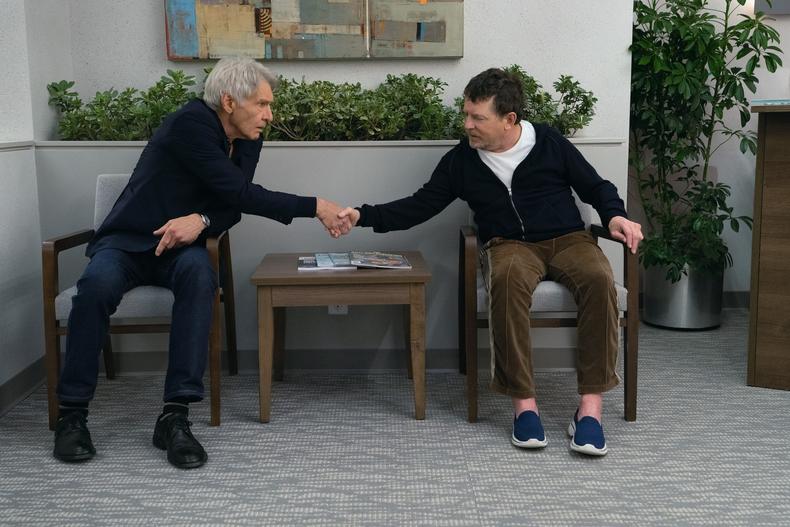 Harrison Ford and Michael J. Fox on “Shrinking” Courtesy Apple TV
“As I learned more about [acting], I realized I didn’t need to hide. I just needed to bring what was in my heart and my head, because that’s what I had to offer.”
What’s been the challenge so far of this new season?
Parkinson’s has always been an issue for Paul throughout every season, and each season is a relatively short period of time. We’re not seeing the full progression of the disease over a lifetime. Because Bill Lawrence and his merry men are kind of making shit up as we go along, it matches the reality of a Parkinson’s patient who does not know what’s coming. I don’t know what’s coming. They layer in what they want, and if they remember to tell me, I do it.
I’ve spent as much time as I could really understanding the symptomology of Parkinson’s, but it’s different with every single patient. That is, to me, a very daunting challenge, only with respect to what I require for myself to get it right. I don’t want to do something mawkish or stupid or wrong.
You’ve talked before how important the physicality of a character is to you. How has that manifested, specifically, when it comes to portraying the physical symptoms?
I’ve worked with neurologists, experts that have guided me. I’ve gotten a lot of advice. There are a lot of other storytelling obligations that the character has. It’s not just an imitation. It inhabits his life in social ways. Michael said that he could see it in my eyes. I think that’s very generous. It’s indicating something else, struggling with the lack of surety or knowledge about where you’re going and how long you have. But I don’t know. This is the part where I run out of patience talking about it, because it’s not mechanical, so I can’t really describe it.
Well, it’s in the doing for you. You understand it in the moment, so I can imagine it’s annoying to describe it outside of the moment.
I’m not annoyed by it, but I think I run out of wisdom. I just think about telling the story. I don’t think that fucking much about acting. Oh no, I shouldn’t say that sort of thing. [Laughs]
Acting is problem-solving. That’s what we do on the set. We stand it up, and we solve the problems. We try to bring it to the audience as hot and rich as they can take it.
You’ve said that playing Mr. Antrobus in “The Skin of Our Teeth” at Ripon College’s Red Barn Theatre in 1964 is when you “caught the illness.” What was it about that particular show, character, or performance that sparked a love for acting?
Mr. Antrobus had a stick-on mustache and a head full of talcum powder. I had a literal pillow under my shirt. So I was invisible. And I found that invisibility freeing. I was finding great pleasure for the first time in my life in a community of like-minded people. I hadn’t seen anything like that since Cub Scouts. I wasn’t a good student. I wasn’t the hottest football player. I did not find community in college until I found this group of people, who I thought were geeks and misfits. And then I realized I was a geek and a misfit.
I found a real enthusiasm for a potential way to spend my life telling stories. We had nothing in common except that we were telling this story. Weaving that fabric was a real adventure, a real new thing for me. At first, it was great to be able to hide behind a character. But later on, as I learned more about it, I realized I didn’t need to hide. I just needed to bring what was in my heart and my head, because that’s what I had to offer.
You famously did not enjoy your time as a studio contract player at Columbia Pictures in the 1960s.
Because they made me do horseshit!
But a lot of people don’t know that, besides the horseshit jobs, that contract came with essentially a formal acting education under the director of talent, Walter Beakel. Did you get anything useful out of that?
Johnny Strasberg [son of Method acting inventor Lee Strasberg] was there, too. Walter and Johnny, they were both Method. Johnny was into describing a practice, almost a religious practice. It was all about bringing your past into your performance so that it was legitimate and authentic. That was in tension, in my mind, with presence. With being there. Sense memories and things like that didn’t make a lot of sense to me. And besides, they made me wear a sport coat and tie to come to the studio.
George Lucas once said, “I think the experience of the ‘Star Wars’ films, especially the first one, and working with a lot of British actors, mellowed Harrison out as an actor.” Do you agree with that?
I could agree with it, but it doesn’t matter. [Laughs] There was Alec Guinness [who played Obi-Wan Kenobi], a very generous and very funny guy. He was the kind of guy who said, “Where are you staying?” I said, “I don’t know, I haven’t found an apartment yet.” He said, “Well, what are you looking for? Can I help? Maybe ask some of my friends?” That mellowed me out a little bit. But I don’t know that it changed my acting. I don’t think I understood enough about acting at that point in my career to make that kind of adjustment.
You’re on so many lists of actors who broke out “later in life” because “Star Wars” debuted when you were 34. Did it feel like success found you late at the time?
It came partially out of my choice not to work when I didn’t have something that I thought was going to progress my so-called career. That’s why I took up carpentry, so I could turn down acting jobs that I didn’t want to do. Everything changed when I became a carpenter. I didn’t have the inclination to change my clothes to match the character. It was just, I’m going to go to this [audition] and talk to this guy, and if he didn’t like what I did, I’ll just go back to work. I’ve got things to do. I did not display the neediness of the out-of-work actor. It is a considerable strain on your life. Having another way to put food on the table for my family gave me the independence I needed to make choices about my career.
What was the last thing you auditioned for?
Well, you might call it an audition. George Lucas called me up one afternoon and said, “Read this script and then go over to Steven Spielberg’s house and meet him.” That turned out to be “Raiders of the Lost Ark.” I read the script, went over to Steven’s house, spent about an hour there, and I had the job. That’s the last time I ever auditioned.
But when you talk to somebody about a movie or a story, you are auditioning. It’s a question. Are you and I talking about the same things here? Do you understand the depth of your feelings about this thing? Are we really going to be engaging together on this project? That’s an audition, in a way.
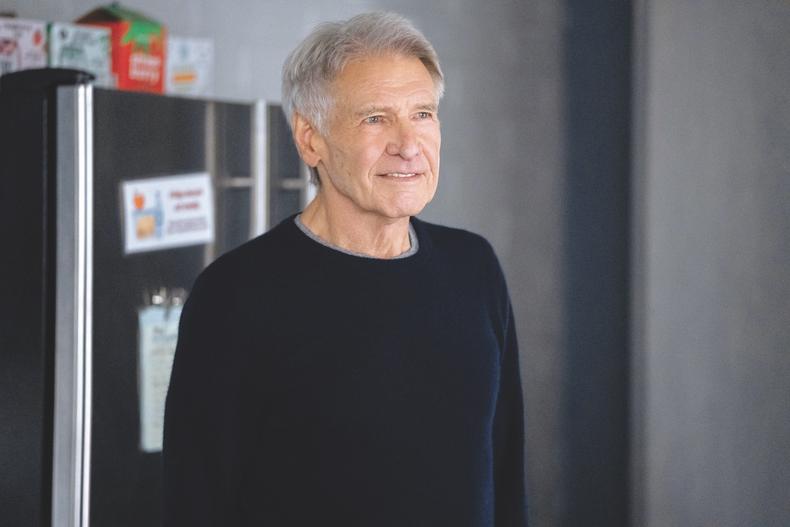
Harrison Ford on “Shrinking” Courtesy Apple TV
“As a carpenter, I learned that you have to get a square, solid foundation, and then you put a brick on a fucking brick on a brick. But you don’t decorate before you have a foundation.”
Just hearing you say “Raiders” makes me think of the vulnerability you put into your characters. It’s probably most prevalent in Indiana Jones, but you see it all the way up through Paul in “Shrinking.” Why is that important to you?
It reads as spontaneity for the audience. It helps them feel like they’re in the room where it’s happening. Every character is a recipe, specifically designed to focus on an argument. Basically, it’s a syllogistic construction. This led to this, led to this, led to that. Vulnerability to whatever degree is human. It can be hidden. It can come in different ways. But it’s just a characteristic of human interaction. The script will tell me whether there’s vulnerability in the man and specifically where it should appear.
I don’t specifically seek out an attractive aspect for a character. He may be an asshole, like Allie Fox [in Peter Weir’s “The Mosquito Coast”]. Was Allie Fox vulnerable? Fucking A, he was vulnerable. Then Tom Clancy’s [Jack Ryan] has a different kind of vulnerability under different circumstances. He’s vulnerable when he goes to visit James Earl Jones, his mentor, who’s going to die. You see his vulnerability there.
You’re making something. As a carpenter, I learned that you have to get a square, solid foundation, and then you put a brick on a fucking brick on a brick. But you don’t decorate before you have a foundation.
That’s a really clean metaphor.
Carrie Fisher made me these two magnetic signs that you could stick on the side of your pickup truck. One of them says “Famous Actor School of Carpentry,” and the other says “Famous Carpenter School of Acting.”
You already mentioned a few of your collaborators: George Lucas, Steven Spielberg, Peter Weir, and there’s also Francis Ford Coppola, Mike Nichols…
I mean, come on. I just happened to be the right age at the right time.
I think you can give yourself some credit.
It was the height of the movie business! That’s what I’m talking about. The opportunities were enormous. The connection between society and the zeitgeist was running both ways. It was a magical time for the movie business. The guys that were doing it were literary people. They understood storytelling and writing. They were serious people. I’m not saying we don’t have them now. We do, in droves, and they’re wonderful. But it was a different kind of thing.
I was going to ask, because there have been headlines comparing that time to now, not only because of studios combining and the rise of streaming, but also because there’ve been movies like “Obsession” and “Backrooms,” both made by wunderkind filmmakers and doing so well. As someone who was there, do you get that sense? Is it even possible to recreate that period?
I don’t think it has to be [the same]. You don’t go back and try to do something that has already happened. You just make the best use of what circumstances are currently available. There’s wonderful work being done. The quality of writing in streaming is really significant. The opportunity in streaming to build a character over a period of time is significant. There are fantastic actors. There’s been so much material developed that I think it’s pretty overwhelming, but it does mean work for a lot of people that are enormously talented. I think there’s probably way more talent on the performer side than there was back in my heyday. But I don’t think about this shit. I’m just making stuff up.
You brought attention to a pretty relevant topic when you praised Troy Baker’s voice performance in “Indiana Jones and the Great Circle,” saying “and it didn’t take AI to do it.” As someone who is so iconic in look and voice and character, do you have any concerns about AI?
I don’t know enough about it, and I don’t know what will constrain it. What social or business circumstances are going to constrain it? But I don’t really care enough about legacy to worry about it. [Laughs] What goes on after I’m dead is not my business.
Obviously, there are real issues, and people are seriously investigating those issues. I’ve only really experienced a taste of it in the last “Indiana Jones,” in which I was de-aged at the beginning of the movie. But that was a very different process of AI. They had, in Lucasfilm’s vaults, every possible aspect of my physiognomy captured through 20, 30 years of aging. They were able to reference those moments and use that as the base for what they were building. So it was all real, in a way, and was effective. Other times I’ve seen it as not so successful, but that’s an aesthetic judgment.
What do actors owe other actors?
Different every time. The person is only part of the picture. The circumstances are the other part. The material is the other part. It’s like building a structure and then going in, deciding where the furniture should be, whether we should decorate or just leave it plain, whether we need to let the light in or not. You do for another actor what you think will help them do their best. You get into a scene, and no matter the experience of the person you’re working with, they are as important as you may think you are. They may think they’re a bit part actor or whatever. But in that moment, for you to be good, it has to be good for them. So you owe whatever it is that will help them do their best work.
Everybody’s worked with somebody that’s competitive and wants to fuck with you. But I think you want to make people as comfortable and as engaged as possible. Allow them to understand that we’re there for them and they’re here for us. You just have to fucking be nice.
This story originally appeared in the Aug. 17 issue of Backstage Magazine.