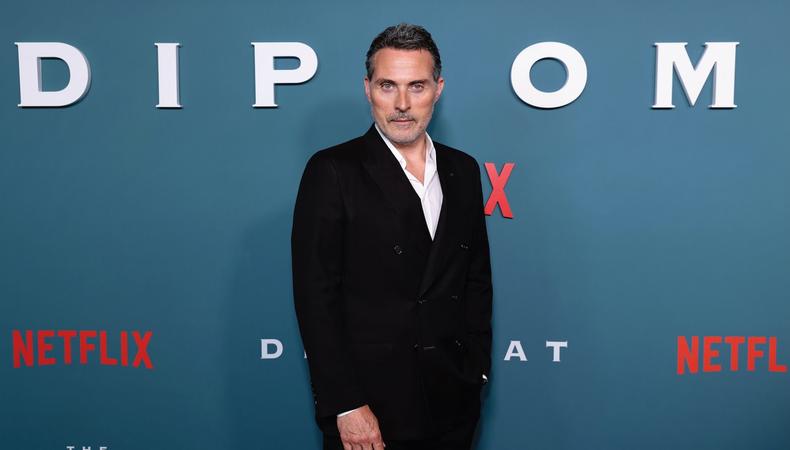
Rufus Sewell has spent more than three decades playing charming cads, kings, and complicated men—but it’s silver-tongued political operator Hal Wyler on Netflix’s “The Diplomat” that just earned him his first lead actor Emmy nomination. The nod is his second overall, following a 2019 guest actor nomination for “The Marvelous Mrs. Maisel.” Here, Sewell shares why he never second-guesses a first read and what a doughnut has to do with diplomacy.
What does the Emmy nomination mean to you at this point in the show’s life?
It came as a surprise—they say expectation is the thief of joy. There are certain roles you think, if you do them right, they won’t necessarily get noticed. I’ve trained myself to have no expectations and to have my own way of evaluating my work. Nevertheless, when I got yanked out of the shower by my wife after hearing a worrying yelp, I was delighted once it actually sunk in. It’s also great for the show. It was fabulous when Keri [Russell] won [her Actor Award]; the audience is growing, the appreciation is growing. I’m very happy.
What sparked when you read the pilot? Does that initial response still inform how you portray Hal?
It’s like a first impression: It’s not everything, but it’s never nothing. What am I feeling when I read this? What makes me go, I want to do this? Then you try not to get in the way of that. For me, the way in was those early scenes between Kate and Hal, where they’re just hanging out, and you get the strong sense they’ve been together for a long time—a little bit of love taken for granted, a little bit of comic contempt. They live on their wits: double meanings, insults. That’s very hard to pull off without it being self-conscious. A kind of naturalistic screwball is a style that’s attempted and failed at quite often.

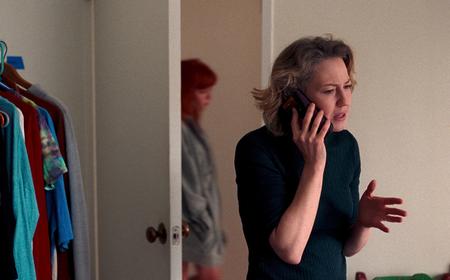
Rufus Sewell on “The Diplomat” Courtesy Netflix
Hal made choices this season that might look a bit villainous. How do you play that while protecting his internal logic?
The stakes are so much higher now. Easy decisions don’t make it to the president’s desk. The end of Season 3 is very much from Kate’s perspective, and it sets things up looking pretty black and white. But with Debora Cahn’s writing, if you continue to watch, more will be revealed. I needed to know for myself: What are the reasons you would do this, and what would happen if you didn’t? Kate is a similar kind of creature—they’re bonded because they both have a killer in them. Hal’s belief has always been that access is the most important thing. Your aims can be 100% pure as snow; but if you’re not in the room to influence outcomes, it’s worthless. So what compromises are you prepared to make to get in the room?
Is it hard to master the diplomatic jargon Hal wields so adeptly?
I don’t have as much as Keri—she has all the acronyms. Luckily, she’s doing all of that, and I just nip in, steal a doughnut, do something naughty, and leave. But when I do have it, it’s a bit of a panic, because you have to get past proficient to second nature, third nature, fourth nature. These people have been using these phrases since their teens. It’s not about getting the language—it’s about getting past the language. I struggle, to be honest.
What’s your best advice for people who are just getting started?
Don’t take anyone else’s descriptions of the world—use your own. When someone says, “Sadness is this, happiness is this,” fuck that. All you have is this, so use that. The wonk you have, the different take you have, is what you have to offer—the way you see the world, the way you respond to material. And then read everything you can.
This story originally appeared in the Aug. 17 issue of Backstage Magazine.