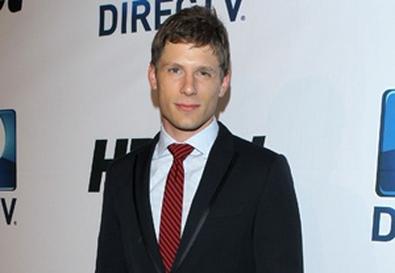
Photo Source: Michael Tran
Lauria got his start at the University of North Carolina School of the Arts, graduating in 2007 after studying in the classical theater training program. A Los Angeles showcase his class put on for agents and managers led him west, but it wasn't an easy decision to make. To him, New York's theater community molded actors. "I wanted to get out of school and have an opportunity to work in theater with actors in their 50s, 60s, 70s and learn my craft and sharpen my craft onstage with them," says Lauria, whose father is an animator. Believing that he would get this start by doing theater and slowly move into television and film, Lauria didn't foresee his journey beginning the way it did. "It kind of threw off my expectations," he confesses.
His first prime-time TV gig was NBC's "30 Rock," and the job fell on his first wedding anniversary. "I had auditioned on a Friday or on Thursday and I got the call Sunday that I had booked the job for '30 Rock.' I was flying back [to New York] on Monday and had to shoot Tuesday," Lauria recalls. When he arrived in the Big Apple after 90 minutes on a bus and two trains, Lauria scarfed down "two Egg McCheesers on the way" because he had never heard of craft services. Adding to his uneasiness were last-minute script changes that included a shirtless scene and working alongside veteran actors on his first job. "At some point, Alec Baldwin goes, 'So, do you model or something?' " Lauria says of his experience. "And I was like, 'No man, I'm an actor. I'm a trained actor!' I kept screwing up my lines and he says, 'Come on, kid, you got a long career ahead of you. You gotta get this!' "
And Lauria did, gradually. "It was that one job on '30 Rock' that let me get my feet wet," he says. Lauria then snagged a recurring role, as Roy Merritt, on NBC's "Lipstick Jungle." After auditioning for director Timothy Busfield, the producers fought for him after the network hesitated because of his "newcomer" status. "The casting [people] said, 'You already cast him in "30 Rock," remember?' " Lauria reminisces.
Though "Lipstick Jungle" was his first regular role, his big break didn't come until "Friday Night Lights," also from NBC. Lauria, who had signed with a new manager, had an eventful pilot season in early 2009. But after testing for a project that didn't come through and walking away from another, his career stalled. Yet this didn't deter him. "In this business, if you have some kind of spiritual foundation for life, it's invaluable. There's a lot of rejection or disappointment, and I never feel that because I always feel like I'm going to have exactly what I need to do," Lauria says.
He credits his positive outlook, and never giving in to desperation, with getting him over the hump—along with some luck. "If I would have freaked and tried to get something earlier or made compromises and tried to get something else, I never ever would have had a chance to get 'Friday Night Lights,' " Lauria says. A summer passed without any employment, and by that point he was searching for jobs on Craigslist. A few days after he had that moment of clarity, Lauria booked the gig and began filming in August.
Smooth Sailing
Lauria entered a series that by its fourth season operated like a well-oiled machine. "Kyle [Chandler] gave a little speech about preserving the integrity of the piece and how special it was. He also mentioned that it would be the best job that we would ever have," Lauria says with a laugh. It was during hiatus between the fourth and fifth seasons—NBC gave its approval for Lauria to pursue other projects after rumors surfaced that Season 5 would be its last—that his next opportunity struck.
The creative team behind "The Chicago Code," then called "Ride-Along," had already gone through a series of casting sessions by the time Lauria came in. Director Charles McDougall remembered him from a test he did for "The Good Wife," and creator Shawn Ryan was familiar with his work on "Friday Night Lights." Lauria auditioned for two roles: Caleb, the young sidekick to Jason Clarke's unaffected Jarek, and Liam, an Irish undercover cop. "I auditioned for Caleb, and I said, 'Can I audition for Liam too?' " he says. It wasn't a random request; Lauria grew up in Ireland. He ended up with the role of Caleb; Liam is played by Billy Lush.
Going from "Friday Night Lights," where handheld cameras were used, to "The Chicago Code," which is more traditional in scope, was a drastic change. "You get these big, gorgeous cinematic shots that look like a movie. We've got explosions and I'm firing guns," he says, laughing. Working with Clarke has been eye-opening, and Lauria has learned to embrace imperfections. "Jason has really impressed upon me, 'Let it be awkward. Let it be uncomfortable. Allow yourself to have the danger of existing in that moment of discomfort.' There's going to be that one time where something really special is happening because it's truthful, totally unexpected, totally unguarded and that's where the jewels come from," Lauria says.
So does he liken himself to Luke Cafferty of "Friday Night Lights," a well-behaved Texas football player, or Caleb? "They're good guys. They're really sincerely good guys that want to make the right choices," Lauria says. "Caleb is more cerebral and Luke maybe holds things inside a little bit more." He emphasizes that it's difficult to play someone he has no affection for. "There's some part of them that I think is either like me or that I would aspire to be like, that inspires me enough to want to serve the character, tell their story," Lauria says.
It's possible to count his roles on one hand, but it's the quality that's more important than the quantity. He says candidly, "There's a lot of crap out there, either on the news or on television or day-to-day, and hopefully you can bring something to the table that's going to uplift or inspire and not add to the crap heap."
When asked to provide advice for aspiring actors, Lauria begins to dole out wisdom before stopping himself. "Know what effect you want to have in your art or whatever gift you have," he ultimately says. "As long as you measure every choice that you make in your career against how it's adding up to what you really, really want and what you really hope to do with your gifts, then I think you're going to stay on track."