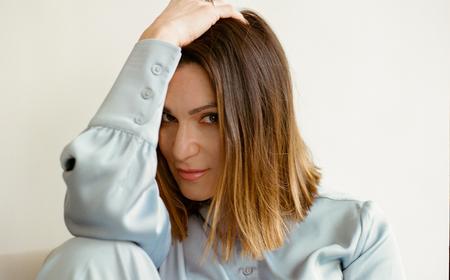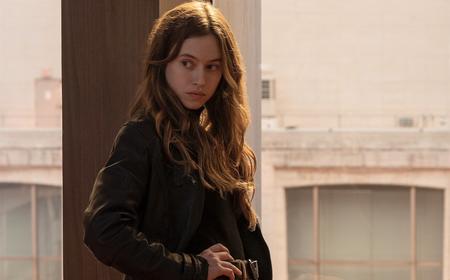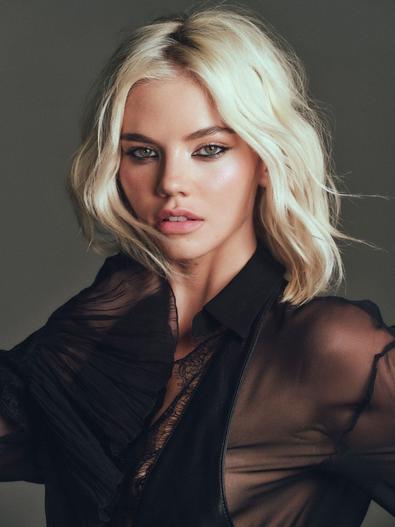
Hayes Warner first made her name in music as a New York pop singer with a rock edge, millions of streams, and a Lollapalooza performance. Now she’s making her screen-acting debut as Debbie Schaffer on “The Shards,” the Ryan Murphy and Bret Easton Ellis FX adaptation of Ellis’ 2023 novel, premiering Aug. 5. Set in 1980s Los Angeles, the series follows a group of privileged prep school students whose gilded lives curdle when a serial killer closes in. Warner co-stars with Graham Campbell, Kaia Gerber, Homer Gere, and Igby Rigney. Here, she reflects on pursuing a dream role, learning a new craft on the job, and being a multihyphenate.
For my final callback, I taped a black bedsheet to the wall of a Best Western in Midland, Texas, propped up a ring light, and had my dad read Liz Schaffer’s lines while I auditioned for the part I’d been chasing for seven months. I was on a music tour at the time. The next day, the call came: Move to Los Angeles in two weeks, we start shooting, the role is yours. I left the tour. It was the best day of my life.
Let me back up. I’d read “The Shards” front to back more times than I can count—I highlighted the entire book—and I’ve been a fan of Ryan Murphy for years. When I heard he was adapting the novel for FX, I called my agent and asked whether there was any way to get an audition. Just landing that audition felt like a celebration. I filmed the first self-tape in our kitchen with my dad and a ring light.
A few weeks later, I learned that Ryan wanted to meet me in New York. Then FX flew a group of us to Los Angeles for a screen test. When I walked in and saw a room full of gorgeous, blond actors who’d already starred in shows and films I loved, I thought, I’m done. None of us booked it that day, though Graham, Homer, and Igby were cast. Everyone who’d read for Debbie went out for drinks afterward, and the refrain was the same: It wasn’t meant to be. But I couldn’t accept that. Debbie was my dream role.
During the screen test, my nerves got the better of me. Ryan gave me a note, but I didn’t fully understand it, and I was too anxious to ask him to explain. So afterward, I did something impulsive: I wrote him a letter. I thanked him for his time, told him how deeply I connected with Debbie and how I read her, admitted that my nerves had kept me from asking about his note, and asked for one more chance to get it right. I sent the letter and heard nothing back.
Then, while I was on tour in August, word came that Ryan wanted to see me again. That’s how I wound up in that Best Western in Midland with a bedsheet and my dad. A month into shooting, Ryan sent me a note of his own: He was glad they’d cast me, and he told me to keep standing up for myself.
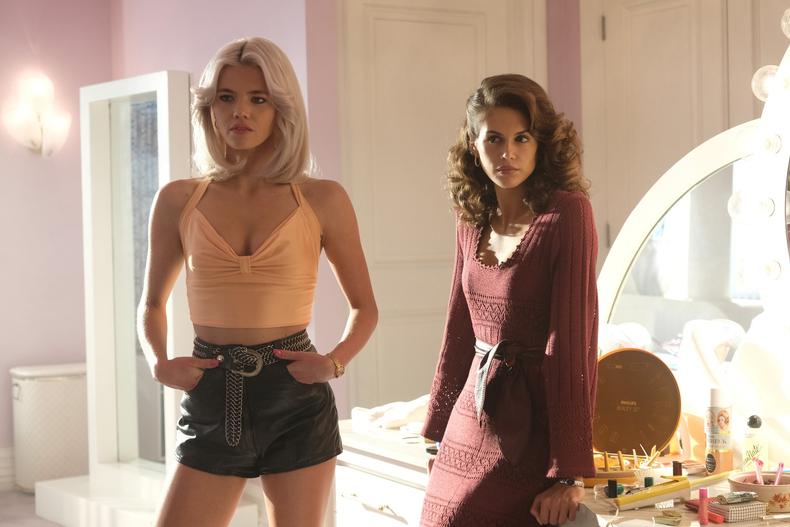
Hayes Warner and Kaia Gerber on “The Shards” Credit: Ray Mickshaw/FX
Learning a new craft on the job
I grew up doing theater and studied musical theater in college, so performing wasn’t new to me. Screen acting was. Most of what I know I picked up as I went, starting with how a set even runs.
Being a musician turned out to be more useful than I expected. Onstage, I’ve learned not to overthink what people make of me. I can prep endlessly—the setlist, what I’ll say between songs—but the second I’m up there, so much unfolds live. Someone shouts from the crowd, and I’m improvising; the room feels flat, and I have to adjust. That instinct carried straight over. I’d prepare a scene as much as I wanted, then get a fresh direction from Ryan or find it wasn’t landing the way I’d imagined with my scene partner, and I’d switch it up on the spot.
It helped that we often got scripts close to when we shot them, with no time to overanalyze. We filmed out of order, and we never knew what was coming next; we didn’t even know who the killer was. That kept me present. Watching the episodes now, I can pinpoint the early days when I was panicking and the moment things started locking into place. I’m still proud of those first episodes; you can see me learning in real time.
Getting to know Debbie
What drew me to Debbie is that the series lets you see her beyond Bret’s point of view. While reading the book, I kept thinking, He sees her this way, but there’s so much more going on. She isn’t shallow. She’s navigating a complicated home life and a lot of survival mechanisms, and you get her relationships with her mother and father up close. Those family scenes were the hardest to shoot, because they explain why Debbie is who she is, and I wanted to do them justice. The scenes with my friends—Graham, Kaia, Igby, and me around a table—clicked easily, because we’re all best friends in real life. The family material asked me to dig deeper and get more grounded.
To find Debbie, I studied the early ’80s—what was happening in the world, what that life looked like—and I watched films from and about the era, like “The Breakfast Club.” Music was my No. 1 route in. During an early callback, Igby sent me the playlist of songs that appear in “The Shards,” and the moment I heard “Vienna” by Ultravox, something clicked. On set, I kept my wired headphones in constantly (everyone teased me about it), pairing whatever I was hearing with the energy of the scene.
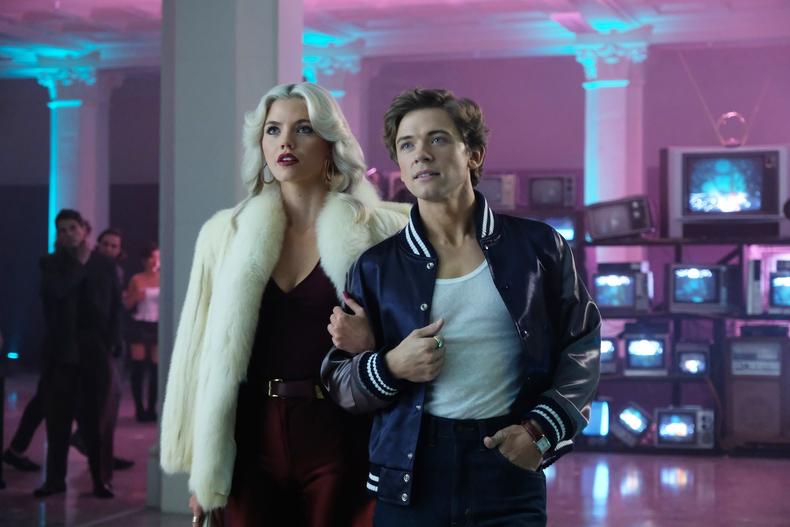
Hayes Warner and Igby Rigney on “The Shards” Credit: Ray Mickshaw/FX
Some of the work I’m proudest of came from simply reacting to my scene partners. Playing opposite Evan Rachel Wood and Wes Bentley, who play Debbie’s parents, was surreal. Evan would appear on set at 4 a.m. in a fur coat, offer one perfect line of advice, and seem to evaporate like a wizard. Wes was the kindest; we’d rehearse together beforehand so I felt ready. When I stopped planning and just responded to what they handed me, the scenes turned easy, because they’re so good.
Debbie also asks a lot of an actor, and some of that meant working closely with our intimacy coordinator, Sasha Smith, who choreographed those scenes like a dance and made sure we always knew exactly what we were doing. It helped enormously that Igby, my scene partner for much of it, is one of my best friends: respectful, careful, and generous. We’d talk through what we wanted each scene to accomplish, and because everyone on set felt like family, I felt safe enough to stay focused on the story.
What music gave me
Part of why Debbie resonated with me is that her energy draws from the artists who inspire me onstage. Debbie carries herself with that kind of confidence, a little swagger, and in those moments I could tap straight into my stage persona. There’s a real gap between who I am onstage and who I am in daily life, and I know how to click into it fast. Then came the scenes where I had to release all of that and just be vulnerable and present. Having both gears made the whole thing a blast.
Why I won’t choose just one path
People keep asking whether I’ll lean toward music or acting from here, and my answer is both. I’ve been proving to myself that it’s possible: During our eight-month shoot, I kept writing, and I have two songs I wrote for “The Shards” on the track list, alongside Troye Sivan, who has long been an inspiration. I have a lot of new music on the way; I’m auditioning for other projects, and if we get a second season, I’d do this for the rest of my life.
If I could offer one piece of advice—the same advice I’d give my younger self—it’s that rejection is redirection. It sounds cheesy, but you have to stay a little relentless about wanting it. Reaching out to Ryan when everyone told me it was over is the reason I’m here. All those noes, all those tour vans, all those years of wanting it—let them push you forward instead of talking you out of it. I don’t believe in luck. I believe in hard work and timing. So keep going.
This essay is by Warner, as told to Suzy Woltmann.