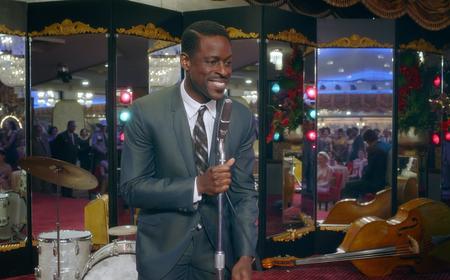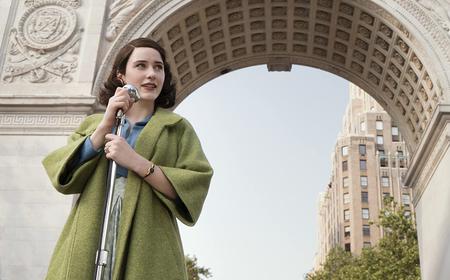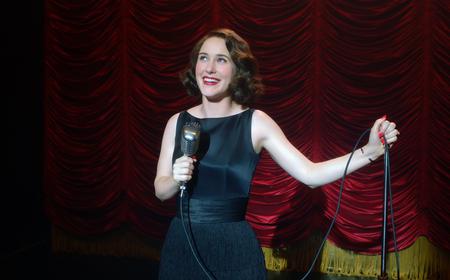
According to production designer Bill Groom, experience is something that most certainly improves with age. Groom is in the midst of a career boom that has seen him contribute his skills to projects ranging from “Boardwalk Empire” to “The Marvelous Mrs. Maisel” and at 70-years-old, he feels as though he has never been in a more fulfilling position.
Talking to Backstage, Groom shares why careers in the entertainment industry are rarely linear and how he tackles the process of turning present-day New York City into the 1950s version seen in “Maisel.”
What does a production designer do?
I’m responsible for the physical look of the movie or TV show, as opposed to the photographic look, which would be the responsibility of the director of photography. So I’m responsible for everything the actor sits on, sits in front of, picks up and holds—the physical environment [of the piece].
How did you become a production designer?
I was an art major and [then] got my master’s degree in theater design from Tulane. From there, I started teaching. I managed to make the step from teaching into professional work and my first real job in New York was as an art director at “Saturday Night Live.” I went in and met with Eugene Lee—who’s still the production designer there. Eugene is kind of a genius designer but [he] had a habit of taking on more jobs than he could do. So he was doing a PBS series [“Life on the Mississippi”] and really didn't have time to do it and sort of handed it off to me. I used to work with a producer who always said: these careers aren’t linear. My career hadn’t really taken off (if you want to use that term) until I turned 60. I’ll be 70 this year and my career has never been better. So if you just kind of hang in there, don’t give up, believe in what you’re doing and be patient, [you’ll] get where you want to be.
 8 of the Best Production Design Training Programs
 How do you find jobs?
[“Maisel”] came through my agent. And then, as it turns out, Amy [Sherman-Palladino] and Dan [Palladino], the showrunners, are my neighbors in Brooklyn. I was originally hired to do the pilot and we didn’t know where it would go from there. And then it’s just turned out to be such a success.
What is a typical day like in the life of a production designer?
There’s no typical day and there’s no typical project, either. There are certain things that are always the same and you know how to deal with [them]—or you think you do—and there are certain things that are always the same that are really unpleasant. But that’s one of the things I love about the business is that you’re always working with a different group of people, very often with people you’ve worked with before but it’s a different combination.
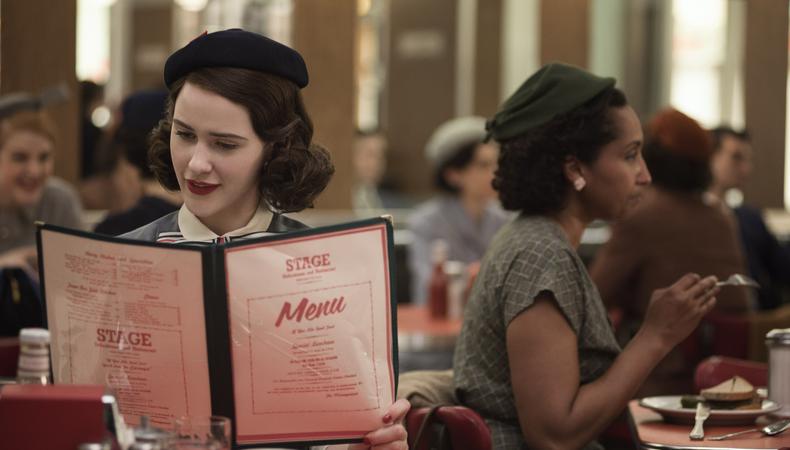
You always start with the script—that’s where the whole thing begins. I like to get a broader sense of what the script is and what the story is, then dig into some of the details of the research. Location scouting is important as well. Occasionally there are productions that are all done on a stage and every element is created without any real existing environments involved. But most of the time, and certainly with “Maisel,” we’re doing location scouting, to find locations that fit the story. [You] start to see where you have locations that work for the story, what you need to build to add to those locations or what you need to take away from those locations that may be too modern.
“I’ll be 70 this year and my career has never been better. So if you just kind of hang in there, don’t give up, believe in what you’re doing and be patient, [you’ll] get where you want to be. ”
On “Maisel,” we cover a lot of ground, more than many TV shows, just in terms of the number of locations [and] the number of sets that have to be ready. It’s a lot of work in a short period of time. The period aspect is always a challenge. Finding a period environment [that] creates a context for the characters, the story, the emotion.
Obviously, [I collaborate] with the director and the creator of the show, but I [also] work very closely with the location manager. Once we get closer to shooting, I work with the director of photography [and] costume designer. Visual effects is certainly one that I work very closely with. We have a great visual effects supervisor and we’ll stand at a location and I’ll say, “should we build this storefront or can you take care of that?” There might be times when there’s something that involves the sound department [and] the grip department, doing all the rigging and the platforming.
What advice would you give an aspiring production designer?
Just to be open to everything. Be open to things that come your way. I think it’s probably a mistake in this kind of business to be too determined to do one particular thing. I think you have to be open to what's available to you and make it yours.
For more on how to get work on a film crew, visit Backstage’s crew hub!