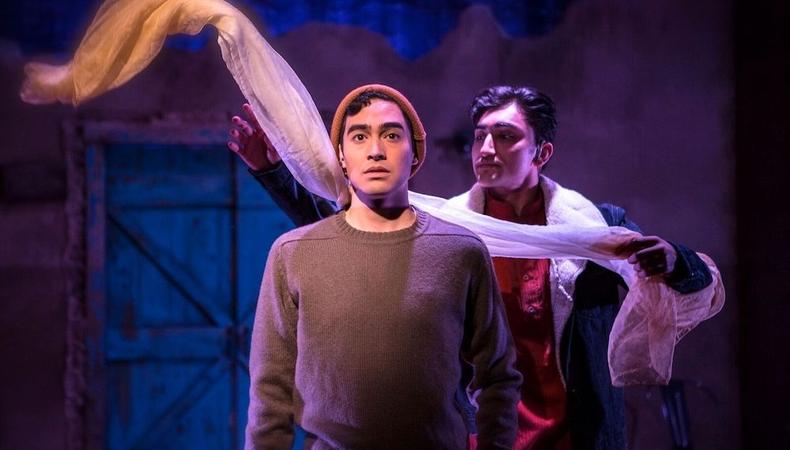
Though spring in New York is no stranger to new musicals, the one currently playing at the Abingdon Theatre Company is unlike anything this city has seen before. Yes, “The Boy Who Danced on Air” is a love story, but it’s one that takes place in rural Afghanistan. And it’s set against the backdrop of bacha bazi, an ancient tradition of wealthy men taking in boys from poor families, training them to dance, and often sexually abusing them. And it also features a subplot about an American power plant. Oh, and it’s also Abingdon’s first musical ever.
So yes, its central theme is well-trod in musical theater, but it’s also completely unlike any other musical.
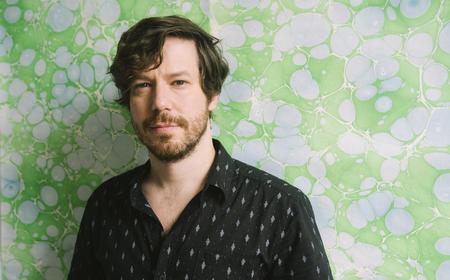
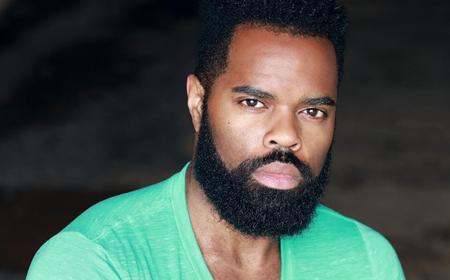
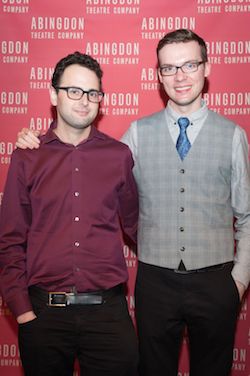
Behind this utterly unique story? Tim Rosser (composer) and Charlie Sohne (book writer and lyricist), whose compulsive DVR habits inspired what became the 2015 Jonathan Larson Award-winning musical.
As the show enters its final week in New York, Rosser and Sohne chatted with Backstage about their writing process, how they dealt with such a morally complex story, and the musicals every actor should see.
 Tell us about “The Boy Who Danced on Air.”
Sohne: “The Boy Who Danced on Air” is a love story that takes place in rural Afghanistan and it’s set against the backdrop of bacha bazi, where wealthy older men take in younger boys from poorer families and they train them to dance and they parade them around at these parties, and very often, the men sexually abuse the boys. But our show at its core is a love story between these two boys, Paiman and Feda, [as they] start reaching the age where they’re growing out of the practice and have to find a way to carve out space for themselves and begin to sort of discover their identity.
What was the inspiration for the show?
S: I went through a period where I was obsessively DVR’ing “Frontline” episodes on PBS and I came across this documentary called “The Dancing Boys of Afghanistan.” I still remember the feeling how destabilizing it was. I didn’t know anything about bacha bazi, I didn’t actually know a ton about Afghanistan and I think I was like a lot of Americans in that a lot of what I did know was just sort of directly to the U.S. involvement there. So learning about the practice immediately complicated my ideas about so much of what I thought. And the documentary really just stuck with me.
At the time, I was like, ‘I really want to write something about this. Too bad I’m a musical theater writer, this would probably make a really good play.’ And I kept thinking about it and the more I thought about it, it kind of seemed like it needed to be a musical. There’s so much about music and dance inherent to the world and central to what’s going on that music would have to be a part of the story. And when I landed on the idea that it should be a love story between these two dancing boys, that’s when I started to see it as a musical.
Rosser: Charlie brought the idea to me. He showed me the documentary and I too was very shocked and I found it very thought-provoking. And when he said he wanted to turn it into a musical or use the practice as the basis for a musical, I was very hesitant to do it. I didn’t know much about the music of Afghanistan, and it’s a tall order to go from knowing next to nothing to trying to write a score that’s influenced by that style. And also I couldn't imagine how this story would translate to the stage until later when Charlie actually wrote up the treatment of the story…. Reading it, I was like, ‘Oh, there’s something that makes so much sense about this as a musical. The story feels like it wants to sing in certain places and there’s already a lot of dance inherent to the story so maybe we should give this a shot.’
S: A big key for both of us was when we started realizing that one thing we would want to do is bring the audience very close to the characters and bridge the gap of distance that a Western audience would feel coming to the theater and watching a practice like this. So that’s really when the power of song and what musical theater can do became essential. I think there’s so much about why those of us who write musicals that come from this idea that song allows us to connect with people who are different than us because it’s a universal notion and doing that with this material felt like something that was the right thing to do.
READ: 23 Must-Know Musical Theater Audition Terms
Do you think the music makes the morally complex subject matter easier for an audience to handle?
S: I do think there’s an element that—I don’t know if we planned this, but it does work in a certain way—the songs and dancing in the show do make what could be a very dark, complicated piece...it gives it real moments of transcendent hope. One of the things that was very powerful to us about the idea of writing the story of the dancing boys was watching these boys struggle to create a space for themselves in an environment where they don’t have a lot of power. The music and dance in this piece really help with that because you feel the outside stakes in a way you wouldn’t if it was a straight play.
What’s your writing process like?
S: For us, it always starts with the story. In this case, I wrote a short treatment that outlined what the major events in the story would be. Then Tim and I will sit down and talk about where we think the songs are and what we think the songs should be dramatically accomplishing.
R: For me, ideally we have more than just a treatment. I like to see as much of the script as Charlie can get done because it makes such a difference to see how people talk and really understand where they are in the scene when the song gets started versus imagining, ‘Oh, maybe we can get him really mad so he can start the song.’ I think it’s nice to have as much information as possible. And maybe that’s particular to our process because usually, the next step is I’ll write music and basically try to create a piece of music that will support whatever it is that’s supposed to be going on and Charlie is very good at following roadmaps like that, so I’ll send it to him with a couple of explanations about a section I intended to be about a certain thing or where the turn happens. And then Charlie will do his best to write lyrics for the puzzle I’ve presented him.
S: That’s actually my favorite part: getting a melody and listening to it a lot and starting to see a lyric emerge. My friend Kellen Blair, who is an amazing lyricist, I heard him talk about this process once and he called it ‘decoding the map.’ Basically, you listen to the melody a ton of times and you start to hear things—like every time the notes go down, ‘That would be a great place for a joke’ or ‘It’s really expansive here, he’s probably got to talk about where he wants to go next.’ You’re doing is uncovering these clues that the composer has left for you and hopefully, they’re things you’ve talked about beforehand…. So we’ll go through that process where I’ll write the book and Tim will start writing full songs that are sung on neutral syllables. I’ll write a first draft of the lyrics, send it back to Tim, he’ll very often do a second recording so I can hear how the words are sitting on the melody. [Then] we’ll do table reads of the book because we can’t afford to ask singers to learn the music immediately. But we’ll start hearing the book aloud and getting a sense of where the story works and where it doesn’t…. And then what’s amazing is you go through all of that and you get into production and see the show with sets and costumes and everything, and that’s all exciting but you start going, ‘Oh my god, now that I’m watching this in a space, there’s a better way to do this,’ so it’s kind of an exciting process and it’s amazing how much work you do on something up until the moment you see it on stage and once it’s on stage, you only feel like you want to work on it more.

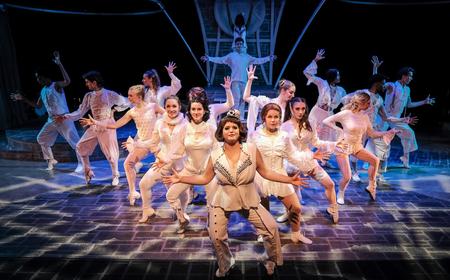
Deven Kolluri, Jonathan Raviv, Nikhil Saboo, and Osh Ghanimah in “The Boy Who Danced on Air” (Maria Baranova)
What advice do you have for creators looking to get their work performed in New York?
S: The great thing about the way things work in New York is there are a lot of organizations that are dedicated to helping you get your material in front of people and on its feet. For us, the big turning point was the National Alliance for Musical Theatre. They do a festival every year where they present 45-minute chunks of eight shows to hundreds of theaters who all fly in for the weekend. That kind of opportunity is exactly the thing a new show needs, particularly to have an organization like that take a risk on a show that is not easy material...I don’t know how we would have gotten to where we are with the show without them. Similarly, organizations like BMI—we both came out of the [BMI Lehman Engel Musical Theatre Workshop] and having that community where you can present your work and where people are looking out and become familiar with your piece is invaluable.
READ: How to Become a Musical Theater Actor
What’s one thing you wish you knew about New York theater before you started?
R: I don’t think I knew quite what an undertaking putting on a musical is for a theater company. I’m actually really glad I didn’t know going into this project, but over the course of this project, it became very clear that to do a musical at all is a huge risk for an institutional theater. And to do a musical that could potentially spark controversy or have people who wouldn’t like it because of the subject matter—that’s a difficult place musical theater is in right now. But I am really glad we didn’t know that and I think for our next project, we’re going to try to forget! [laughs]
In a broad sense, we both knew that getting a musical from page to stage was difficult. But I think at every step we learned just how much it was costing people and how difficult it was. And I think that’s why we got really lucky that we had institutions like Diversionary [Theatre] in San Diego and Abingdon here in New York...At a certain point, the decision was made to just go for it and see what happens. And to come across people like that in an environment that is in certain ways very necessarily conservative, it’s the biggest gift a writer could ever have.
One musical you think every actor should see?
S: I’m going through a very major Kander and Ebb phase right now so I’d have to say “Cabaret.” I think the way that they tell that subject matter and the way that those song moments work is just incredible. It’s a masterclass for anyone who wants to write a musical about subject matter that might be difficult because they found so many inventive and amazing ways to make the music necessary and not drag the story down or take away the things you like in a musical. But it’s these incredibly fun but also deeply ironic moments that both at the same time you find yourself humming along and also, you know, chilled to the bone.
R: Mine might actually be skewed more toward what musical theater writers or composers [should see]. Off the top of my head, I think I’d pick “Ragtime.” Stephen Flaherty found the perfect genre to write an entire musical around. To use ragtime as sort of a starting point for a score that is so wonderfully cohesive but also full of variety at the same time. That’s such a hard thing to accomplish: to write however much musical—an hour’s worth of music—that’s full of surprises and unravels in a wonderful way where everything feels like it should happen the way it happens, but it also doesn’t get boring.
Check out Backstage’s musicals audition listings!