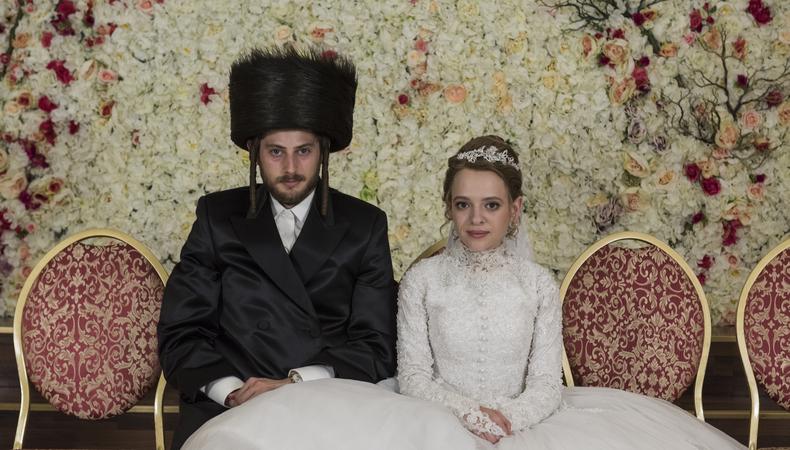
Netflix’s acclaimed miniseries “Unorthodox” follows the experiences of Esty, a young Orthodox woman living in Brooklyn who flees to Berlin to escape her arranged marriage. For costume designer Justine Seymour, the extreme specificity of the show’s costuming needs was both a delight and a challenge.
Speaking to Backstage, Seymour shared her design process for “Unorthodox” from pre-production mood boards to how she and her team cared for the pieces between shoot days and describes how she went about using faux fur to replicate the Satmar community’s shtreimel hats.
What does a costume designer do?
The job of a costume designer is to create a character that is understood on a visual level: to interpret and incorporate all the clues given by the writers [to create] beautiful or ugly costumes that become a physical guide and support the narrative. There are also technical sides to costume design. Each costume needs to work for the scene on a practical level.... It is my job to think of all angles for the clothing to work in the scene while keeping the actor as comfortable as possible.
 How to Get Started in Costume Design
 How did you get into costume design?
I have always loved sewing. I started making clothing for my dolls and toys at around five-years-old. I was making dresses for my younger sister when I was 10 and for myself by the time I was 13. I was fascinated by how the fabrics made me feel. My first job in the world of design was making costumes in London for TV commercials. I had to make a tailored suit, shirt, and tie for a man in a gorilla suit. For some reason, I remember his neck being 37 inches. [That] was one of my first real design challenges. The first feature film that I was head of the department as costume designer was an Australian comedy called “You Can’t Stop the Murders.”
What kind of training does an aspiring costume designer need?
I am an old school designer. My skill-set includes sewing, cutting patterns, dyeing and aging fabrics, altering, and I love to draw. Being a very hands-on designer, I personally needed to know everything I could about how my department works. Having said that, there are many roads that lead to the same destination.
Like any job, you start at the beginning. Time, persistence, and talent are the main ingredients to a successful career in the arts. I was very fortunate in securing a place at the Australian Film, Television and Radio School in Sydney, where only one costume design position is available each year. The facilities and freedom to create at film school was the training that set me on my road, feeding my passion for storytelling and giving me the practical skills I needed. Each journey is a personal journey; if you are driven and passionate about design, you will find your way and you will learn the skills you need to create the stories you want to tell.
What do you look for when hiring your team?
My team is so important: we need to work hand-in-glove for four-to-nine months. I often seek advice and referrals from other designers that have worked in the city I am planning to work in. I look for experience and if I am in a city with few experienced crew [members], then I look for enthusiasm and listening skills. In Berlin, the “Unorthodox” team was great, they were passionate about the project and happy to work very hard to achieve what we needed. I am very grateful to each and everyone for the support and care.
What was a day in your life like on “Unorthodox?”
During pre-production, I will do nearly all the design work for the mood of the show and the main characters. I put together mood boards for each character and then give a design presentation to the creative team. When the design moods are approved, I start the enormous task of finding, buying, and building the wardrobe. Meeting the actors and discussing their character is a wonderfully collaborative process; we work together to find the character.
The costume department works closely with the cast, background actors, and all of the creatives. The script is lovingly called “the Bible” and it is my road map. On set, we work closely with the sound department, camera, hair and makeup, stunt coordinator, 1st and 2nd ADs, and, of course, the director. Filmmaking is hugely interactive and collaborative; we all need to work together, as there are many moving parts to this machine.
 Crew 101: Everything You Need to Know About Getting Your First Job On Set
 The wedding shoot day on “Unorthodox” is an example of a big day on set. The planning for the wedding day took weeks to organize, including a special production meeting for all the departments to strategize getting the coverage in just two days. The main cast costumes were fit during pre-production, allowing my tailor, Matthieu Niemeier, time to alter the costumes, including cutting up and remaking the wedding dress, which I had purchased from eBay. There were 200 Satmar characters to create, who needed to be dressed from head to toe in our costumes. The clothing is so specific, right down to the pantyhose that the women wear.
We shot this scene in the height of Berlin summer, and it just so happened that there was a heatwave. It was really tough on the cast, dancing, and singing all day in a very heavy wardrobe in 100-degree heat. At the end of a 12-hour shoot day, all the actors need to give back the costumes for us to reset for the following day. This includes washing all the undergarments, shirts, and drying all the clothing that was wet through from sweat (this is the underbelly of my department but a very important job). The cast was due back the next day to continue the shoot so everything needed to be perfect to start all over again.
Once we have wrapped, the wardrobe is [usually] stored for around 3 months, allowing for the editing process. If during the editing process they find they need to reshoot a scene, we have the costumes ready and waiting to facilitate the reshoot. After the edit “lock-off,” the production company decides what to do with the clothing. On “Unorthodox,” I asked that the men’s Satmar clothing be donated to the Berlin Theatre Company Wardrobe Department, for other designers to pull from and rent for future productions.
What was the biggest challenge you faced with “Unorthodox”?
The Satmar community has a specific hat called the shtreimel. [It] is worn by the married men in the community, received on the wedding day as a crown. The hat is made from six mink pelts [and] can set you back $1,300 each. I needed 45 of them for the wedding scene. The real shtreimels were not only very expensive, but I was reluctant to contribute to the fur industry. I found the solution was to build these hats from scratch [out of] faux fur. Maria Schrader [director] is friends with Geseke Brandis, who runs the Hamburg Theatre studio workshop. I traveled to Hamburg to have all 45 built by Geseke’s team. With help from Eli Rosen, our Satmar consultant, we came up with the pattern for these huge hats and the studio workshop started building them. The shtreimel challenge took about a month to resolve.
What advice would you give an aspiring costume designer?
The one huge mistake I made was a missed opportunity. I was at a dinner party way back in the 1990s and Sandy Powell [Academy Award-winning costume designer of “The Aviator”] was one of the guests. Being a young designer, I felt intimidated. I will always regret not asking for advice or just chatting about her work. My advice is to be brave, make connections when you can, learn as much as you can [and] be [as] observant as you can.
For more on how to get work on a film crew, visit Backstage’s crew hub!