At the beginning of Act 2 of Sarah Ruhl's Dead Man's Cell Phone, Gordon, the titular deceased character, delivers a comically ironic, coolly moving description of his last morning. Delivered with a dry, almost deadpan wit and a knowing sneer by the sly T. Ryder Smith, the monologue is a sharply observed commentary on our fragmentary, disconnected age. Everyone Gordon passes is on a cell phone, revealing the most intimate details at the top of his or her lungs. On the subway ("a tomb for people's eyes"), he conjectures that people in transit are moving too fast for their souls to catch up with their bodies, making subways and airports very similar to hell. "That's when you bomb them," he concludes. There are further bits of fascinating opinion, including the idea that how people eat their sushi or breakfast cereal reveals their innermost attitudes. It's a wry, fascinating, ultimately shaking five minutes.
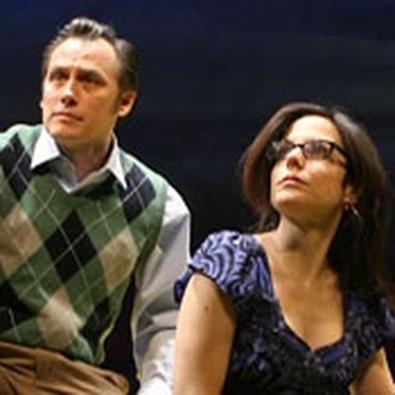
Unfortunately, that's the high point of the play, because Gordon is not the protagonist. That role is taken by Jean, a shy, mousy woman who happens to be dining at the same café when Gordon silently passes away. She answers his cell phone when he fails to pick it up and becomes intimately involved with his dysfunctional family and his criminal business dealings. Jean is a blank slate, seeking an identity through Gordon's abandoned phone. We know almost nothing about her. Indeed, Ruhl has made her so nondescript that not even the magnificent Mary-Louise Parker can bring her to believable life. Parker does manage to make Jean a sympathetic figure, but Ruhl gives her so little to work with that we soon lose interest in Jean's sad little life. And it doesn't help matters that Parker endows Jean with a halting speech pattern reminiscent of Sandy Dennis; instead of revealing character, it just becomes annoying.
In addition, Ruhl ventures too far into crazy Christopher Durang territory -- sending Jean to South Africa on a bizarre clandestine mission and then into a boring existential afterlife. These wacky side trips lessen the impact of the valid and vital views she offers. I loved her thoughts on how digital cameras eliminate the need for memory, while stationery and letters provide permanence because paper is real. But she detracts from these pointed observations with the nutty, ungrounded shenanigans. One can overlap pointed realism with outlandish comedy, but you have to establish characters we care about; Ruhl has missed this step.
Anne Bogart provides a smooth, efficient staging, beautifully lit by Brian H. Scott, and the cast is certainly game. As Gordon's mink-draped mother, the always moving Kathleen Chalfant conveys sorrow and frostiness simultaneously as her funeral oration is interrupted by ringing phones.
It's ironic that the play has individual worthy fragments, as Ruhl's point is that we live in fragmentary times. Bits of information fly through the air and we can only snatch at a few. Dead Man's Cell Phone is as unsatisfying as an overheard conversation: We've only been given part of the story.
Presented by and at Playwrights Horizons,
416 W. 42nd St., NYC.
March 4-23. Tue.-Fri., 8 p.m.; Sat., 2:30 and 8 p.m.; Sun., 2:30 and 7:30 p.m.
(212) 279-4200 or www.ticketcentral.com.
Casting by Alaine Alldaffer.