Actors are no strangers to playing soccer on set. Plays, including “The Red Lion,” “Sing Yer Heart Out for the Lads,” “The Wolves,” “Red Pitch,” the stage play–turned–TV series “Dear England,” and the Andrew Lloyd Webber and Ben Elton musical “The Beautiful Game” are all examples. As are films such as “Offside,” “The Damned United,” and “Bend It Like Beckham.” Those titles are inspiring enough to encourage many of us to don shin guards, jerseys, and cleats, and brush up on our dribbling, juggling, and tackling.
But does the intersection between acting and soccer (or football, as it’s known in the U.K.) run deeper? So it would seem. Many actors play the sport to a decent level before switching track and training to become a professional thesp, suggesting there are transferable skills between the disciplines.
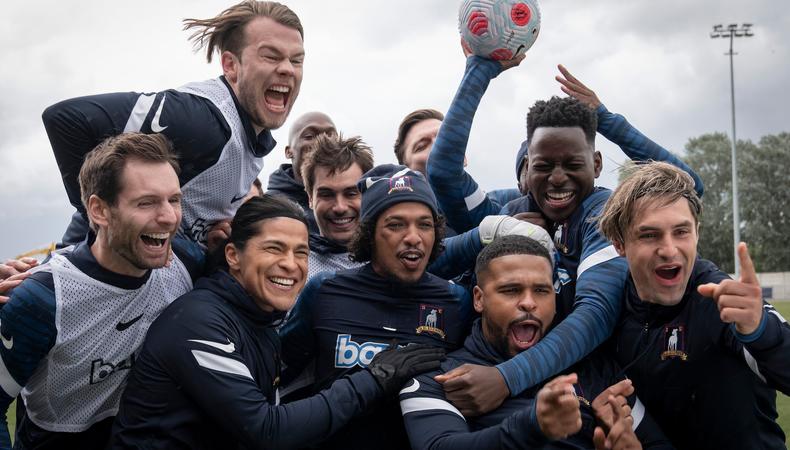
For instance, Kola Bokinni, of “Ted Lasso” fame, trained as a soccer player before portraying Isaac McAdoo in the series. Outside the world of A.F.C. Richmond, Eric Cantona (“AKA”), Sean Connery (the original James Bond), Owen Cooper (“Adolescence”), Lorànt Deutsch (“You Will Be My Son”), Thomas Hanzon (“Faithless”), Vinnie Jones (“Reckless”), Vesa-Matti Loiri (“Pojat”), and Matt Smith (“Doctor Who”) have all enjoyed stints on the long green pitch.
Looking beyond soccer, the WWE’s John Cena (“Bumblebee”) and Dwayne Johnson (“Moana”); martial arts’ Jackie Chan (“Crime Story”); the NFL’s Terry Crews (“Sorry to Bother You”), John David Washington (“BlacKkKlansman”), and Carl Weathers (“Rocky”); bodybuilding’s Arnold Schwarzenegger (“The Terminator”); and diving’s Jason Statham (“Spy”) all made successful transitions from athlete to actor.
Very few actors have traded the screen for the stadium, however. Cristo Fernández—who played Dani Rojas on the first three seasons of “Ted Lasso”—advanced into a league of his own after signing with El Paso Locomotive, a USL Championship team (the second tier in the U.S.’s United Soccer League). But if he’s the first, he may not be the last.
Although we stereotypically divide the jocks and the theater kids, maybe there’s more overlap than we assume.
Theater director James Grieve, a passionate Manchester United supporter who launched the GAME/SHOW podcast specifically to discuss the “surprising similarities between football and theater,” believes the two are “at the very least bedfellows,” if not “with a sizeable overlap in the center of the Venn diagram.” At the surface level, he notes both actors and soccer players have a version of a stage, and both have audiences or spectators who observe from their respective stalls and stands. Both are considered players—performers, who play. And, historically, both spectacles took place in the same arena.
Gene Moyle, a sport, exercise, and performance psychologist—and a proud supporter of Australia’s national women’s soccer team, the Matildas—points to deeper commonalities, such as actors and players of professional sports sharing the demands and pressures of striving to perform at “the ‘pointy’ end of human potential.” It requires individuals “investing significant time and energy working across the mental, physical, and technical aspects of their specific discipline, honing their craft or sport, to be the best they can be at it.” These “significant hours, days, months, and years of learning, practice, and training” culminate in a “single moment in time—a performance happening in real time—that will never happen again in the exact same way.”
Related is how the pursuit of peak performance comes to inform one’s identity. Performance psychologists often observe that actors and athletes alike tend to identify as “an actor” or “an athlete,” rather than “someone who acts” or “someone who plays soccer.” To an extent, this self-identification is helpful, supporting the commitment necessary to succeed in highly competitive domains. But an over-investment in the performer identity—at the cost of the person identity—has been linked to compromised well-being.
Another shared occupational hazard is the social critique and celebrity and fan culture that accompanies performing in the public eye. Actors and soccer players are common targets of mortal idolatry and damnation, receiving both the best and the worst from others in person, in print, and online. To navigate such scrutiny sanely, the ability to focus, to remain tethered to personal values, and to surround oneself with nourishing people and practices becomes mission-critical.
There is a beauty and poignancy to the work of public performance, however. As Grieve says, we appear to have a “deep human need to commune,” and the theater, the cinema, and the stadium are among the few places left that meet that need.
Grieve also notes that acting and athletic performance are narratives—both are inherently dramatic. A soccer match can feature as much triumph and despair as a Shakespearean tragedy, and, as audiences and spectators, we pilgrimage to these places to step outside the hum and hubbub of our everyday lives, and, for two hours, lose ourselves in a story that alternately moves, inspires, challenges, and instructs us.
Both disciplines feature influential mentor figures too. Parents, guardians, and teachers can make or break the participation and performance of budding actors and athletes. Then, at the professional level, casting directors, directors, and producers have significant sway over the success of actors, just as scouts, coaches, and managers do over soccer players.
Moyle adds that both types of performer are constantly “working very closely with others—other athletes and actors, coaches, artistic directors, support staff, production teams—to achieve the best performance or outcome they collectively can…even in individual sports or solo performances.” In many ways, screen and stage acting are as much team sports as soccer.
Still, for all those alluring, intriguing intersections, the two diverge in a few fundamental ways. The first, of course, is that acting is largely a subjective art form.
“You might have two performing artists who are equally matched in their technical, physical, and mental abilities, but the artistic decision-maker might prefer one artist’s look, style, method, or approach better than the other,” Moyle says. That isn’t the case in soccer, where the game “is won based upon the tangible outcome of which team scored the highest number of goals. Whatever way in which the ball gets into the net successfully isn’t important, just that it does. It’s not won on the basis of which team had the best-looking technical execution of kicking the goal.”
Another crucial point of difference is that athletes and, increasingly, their performer counterparts in music, dance, esports, and circus, have psychological skills training, not just technical skills training. Moyle refers to it as “the athlete mindset,” which “recognizes the importance of all the areas that potentially impact [the performer] in their personal and professional lives.”
“This includes personal relationships/social support, finances, career, study/work, and hobbies and other interests,” she says. “Setting goals across each of these areas, which involves thinking and working holistically, is critical to getting the best out of [the performer] and ensuring that their whole environment helps, not hinders, them.”
It may be that last point that most accounts for the pattern of amateur soccer players (and athletes in general) later succeeding as professional actors. In today’s world, talent alone is not enough. In addition to technical skill, actors need to be psychologically skilled. They need to be able to reliably perform at their peak—and stay well in the process—to sustain their performances over time. A background in soccer will not only have prepared them for that, but given them a head start on other actors.
Given that they’re trained to better manage the realities of performing under pressure in the public eye, it’s perhaps not surprising that performers from the pitch have found success in the picture house.
Season 4 of “Ted Lasso” is streaming on Apple TV+. For more from the “Ted Lasso” universe, check out our interviews with Fernández, Brett Goldstein (Roy Kent), Juno Temple (Keeley Jones), Hannah Waddingham (Rebecca Welton), and Theo Park (the series’ casting director). We’ve also unpacked the making of the series, advice from the show’s writers, and how to get cast on it.