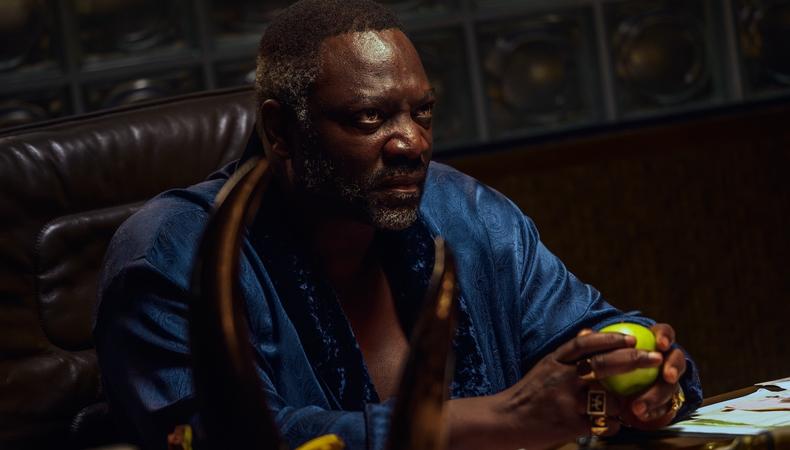
In his breakout role of ruthless prison gang leader Simon Adebisi on “Oz,” Adewale Akinnuoye-Agbaje was at the very forefront of HBO as a TV pioneer. Now, nearly 30 years later, the actor returns to the network to help bid farewell to one of its biggest successes, “Euphoria.” For the third and final season of Sam Levinson’s dark teen drama, Akinnuoye-Agbaje joins the cast as Alamo Brown, a dangerous-yet-magnetic strip club magnate who takes Rue Bennett (Zendaya) under his wing.
Here, we sit down with Akinnuoye-Agbaje to discuss his onscreen evolution since “Oz,” building a unique chemistry with Zendaya, and staying in character as the enigmatic Alamo.
A two-part question: How has everything surrounding the making of an HBO show changed since “Oz”? And how have you changed as an actor?
We were very much on the precipice of HBO as we know it today. There was an excitement, this creative freedom for us to just do what we needed to do. We had great creators and producers—Tom Fontana, of course, and Barry Levinson, the father of Sam Levinson. It was just very innovative. You knew you were doing something special, because it was the first time, and you’re working with such great creatives. Thirty years later, working with Sam on “Euphoria,” obviously it’s a much bigger production. It’s the quintessential Hollywood experience, really. It shows just how far things have come. We’re shooting in Los Angeles, which is a rarity today, in Warner Bros., which is one of our historical institutions in Hollywood, and we’re shooting TV on a specially designed Kodak film stock, designed for film and cinema, 65 mm and 35 mm, which is really unheard of. Back in those days, we shot digital. And here we are, really shooting the full cinematic experience. The scope has gone through the roof.
As an actor: I think it’s just maturity. In that time, I’ve also directed a film, and that’s given me a new appreciation for my career as an actor. It’s certainly an attitude of gratitude, because when you wear so many hats putting a film together—writing, directing, producing, and starring—you just have a lot more gratitude for being able to focus on one character. And I’m just not as precious about the material. I’m actually at a period where I’m really just enjoying the work.
You mentioned that classic Hollywood feel. There’s a lot of Jim Brown, classic Western influence to Alamo. What was the prep that went into that?
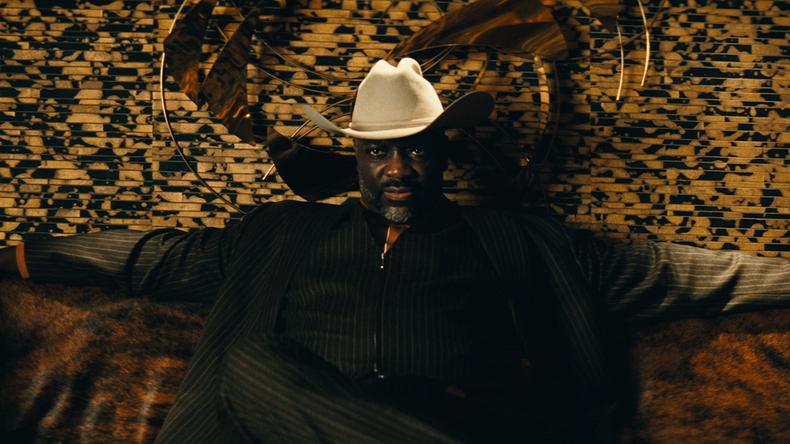
First off, this is the brainchild of our creator, Sam Levinson. He’s lived with not only the vision, but these characters for years. So when I came on board, we had a conversation about what inspired the character of Alamo Brown, and as you rightly pointed out, it really was influenced by the Western iconography of the ’70s and ’80s, and those great films of Sergio Leone. Sam wanted to emulate those films in a contemporary way. In doing that, he also mentioned [performances] that inspired his creation of Alamo Brown, one being the iconic Jim Brown. Woody Strode, Eli Wallach. For me, that research was a dream, because I grew up on those movies, particularly at a time when there were few Black male leads depicted in movies, especially of that caliber. So as a young Black boy living in England, to see Jim Brown or Woody Strode on the screen, it had a big impact on me. It’s probably one of the reasons I got into film.
I drew a lot upon the music of Isaac Hayes, because it just encapsulated the mood. There was an ominous but theatrical side to the music. “Hyperbolicsyllabicsesquedalymistic” was a tune we played constantly on set, and “Do Your Thing.” If there was one theme tune that I would credit to Alamo Brown, it would be “Walk on By” by Isaac Hayes. Every time we went into the makeup trailer, it was [that song] on cue.
Also, researching the term “cowboy,” and knowing that the original term was for Black slaves. Because “boy” was a derogative term given to a slave. Delving into the history of the cowboys, the Black cowboys, it was a whole culture and a real history that is not as well-known as the Hollywood depiction. The Caucasians were called “cow man,” or “herdsman.” To immerse myself in that history and put that into Alamo Brown was really important for me, for him to be rooted in a real cowboy culture and the origins of it.
And, ultimately, learning to ride a horse. I couldn’t play a cowboy authentically without riding a horse. That’s such an intrinsic part of the lifestyle. When all the boots, the buckles, the hat, and everything comes together, it gives you that quintessential cowboy swag that you don’t have to force. When you harness a beast, and you’re out in the wild, you’re sweating, you’ve got your hat on—you just feel like you’re part of that life. There’s something very primal about that, and it was important to have that with Alamo. Yes, he’s got his suits, but he’s a frontiersman.
Courtesy HBO
Much of your screentime and arc is across from Zendaya. How did you get on the same page about how that relationship would play out?
It’s interesting, because obviously I’m coming into the show two seasons down the road. There’s this chemistry and camaraderie among the cast already. I found that very useful, coming in as an outsider. And that’s kind of organic because that’s what Alamo Brown did in the series: He meets them for the first time and is discovering who they are, and they’re exploring each other. Just the way I work, I stay very much in character. Whilst it was really enjoyable to work alongside Zendaya and my cast, there wasn’t an awful lot of social time. I was in character, and I felt it important always to keep them guessing and have that mystery, not really knowing who Alamo was. Nobody needed to know Adewale. The moment I arrived, everybody called me Alamo. It was very important that they did that.
Zendaya was so generous; she embraced that. Our first scene together was quite a funny scene. It still had this ominous threat lurking beneath it, but it was fun. I just knew it was important to be able to authentically make her laugh in that scene. I felt that would break the ice between the characters. Once she saw that, yes, Alamo is threatening, maybe ominous, but has a sense of humor, that chemistry between the characters was born. There’s this almost father-daughter relationship there, even though she works for him. That probably reflects our age group and the generations we’re in in real life. But there is a respect that he has for her, because she’s very smart, and that’s also true in life. [Zendaya] is a very, very, very sharp young woman, so a lot of those things were organic.
There’s a performance choice in your first big scene with Zendaya where Alamo is clacking his rings together. Where does something like that come from?
The wonderful thing about working with Sam is he really gives you creative license to create the character. The character was on the page; it was so beautifully written. But he allows it, as well written as it is, to be a springboard. You as the actor have to come in and breathe life into what is already a great script. So, elements like that, it’s just playing around with things, and that was a choice I made in the moment. When we were doing the accessories and props, Sam didn’t even partake. He just said, “Let Alamo choose his own weapons,” which I thought was beautiful. The three rings and what hand they went on, it was important to me that I choose that, the “A” being in the middle. When I put them on, they naturally clicked, and I liked that sound. I would just do that whilst I was waiting for scenes to be set up. So when that scene started, it was just the natural thing for me to do, and I thought it also created a certain tension.
The climax of Episode 1, where Alamo shoots the apple off Rue’s head, did you actually shoot that up in the hills?
We shot that in Palmdale. It was on a hill, it was at night, and it was freezing cold. [Laughs] It’s the worst day to shoot in a Speedo, with 35-mile-an-hour wind. Fortunately, I didn’t have any lines, because I don’t think they would have come out. My lips were frozen. They give you these things to rub your hands to keep them warm. Well, you could imagine where I put those.
I heard someone say once that most screen acting is pretending you’re either not very cold or not very hot.
They had these heaters stationed just off camera, so every time they said “cut,” I’d run over and hug the heater. Fortunately, it was just a couple of takes. These are things that you do; we all have to brave it. I think that was Sam’s way of digging me: “You want this role? Get up on that hill.”
You’re someone who built an acting career without going through formal training. What’s your advice for performers on a similar path?
There are many paths to the same destination. I would never put down any path. If you choose to go through acting schools, the RADAs… My path was, what I call, the Rough and Dirty Academy, that RADA. I feel very proud of that. I think it has given me a certain rawness that I can convey. The technical stuff you can learn very quickly on a set if you’re attentive. But there are things they can’t teach you in any school. That’s what you learn in life. That’s been my greatest school. Because when they call “action,” that’s what they’re asking for.
For young actors, it’s an exciting time, because with the expansion of digital platforms, there’s such a demand for content, which means a demand for actors. Formerly, the gateway was very streamlined, and not many people from diverse walks of life could necessarily get through. Today, whether you have the money to go to drama school or not, you can pick up a camera. You can write. You and your friends, you can film it. It’s not complicated; it’s hard work. You have to believe in yourself. Use your childhood, your life experiences as your resource. You can have all the technical ability and even talent, but when you want to touch hearts, it’s going to have to come from something that you’ve experienced.
This interview has been edited for clarity and length.