Ambitious academics collect degrees. Keke Palmer, the multihyphenate’s multihyphenate, collects jobs.
So far, the gregarious actor’s 25-year career has included—and this is an incomplete list—childhood stardom, critically acclaimed performances in films like Boots Riley’s “I Love Boosters” and Jordan Peele’s “Nope,” three studio albums, two Emmy Awards, and one bestselling memoir. She’s hosted everything from game shows to “Good Morning America,” played Cinderella on Broadway, and booked Michelle Obama on her podcast. Along the way, she’s also become one of the internet’s main characters, making countless contributions to the cultural lexicon. “Sorry to this man”? That was Keke.
As for her latest job, well, let’s just say that at UCLA, they call her “Professor Palmer.”
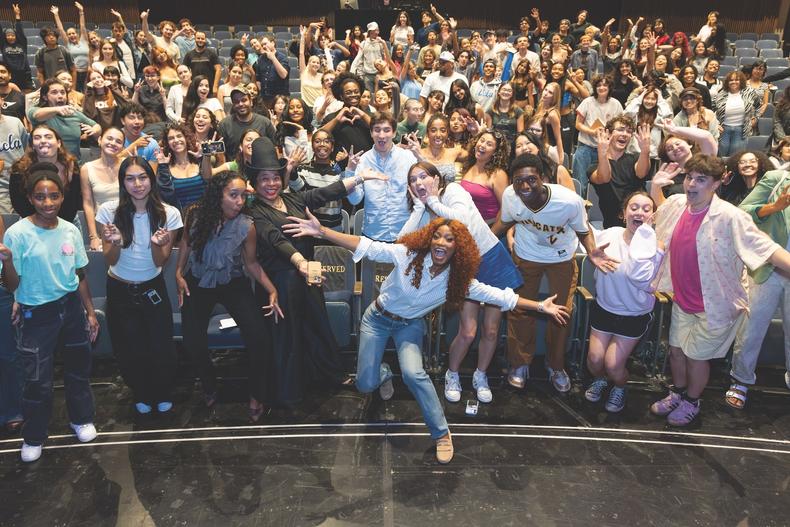
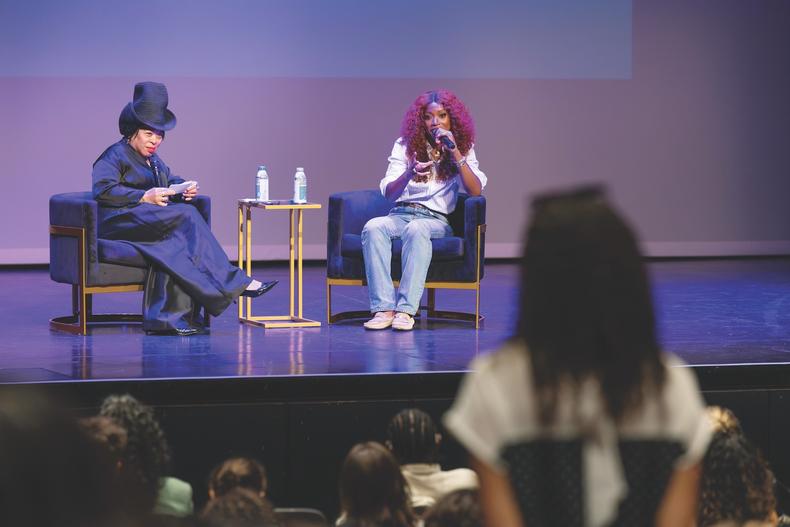
The 33-year-old actor recently kicked off a yearlong stint as the School of Theater, Film and Television’s artist in residence, part of a broader five-year partnership between UCLA and KeyTV Network, Palmer’s media company. Across three sessions—collectively titled “Know Yourself, Own Yourself, Free Yourself to Build New Frameworks for Change”—she’s teaching students how to navigate a creative career the Keke way. The first session was held Oct. 1.
“When she talks about owning your story, she doesn’t talk about it only as self-interest,” says Celine Parreñas Shimizu, the school’s dean and moderator of the sessions. “It’s about what you’re building for other people.”
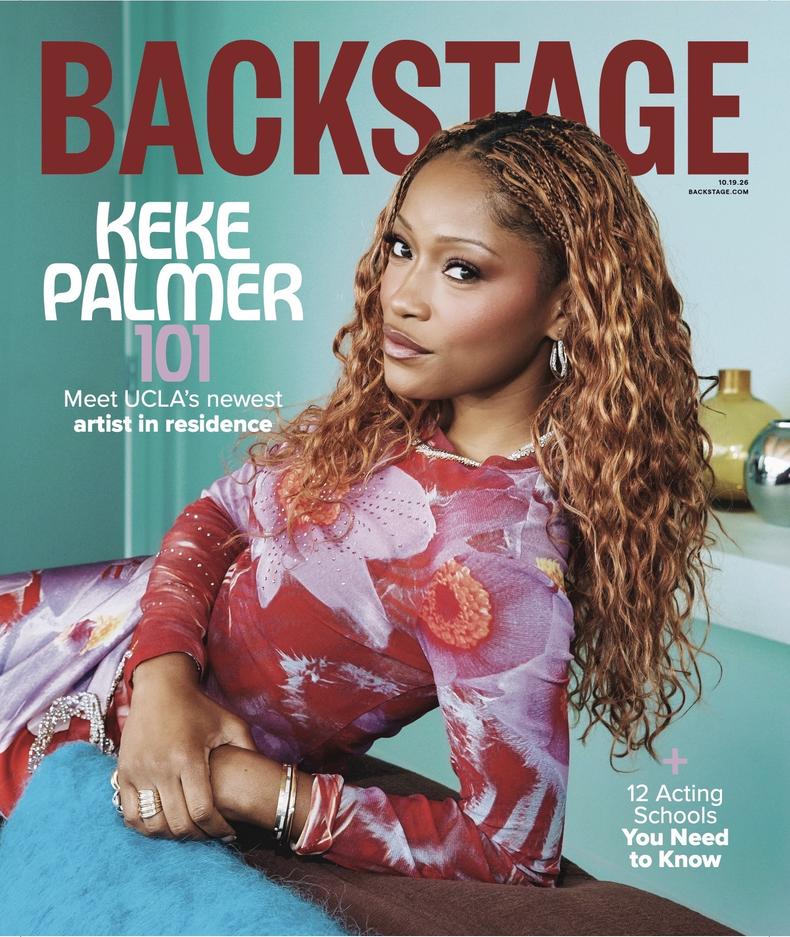 Palmer’s many side quests directly inform the residency’s curriculum. Since she made her film debut at 10, and as her career started spanning multiple industries, she’s often felt her identity and image becoming fragmented—especially in the eyes of others. Along with practical advice and their own personal brand books, UCLA students will walk away with a key Palmer philosophy: Why think of yourself as broken glass when you’re really a disco ball?
“We don’t have to abide by a list of rules,” she says. “We’re redefining constantly what it means to be all the things that we get to be in who we are.”
In the spirit of Palmer’s collegiate era, Backstage asked her to share essential performances and frameworks that shaped her craft. Think of them, gathered here, as the syllabus for Keke Palmer 101—no student ID necessary.
Lesson 1
Intro to Palmerology
Watch an early Palmer performance that built her acting foundation.
Two decades on, the actor’s relationship to “Akeelah and the Bee” continues to evolve. Though not her first mainstream project, director Doug Atchison’s 2006 drama gave Palmer her first lead role and a breakthrough moment. She starred as 11-year-old Akeelah, whose Scripps National Spelling Bee aspirations meet challenges posed by her race and class.
Not many child actors can say their acting teachers included Angela Bassett and Laurence Fishburne. Palmer also absorbed the character’s lessons for herself: the power of words to give life meaning, the ability to articulate her thoughts, a lifelong love of etymology. What can she say? The lady loves a Latin root.
In fact, her UCLA residency’s focus on self-authorship can be traced right back to the film. Like Akeelah, Palmer learned how to fight outside perceptions.
“Doing it at such a young age instilled in me belief systems and practices that still help me to get through difficult times, when I’m challenged with who I think I’m supposed to be, and who I am, and how to redefine myself in spaces that maybe weren’t created for me,” she says.
Lesson 2
Brand Building for Beginners
Study systems and artists that taught Palmer about industry longevity.
After breaking out with “Akeelah,” Palmer matriculated at two prestigious show business academies: Disney and Nickelodeon. As a product of the same machines that produced Miley Cyrus and Ariana Grande, she starred in projects like “Jump In!” and “True Jackson, VP.”
Palmer remembers observing how these institutions worked from the inside. They taught her about building a star from scratch, but she also quickly learned this: When a performer is no longer the product that a network is pushing, that performer must take matters into their own hands.
“I was going to have to act like an institution about myself,” she remembers realizing. “It was going to have to be Keke Palmer, the brand. I was going to have to do it like Disney did, or do it like Nickelodeon did, or at least find a way to do that within my own framework. I was going to need to make myself an actual business, not just a talent.”
Marketing, styling, and partnerships would be just as important to longevity as acting chops. Palmer particularly started studying the “legibility” of successful performers—what they offered to the audience, and how they communicated that.
Authenticity emerged as a common thread. She particularly admired Rihanna and Andy Warhol. Rihanna, a social media titan with a diehard online fan base and no filter, redefined the relationship between artist and audience. Warhol’s use of advertising and celebrity images in his paintings unlocked an understanding of self-awareness in art.
Palmer came to appreciate the amount of thought that went into balancing art and commerce.
“That’s the devotion of an artist really caring enough to ensure that [their work] lands,” she says. “They’re not in control of everything, but they’re trying to be as honest as they can while still entertaining you.”
Credit: Reed Hutchinson
Lesson 3
Advanced Child Acting
Watch a performance from another actor that’s in conversation with Palmer’s work.
Game, as they say, recognizes game. Palmer thinks any actor should watch Brooklynn Prince in “The Florida Project,” the acclaimed 2017 indie drama from director Sean Baker (“Anora”).
Prince, just 6 years old at the time of filming, plays Moonee, a spirited but neglected girl living in a Kissimmee, Florida, motel with her struggling mother. Left to run wild under the shadow of nearby Walt Disney World, Moonee finds refuge in imagination as the harsh realities of poverty come crashing down.
In Prince’s staggeringly truthful performance, Palmer sees an actor accessing deep, natural vulnerability. “It’s a place that you can get to as a kid much more easily than as an adult,” Palmer says. “What she was displaying in that film is the raw material that you want to always remain close to within yourself.”
Plus, as a member of the same exclusive club, Palmer knows how challenging it can be as a little kid on a big movie set.
“Most people ain’t did the thing,” she says. “How can I say how it is to play tennis, or how good Serena Williams did, when I can’t even hit nothing with a racket?”
Lesson 4
Foundations of Comedy
Watch a performance by a mentor that influenced Palmer’s craft.
When Palmer names the first artist who comes to mind as a formative influence, the only rational response is: “Oh, of course.” It’s gotta be Eddie Murphy in “The Nutty Professor,” the 1996 family comedy directed by Tom Shadyac.
“When a lot of people think about Eddie Murphy, they solely think about him as a comedian,” Palmer says. “But he really is just a great actor and a great artist.”
Murphy famously played multiple characters in “The Nutty Professor” and its 2000 sequel. With the help of Oscar-winning prosthetic makeup, he brought seven different characters to life, including Sherman Klump and his entire family.
“At some point, you forget that all those characters are Eddie, because he’s not playing them as comedy,” Palmer says. “He’s playing them with true reverence, respect, and nuance.”
While some of the humor might be dated now, “The Nutty Professor” explores what it’s like to live in a body that you feel betrayed by. Palmer has always appreciated the pathos that Murphy found in that premise amid all the broad comedy. Because great comedic turns make an audience feel at ease, the performer’s effort might not be obvious. As Palmer grew in her craft, she realized how much sweat goes into making people laugh.
“It actually takes a lot of intention, almost like mathematics, for the person that’s doing it, whether it’s the rhythm, the timing, the cadence,” she says.
The influence of Murphy’s work radiates from Palmer’s high-energy, charismatic characters. She even portrayed an entire family by herself in “Turnt Up with the Taylors,” her Emmy-winning web series. Murphy and Palmer finally worked together in “The Pickup,” director Tim Story’s 2025 heist comedy.
“Working with him, it was apparent that he is very serious,” she says. “Not in a bad way—like in a real way. He’s earnest. Humor was just one of his tools to get these thoughts and feelings across.”
Credit: Reed Hutchinson
Lesson 5
Music Theory for Actors
Listen to the music that inspires Palmer’s creative practice.
Music has always been part of Palmer’s creative process. Like a lot of actors, she travels to different emotional places by putting on headphones. To get back in touch with her teenage self, she might listen to Fefe Dobson, the Canadian pop-rock singer. Drake’s album “Take Care” reminds her of young adulthood and its growing pains. She’s been known to bump some DMX from time to time.
“It’s always based off of a mood and almost thinking about my life as cinema—like, what is the score for the day?” she says.
If Palmer needs to cry in a scene, she has a go-to: “Missing You” by Brandy, Gladys Knight, Tamia, and Chaka Khan. The song memorably played at the end of the 1996 crime drama “Set It Off.”
“It’s so sad,” she says. “Jada Pinkett’s cutting all her hair off, and all her friends is dead.”
Music also helps Palmer parse how she thinks about artistic references. She points to Michael Jackson and the Beatles as artists who synthesized myriad muses into cohesive creative voices. James Brown and Jackie Wilson blazed trails for the former; B.B. King and Chuck Berry directly inspired the latter. Yet neither Jackson nor the Fab Four sounded exactly like those acts.
When she listens to their music, Palmer hears permission to embrace your influences and trust that your own perspective will come through.
“We’re directly connected to the source, and we have consciousness that cannot be reproduced,” she says. “A point of view is gonna always be unique. How can we run dry?”
Lesson 6
Independent Study
Read the authors and philosophers—yes, philosophers—whose theories inform Palmer’s approach to performance.
Earlier this summer, Palmer went viral (as she is wont to do) for a clip from her podcast, “Baby, This Is Keke Palmer,” when she said, in part, of her romantic frustrations: “It’s hard out here. No one’s really looking for a hermeneutical thinker.”
One: Hermeneutics is the study of human interpretation, in case you’re afraid to ask. Two: The moment revealed a side of Palmer that not everyone knows. She’s a bit of a philosophy nut.
“She is truly a secret genius,” Shimizu says. “I don’t think people know how well-read she is, in terms of her large bibliography of references for how she thinks and moves in the world. She’s a very rigorous thinker in terms of thinking about the fragmentation of herself, or even the unreality that is fame.”
Palmer name-dropped Jacques Lacan in her first conversation with Shimizu. The French psychoanalyst shows up on the residency’s reading list, as do thinkers like G.W.F. Hegel, Karl Marx, Toni Morrison, and Audre Lorde.
“My sister and I are very close, and my sister is a professor of psychology,” Palmer says. “She and I have a lot of discussions where we talk about this kind of stuff.”
Those sibling salons delve into heady subjects like Kenneth Burke’s idea of terministic screens and Jean Baudrillard’s simulacrum theory, both concepts about the nature of reality. Palmer uses them to illustrate points as fluidly as she references the Wayans brothers.
“Everything we see online is a simulacrum,” she says. “How can you really know something fully from a four-second meme? How can you really know a person’s intention from a clip? We are taking such small pieces of information and saying that that’s reality, but reality is actually when you are encountering somebody.”
Palmer’s intellectual curiosity comes from a place of self-reflection. She can be an obsessive thinker, asking “why” until she gets to the root—of a problem, a role, her own humanity.
And really, that’s her own goal for the residency. Palmer wants to get better at distilling her experiences into a blueprint she can share with others. That way, younger performers will understand how to piece together countless versions of themselves to realize their own wildest dreams.
“We need to be offering people things that actually can help their lives, that can service their growth,” she says. “That’s where I’m trying to move with it.”
This story originally appeared in the Oct. 19 issue of Backstage Magazine.