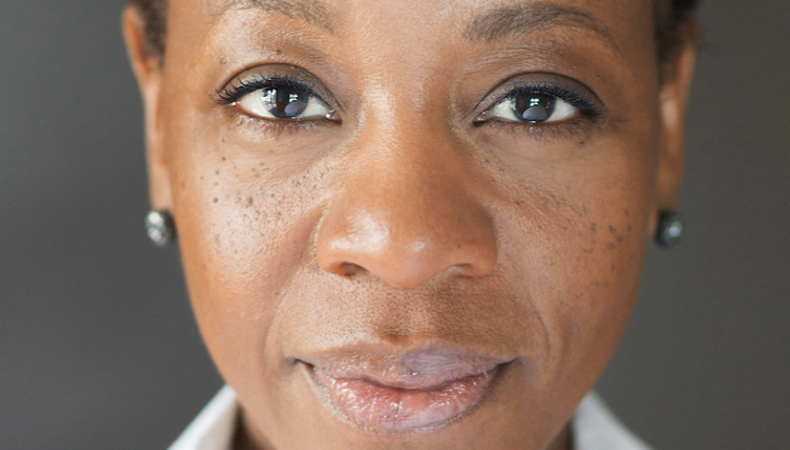
When Marianne Jean-Baptiste got a call from Mike Leigh asking her to star in his next film, she knew she couldn’t miss the opportunity to reunite with the director.
“You start crossing the road really carefully,” she explains. “I don’t want to get knocked over by a car. I don’t want to drop dead before I get there. And I’m thinking, I hope he’s taking care of himself as well.”
Jean-Baptiste first worked with Leigh in his 1993 play “It’s a Great Big Shame!” before earning an Oscar nomination for the filmmaker’s 1996 drama “Secrets & Lies.” But “Hard Truths,” their latest collaboration, is perhaps her greatest achievement yet. The night before our Zoom conversation, she accepted the New York Film Critics Circle Award for best actress. She also received that honor from the Los Angeles Film Critics Association and the National Society of Film Critics.
In the film, Jean-Baptiste plays Pansy, a London woman whose life is defined by her afflictions. Pansy’s roiling anger pours through her, resulting in a litany of complaints that, to the audience, can be very funny, but to her, come from a place of pain and fear. The story charts her fraying relationships with her worried and exhausted sister (Michele Austin), her nearly silent son (Tuwaine Barrett), and her removed husband (David Webber).
Leigh is famous for his process in which actors help build their characters, as well as the script, through an intense rehearsal. Jean-Baptiste walks us through how that works and how it has shaped her approach to acting.
Did you know when you were first working with Mike Leigh that the potential for such a fruitful collaboration was there?
My first encounter with him was an audition, where he just [said], “Come in. Think of a person you know. I want you to get into character, enter that character, and just be in the space.” I found that to be very exciting. I remember it was a loungy-type area and there was a kettle. I thought, I’m just going to sit down and have a cup of tea. There was a newspaper there. So I just sat reading the newspaper and he said, “Well done. Come out of character.”
Then we just talked about it a bit and I left. That was for “Naked.” I got a handwritten letter from him saying, “Sorry it didn’t work out this time, but I really want to work with you in the future.” And I was like, “Yeah, right.” Then I got the call to do “It’s a Great Big Shame!” At the time, I didn’t know the way that he worked. I didn’t realize that we’d spend so much time together talking. So in those initial meetings, you just get to know each other, and that’s when he was like, “You—you’ve got the twinkle factor.”
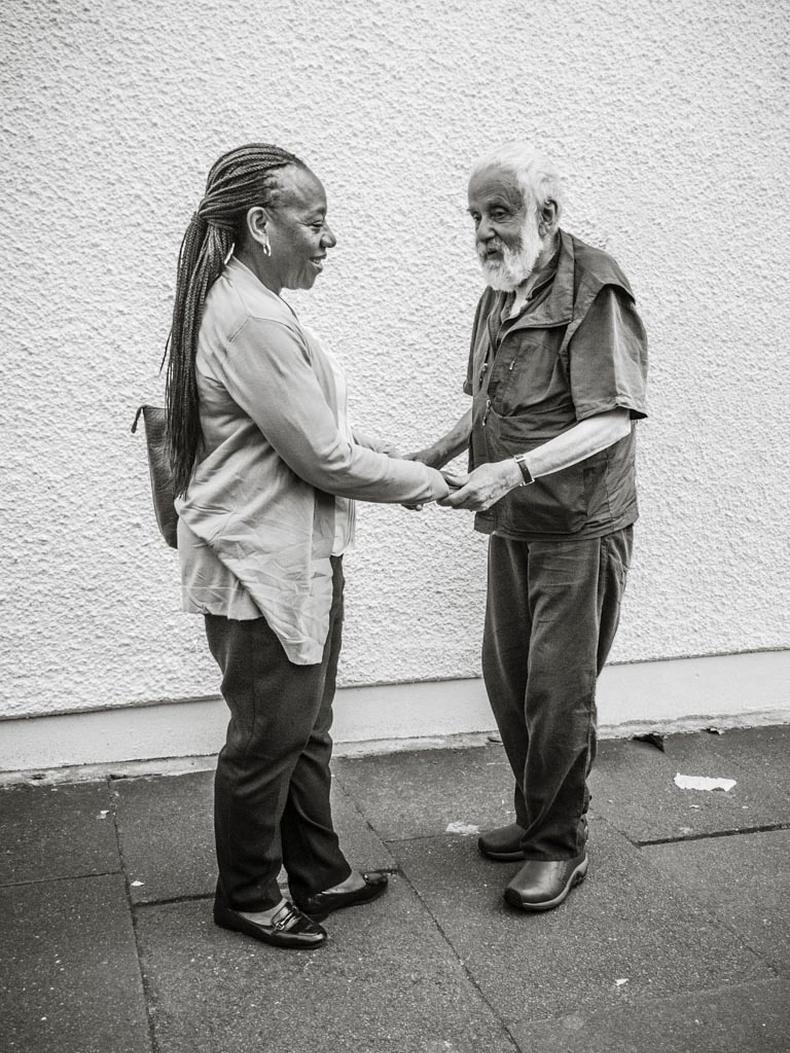
Marianne Jean-Baptiste and Mike Leigh Courtesy Bleecker Street
I love the phrase “twinkle factor.”
He’s got the twinkle factor as well. There’s that little thing in his eye that you know there’s a joke just on the cusp, or he’s thought of something funny. That he’s observing you in a really detailed way, and possibly an intrusive way. That’s because of curiosity and attention to detail. He made me aware of that in myself.
You said when you start on a project with him, he asks you to come in with a list of people you know who might inform the character you’re going to play. Other than that, do you know anything about the structure of the film? Or do you start completely from scratch?
Scratch. You don’t know anything. The other thing he says is, “You won’t know anything your character wouldn’t know.”
Is there fear involved with that?
There’s a whole load of fear. You’re petrified, because you don’t know. And you’re like: Oh, my God, what if it’s shit? What if it doesn’t work? What if this is the one that just falls to pieces? What if I’m not good? What if I do something that’s just too out there?
How did Pansy start to take shape?
The list [of people] starts being whittled down. Once you’ve landed on five and you merge them, you start to go, “OK, well, what was school like [for the character]?” And you start discussing that. He starts giving [the character] failures because those are things he can decide.
I can decide that Pansy loves math, and she does a test, and she works really hard; but he decides that she fails. That’s when you start getting the feel of this character and all of her anxiety and fear and disappointment and heartbreak.
What did it feel like watching the process and realizing, “This is a challenging person I’m going to have to embody”?
Kind of terrifying, actually. You want nice interactions. But also, for me, it was like, Wow—because I’m so not like [Pansy]. It was just such a challenge that I was really excited to play. But also, to find the nuance in it, to find the compassion, the vulnerability. I think it was after [filming the scene where she’s] screaming at the dentist and the doctor—I was like, “It’s not sustainable.” And he was saying, “Angrier, more aggressive. You’re a lunatic.” Even after watching it the very first time, I was just like, “I’m not sure about this, man. This woman is like…whoa. She’s a lot.” It sounds bizarre, but I didn’t see the humor in it, because I was feeling her anger and anxiety at those points.
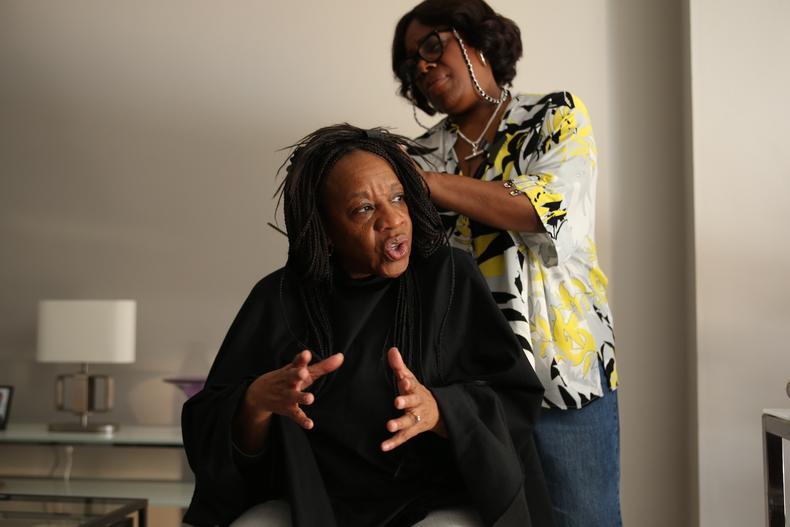
Marianne Jean-Baptiste and Michele Austin Courtesy Simon Mein Copyright Thin Man Films
After working intensely with Mike one-on-one, what is it like when the other actors come into the room?
There’s a stage where the other actors are introduced one at a time, because all of the histories would’ve started at a different time. It takes place in the order in which people would come into their lives. But it feels like a relief because you’re not sitting there with him on your own, under his gaze, his bullshit detector.
Tell me about his bullshit detector.
He will just look at you and just be like, “Oh, that’s a load of crap.” Everything you say when you’re trying to put this character together, he’s looking at you to find out whether it’s coming from you or it’s coming from a real sense of knowing what [the character] would do in that situation. It’s a trusting relationship.
Is the work with Mike what has shaped you most as an actor?
Most definitely.
What do you take with you from it when you’re, say, on a network TV show?
I think it gives you agency. Mike, and I think he said this, he sees actors as creative artists in their own right and not just interpreters. It gives you that thing of knowing that you can tell the whole story. You have the ability to be able to do that. Now, there’s going to be certain confines within a scripted piece of work, but then you do have the tools to say, “Right—who’s this woman? Let me think of somebody that I know in real life that has that feel, has that thing.” Then you start the process in a very truncated way to build that character.
Has your work with Mike changed the way you view other performances, and are there any you think everyone should see?
There are two women [Vic Carmen Sonne and Trine Dyrholm] in “The Girl With the Needle” who give absolutely beautiful, nuanced performances. And I think that they are worth watching. I really do. And, yeah, he’s spoiled me for watching performances in films, because I very often get pulled out by things that I don’t think other people get pulled out by.
What do those things tend to be?
Like when the clothes are wearing the character. Or sometimes you feel that when people are in love with the dialogue and what they’re saying rather than just saying it. When people are trying as opposed to being—when their performance is like that.
This interview has been edited for clarity and length.