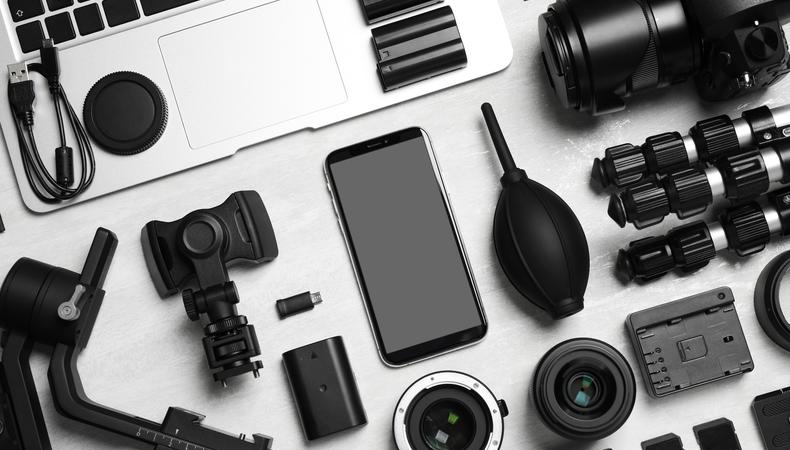
We’ve all heard the phrase “A picture is worth a thousand words,” right? Well, someone has to actually take those pictures—and that’s where photographers come in. Whether it’s helping an actor capture their essence and role type during a headshot session or shooting a household item for a print advertisement, there are plenty of jobs to be had in the field.
In order to be a successful photog, you’ll need the right professional photography equipment. Here’s a comprehensive list of camera equipment that professionals need to get started, as well as a price breakdown for each piece.
1. Camera
If there is one obvious piece of equipment that photographers need, it’s a camera. There are endless varieties out there, depending on which one will best suit your needs. If you are hoping to shoot portraits, the best option for you will be different than it would be for a photographer who’s interested in doing stock photography. Aspiring photographers should plan and budget accordingly.
Cost: The discrepancy in the cost of cameras is large and depends on your needs, as well as whether you buy new or used. Entry-level mirrorless cameras and DSLRs can be found for as little as $300 to $500, while professional-grade cameras can cost $2,000 to $6,000 or more. You’ll need to do some research and figure out which one best suits your goals.
Recommended retailers:
2. Lenses
The lens you use can completely change the photograph your camera takes—which is a very good thing, as it creates diversity in the services you are able to offer. You should look into lenses while researching cameras, since either could inform what you end up purchasing. (You’ll definitely want to start with a prime lens, which is a lens that does not zoom in or out.)
Cost: Lenses will be one of your pricier investments as a photographer. While you can find decent lenses for under $500, high-quality professional lenses typically start around $800 to $1,300 and regularly go for much more than that.
Recommended retailers:
3. Speedlight
A speedlight, also known as an external flash, attaches to the top of your camera and adds light to the photograph you’re taking.
Cost: Speedlights start as low as $40 to $70 for budget models, with mid-range options typically costing $200 to $300, and high-end professional units running $500 to $1,200.
Recommended retailers:
4. Reflector
It’s right there in the name: Reflectors are a piece of material used to direct light in a particular direction and eliminate shadows. They are particularly useful for portrait photography, as they can soften the light that hits your subject. They can be used indoors with artificial light or outdoors with natural light.
Cost: Reflectors start as low as $15 to $30 for basic models.
Recommended retailers:
5. Tripod
A tripod is the three-legged stand that you set your camera on to steady it for taking level shots. No matter your specialty, you will want to have one of these, even if you frequently shoot by hand.
Cost: You can get basic tripods for as little as $14 to $50 for entry-level models. Mid-range tripods suitable for serious photographers cost $50 to $200, while professional-grade tripods can cost $200 to $1,600 or more.
Recommended retailers:
6. Memory card
Memory cards are used to digitally store your photos (and videos, if that’s in your purview). There are many different kinds of memory cards; which one is for you will depend on the card slots your camera has and how much storage space you need.
Cost: The bigger the memory card, the more expensive it will be. But this item is on the lower end of the cost spectrum: You can get a 64 GB memory card for just $10 to $15.
Recommended retailers:
7. Computer software
Photographers need software on their computer to process photographs and to organize and edit images. You can use these programs to adjust things like exposure, contrast, saturation, and color, as well as add in any special effects.
Cost: Adobe Lightroom is the current gold standard for photography-editing software that is functional, cost-effective, and easy to use. The most basic version starts at $100 to $120 annually.
Learn more:
8. External hard drive
You will need to store your photographs on an external hard drive. It is everyone’s worst nightmare to lose their work due to technical failure—yet it happens constantly. With that in mind, you should have at least one other backup drive for your work. You may even want to keep your drives in separate physical locations (one at home, one at the studio, etc.) in the event of a robbery or fire.
Cost: Hard drives that store up to 2 TB start at around $60 to $80; the price goes up from there based on storage capacity.
Recommended retailers:
9. Lens filters
Lens filters aren’t necessary for all photographers, but they can only improve your photos and make your life that much easier. There are three main types: UV filters, which are clear and used to shield the lens from ultraviolet light and protect against damage; polarizing filters, which are mainly used for outdoor photography to increase contrast between clouds and sky; and ND filters, which are gray-toned, limit how much light can enter a lens, and are most useful when shooting in very bright locations.
Cost: Filters are on the cheaper side; they can be purchased for under $50 to $100 depending on size and quality.
Recommended retailers:
10. Color checker
Color checkers are essential for any shoot. As far as individual elements of photography are concerned, color might be the single most important one. This basic piece of equipment, when used in conjunction with software, helps to ensure that the shots you take accurately reflect the color of the actual environment you’re shooting in.
Cost: Color checkers can start as low as $30 to $50; those on the higher end run about $150 to $200.
Recommended retailers:
11. Camera bag
Imagine showing up to a shoot unable to complete the task because your equipment has been damaged from rolling around in the backseat of your car. That’s where a camera bag comes in—but you should purchase all your other gear before you buy one so that you’ll know how much space you’ll need.
Cost: You can get a camera bag for as little as $30 to $50; more elaborate versions run up to $120 to $200.
Recommended retailers:
12. Camera cleaning kit
A camera cleaning kit will keep your images smudge-free. How embarrassing would it be to have your photographs ruined because there was a fingerprint on the lens? Photographers need to have a cleaning kit handy, and they should use it before every single session. (You should never, ever attempt to clean a lens with a T-shirt or paper towel, as that can cause permanent damage.)
Cost: Cleaning kits start as low as $10 to $15.
Recommended retailers:
13. Camera strap
Camera straps mean camera comfort. This is not the most important piece of gear a photographer needs, but if you’re doing a long shoot or one that will require you to move around quite a bit, you will want a functional and comfortable camera strap to sling over your shoulder.
Cost: A basic camera strap starts at $10 to $20; the price goes up from there for more ornate or fashionable versions.
Recommended retailers:
Ready to get started with Backstage? Become a subscriber here!