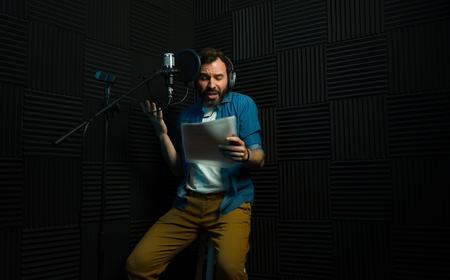
What do the “most trusted man in America” Walter Cronkite and trailblazing sports announcer Beth Mowins have in common? It’s all in the announcer voice! These broadcasting beacons mastered the ability to command universal trust—simply with the power of their instrument. Here’s what you need to know about the announcer voice and why it matters for all actors.
The announcer voice is a vocal style and technique typically used for broadcasts, commercials, sports commentary, and live events. It’s commanding (but not authoritative), warm (but not overly emotional), and strong (but not raucous). And while different cultures and contexts have different standards for what makes an effective announcer, all styles of announcing have one quality in common: clarity. Announcers always prioritize clarity, since successfully conveying information is their primary goal.
How did the announcer voice come to be?
With the rise of radio came the first standardization for delivering information, resulting in the U.S. in what is now known as the transatlantic or mid-Atlantic accent. You’ve probably heard this announcer voice before, whether in archival footage or in parody. As its name indicates, it sounds like a cross between an American and English accent and was used to convey a level of high-class authority. By the 1950s, this accent had begun to fall out of style, and in its place came the general American accent. The whole design of this diction type was to make an announcer feel universal, speaking to Americans from all locals and walks of life.
We still hear the general American accent today from many news anchors and announcers, but other variations have emerged as well. Some announcers want to lend a bit more of their personality to their voice and, as a result, will let more of a localized or casual accent slip through. Meanwhile, National Public Radio (NPR) has created an entire wave of warm, soft-spoken announcers.
In sum, the primary qualities of an announcer voice depend on what’s being announced. If you’re narrating a true crime podcast, you may lean more toward an NPR voice to create an intimate connection with your listeners; and if announcing a football game, you may want to be more brash and traditionally masculine.
Announcers often take the back seat to the information they convey, but many (like this sampling) are instantly recognizable.
Bob Costas: You can’t have an announcers list without a sports commentator, and you can’t mention sports commentators without mentioning Costas. The legendary sportscaster has called nearly every kind of game under the sun, but we believe his greatest work entails America’s favorite pastime.
Walter Cronkite: Even today, decades after Cronkite went off the air, the legendary news anchor’s name remains synonymous with TV news. His announcing voice was steady and reliable, engendering a sense of trustworthiness. As you can hear in this clip, he was able to keep this diction even when rattled by the most shocking news.
Funkmaster Flex: The groundbreaking host of New York City’s Hot 97 radio station, Flex’s ability to pump up the energy in a matter of seconds is unparalleled. Just listen to his work during the premiere of Kanye West and Jay-Z’s “Otis”—arguably the greatest 22 minutes (yes, 22 minutes) of music radio ever. Flex’s lengthy radio tenure shows there is no one way to be a great announcer.
Terry Gross: Just as Cronkite’s voice encapsulates 20th century TV news, Gross’ represents public radio. As the award-winning host and co-executive producer of “Fresh Air”—an interview show that has been a mainstay on NPR for decades—Gross is the epitome of the “NPR voice.”
Beth Mowins: Non-male announcers have historically been few and far between, particularly when it comes to sports play-by-plays—but female announcers like Mowins have worked to level the playing field. After years of calling women’s sports and college football, in 2017, Mowins became the first-ever woman to lend her voice to a nationally televised NFL game. With a career spanning the NBA, MLB, and even the Olympics, Mowins is proof that a combination of talent, training, and drive is the magic sauce behind announcing success.
As an actor, you may not see the immediate applicability of an announcer voice. After all, you’re likely not trying to become the next radio host or sports commentator. Still, it’s worth your while to become familiar with this flavor of diction—here are just a few reasons why.
1. Conquer vocal clarity: Knowing how to project your voice clearly and with authority is a vital skill for any actor. This is useful in theater, film, television, commercials, podcasting—everywhere. Working on your announcing voice can help you master this skill. This doesn’t have to mean doing an old-timey newsreel imitation; it can simply mean embracing your own voice but refining your abilities in articulating and projecting.
2. Optimize for audiobooks: The world of audiobooks is a great one to break into if you’re a voice actor—and, of course, the most important requirement for audiobook narrators is understandability. When reading a book aloud, you may be using more emotion and theatricality, but at the root of it, you’ll likely be applying the same skills an announcer would.
 How to Become an Audiobook Narrator
3. Prepare for period pieces: A classic way for a movie or TV show to situate itself in a specific time period is by including VO from a contemporaneous radio program or news broadcast, which used (you guessed it!) narrator voices. If you’re hoping to get cast in a period piece, take the time to go back through the history of announcing to understand what may be required of you vocally.
4. Widen your range: The 1930s announcer voice was higher-pitched and fast-paced, while the 1980s incarnation was deeper-pitched and methodical. Practicing various types of announcing voices can help you expand your vocal range, making you more appealing to casting directors across a diversity of projects.
5. Connect with the crowd: The announcer voice allows you to effectively communicate and connect with an audience. For actors, learning this vocal style can be invaluable to ensuring people want to hear your voice. You don’t need to make your characters sound like announcers, of course, but you can use subtle announcing techniques to make sure you’re reaching your listeners.