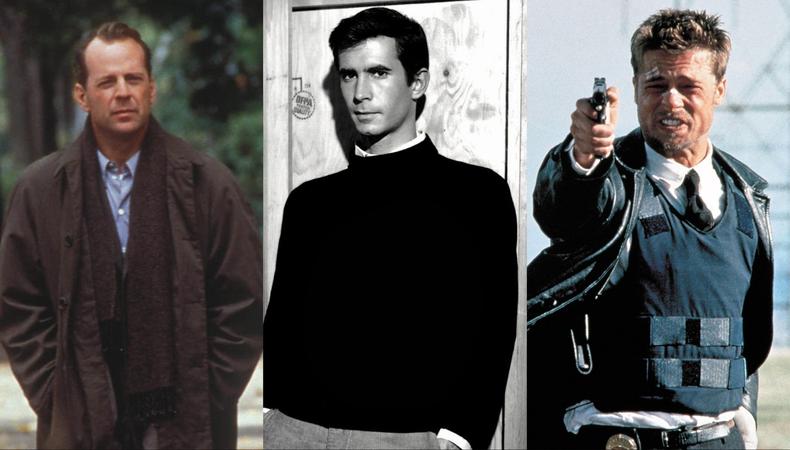
According to Aristotle’s “Poetics,” the best drama comes from storytelling choices that are initially surprising, then immediately understood as inevitable. The leg is swept, and then we are happy to be on the floor.
We often experience this sensation in movies with effective plot twists, which are moments where a story takes an unexpected turn. Some flicks pull these kinds of moves for empty shock value. With others, the twists enrich the experience immensely, and they’re more than worth studying to see how the artists pulled them off.
Here are 13 of the best plot twists in movies. And it should go without saying, but ample spoilers ahead for many classic and contemporary films.
“Citizen Kane” (1941)
The mystery of director-star Orson Welles’ “Citizen Kane,” one of the greatest movies of all time, is finally revealed in its ending shot, a perfect example of showing, not telling. The question throughout the film is: Why did publishing magnate Charles Foster Kane (Welles) mutter the word “Rosebud” on his deathbed?
Using simple but then-revolutionary camera and editing techniques, Welles pushes in on Kane’s childhood sled, labeled “Rosebud,” burning to a crisp. As the score discordantly swells, the impact of Kane’s final spoken word is felt, cementing his tale as a great American tragedy.
“Psycho” (1960)
Actually, “Psycho” is a two-twist picture. The infamous shower scene, where Norma Bates stabs Marion Crane (Janet Leigh) to death, comes completely out of nowhere to the audience, who expected a standard noir in which the lead, Leigh, makes it all the way through.
And at the end, we discover that Norma Bates, with whom innkeeper and son Norman Bates (Anthony Perkins) keeps mumbling his obsessions, has been dead this entire time, a decomposing skeleton wearing a dress in the basement. Instead, Norman is the killer, dressing up as his mother to do his dirty deeds.
Alfred Hitchcock films the initial realization as a silent, slow-motion jump scare, where Norma’s body is turned around with agonizing detail, revealing a skull. Bernard Herrmann’s score accurately conveys the audience’s surprise and anxiety.
“Planet of the Apes” (1968)
A group of astronauts, including George Taylor (Charlton Heston), awake in the far-flung future on a faraway planet run by hyper-intelligent apes who enslave humans. But when Taylor reaches the end of his journey, he sees the washed-up remnants of the Statue of Liberty. And we realize the “Planet of the Apes” was Earth, all along.
This mammoth twist is conveyed with high melodrama in photography (a giant crash zoom out through Lady Liberty’s spires) and performance, with Heston cursing the heavens as he punches the sandy beaches. It is proof that subtlety is sometimes overrated.
“Soylent Green” (1973)
Speaking of Heston losing his absolute mind at the end of a science fiction film: Richard Fleischer’s “Soylent Green” takes place in a futuristic dystopia where the title food source is given to a struggling populace. But through his investigation, Detective Robert Thorn (Heston) discovers the horrible truth: Soylent Green is made of people, effectively turning the world into cannibals.
As Thorn is carried out on a stretcher, he raises his bloody hand in the air and screams the truth to anyone who will listen. The scariest part of the scene? The beleaguered people around him pay no attention.
“Star Wars: Episode V - The Empire Strikes Back” (1980)
“No. I am your father.” With five words, Darth Vader (James Earl Jones and David Prowse) ruins the life of Luke Skywalker (Mark Hamill), and the entire audience for good measure.
This beyond-iconic twist, which links good and evil inextricably, still carries power because of its edit to Luke’s reaction shot. Hamill’s twisted face and pained line delivery (not to mention John Williams’ booming score) hurt in the best way.
“The Usual Suspects” (1995)
Verbal Kint (Kevin Spacey) has successfully led Agent Dave Kujan (Chazz Palminteri) to the true identity of Keyser Söze, a vicious killer. Thus, Verbal is released from prison, free to go.
And then Kujan’s coffee cup falls and shatters in slow motion. It’s the first shot in a thrilling sequence where we realize Verbal was lying the entire time, concocting his story based on information physically behind Kujan in our line of sight. The final nail in the coffin: a close-up on Spacey’s feet as he shifts Verbal’s limp to a more steady gait. He was Keyser Söze, a most unusual suspect.
“Seven” (1995)
In David Fincher’s high-concept thriller, detectives Somerset (Morgan Freeman) and Mills (Brad Pitt) have captured the serial killer known only as John Doe (Spacey, again). Doe kills victims based on the seven deadly sins, but he hasn’t completed the septet.
Until he leads the detectives to the middle of the desert, promising a macabre gift for Mills. The edits and score ratchet in intensity, and Pitt delivers the almost painfully pathetic line reading, “What’s in the box?” The answer: The head of Mills’ pregnant wife (Gwyneth Paltrow), whom Doe killed out of envy. Mills then kills Doe out of wrath, and all sins have been accounted for in a beyond-savvy piece of screenplay construction.
“Primal Fear” (1996)
Attorney Martin Vail (Richard Gere) successfully proves in court that his client, Aaron (Edward Norton), is not guilty of murder by reason of insanity. Aaron’s split personality, “Roy,” took over during the crime, a fact Vail proves by provoking Aaron during testimony.
But, with a scary piece of acting by Norton and some shadowy cinematography, we realize “Roy” was always in charge, and he put on the besotted “Aaron” as a fall guy to literally get away with murder. If you’re a Norton fan and haven’t seen this one, rectify, as he puts on a clinic.
“The Sixth Sense” (1999)
To quote the Lonely Island, Bruce Willis was dead at the end of “The Sixth Sense.” His child psychologist Malcolm Crowe, attending to a patient (Haley Joel Osment) who sees ghosts and has to help them finish their earthly business, is actually one of his patient’s apparitions the entire time, having been killed in the film’s first scene.
Writer-director M. Night Shyamalan lets us deduce this information using flashback, clues that have been planted throughout the entire runtime, and a sensitive dual performance from Willis and Olivia Williams, who plays Malcolm’s widowed wife.
“Fight Club” (1999)
Here’s Norton and Pitt again! This time, Norton realizes he’s caught in another split personality trap—his unnamed character was actually Tyler Durden, the Pitt slab of id, the entire time.
Fincher (again!), who had been manipulating us using our collective understanding of cinematic point of view, lands this twist with voiceover, quick edits, flashbacks of “the truth,” and a centrally confused performance from Norton.
“Oldboy” (2003)
The revelation of the “Oldboy” twist plays like a film-within-a-film. Park Chan-wook is the director of the actual film, but for this sequence, he lets his antagonist, Lee Woo-jin (Yoo Ji-tae), take over.
Woo-jin effectively tells the story of Oh Dae-su’s (Choi Min-sik) unwitting sin using the storytelling (or cinematic) techniques of the unreliable narrator, the flashback that fills in missing information, and finally, the series of disparate images linked together to deliver information.
In this case, the information is that Dae-su was manipulated to have sex with his own daughter, Mi-do (Kang Hye-jeong). His reaction is to cut off his own tongue, which is understandable.
“Saw” (2004)
Two guys (Cary Elwes and Leigh Whannell) wake up in a gross bathroom. A dead guy (Tobin Bell) is in the middle of them. The two alive guys are made to participate in a series of deadly games perpetrated by an unseen killer.
And then, when the dust has settled and Whannell is the last man standing, the dead guy gets up from off the floor and walks out of there. He was the puppet master the entire time, a simple yet devastating revelation communicated with the ironic echoing of lines and information we’d previously glossed over. From that twist, a franchise was born.
“Arrival” (2016)
Denis Villeneuve is a smart director. He knows how to present information in a way that plays on audience assumptions, ensuring that certain scenes of “Arrival,” particularly those of Louise Banks (Amy Adams) with her now-deceased child, will be immediately interpreted as a flashback.
This makes the twist hit both the brain and the heart. As Banks’ peculiar relationship to time is fully unfurled, we realize these weren’t flashbacks at all. They’re flash-forwards, events that have not happened to Banks, her daughter, nor her eventual lover (Jeremy Renner) yet. Banks is, thus, asked in the most visceral way whether it’s better to have loved and lost than never to have loved at all.
But because we’ve already seen these scenes, perceiving time as strangely as Banks, we already know her answer, making “Arrival” a stupendous feat of all filmmaking techniques to convey a powerful twist.