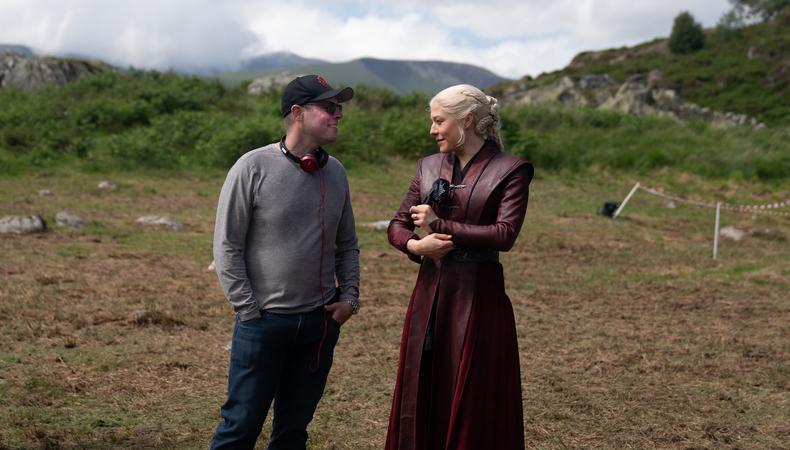
The opening episodes of “House of the Dragon” Season 3 have been hailed as some of the “Game of Thrones” prequel’s best, beginning with the premiere’s adaptation of the source material’s epic Battle of the Gullet. Co-creator and showrunner Ryan Condal appreciates the memes he’s been sent by his actors and the praise he’s received from the likes of “Battlestar Galactica” and “Outlander” boss Ronald D. Moore. But his favorite feedback came from an unexpected place.
“My friend is a commander in the Navy, and he sent me an article today that somebody wrote in an internal Navy publication about how right we got the tactics in the Battle of the Gullet,” Condal shared. “That was the best thing I've read about the show yet.”
A longtime fan of George R.R. Martin’s “A Song of Ice and Fire” epic series, Condal was a natural pick to help HBO usher in the next generation of its “Game of Thrones” universe. And yet, passion and knowledge only get you so far, especially when dealing with a complex adaptation like “Fire & Blood.” Martin’s 2018 release is a detailed, scholarly approach to the history of House Targaryen, whose legacy was pivotal to the original “Game of Thrones” series.
“The fan side of me was like, Oh my god, how do you possibly sift through all this? How do you keep everybody happy?” said Condal, who previously co-created the sci-fi TV drama “Colony.” “Eventually I realized I can't live like that, because that's the way to doom. I have to just trust my true north as a giant fan. After Season 1, I discovered that there are things that you don't think are going to be controversial that are going to be controversial, and I had to come to peace with that.”
Here, Condal digs deep into the “House of the Dragon” adaptation process and how conversations with his stars constantly improve the show.
After two years of setting up the world and characters, did it feel like you were now finally able to just let it rip?
You always have to balance that stuff, because, first of all, on a very practical level, people need to know who these people are and what they're doing. There are a lot of people in blond wigs with similar names, so you have to spoonfeed in a way that doesn't seem like you're spoonfeeding, just to get a baseline of understanding. You also need to engage them with the characters where they actually care on an emotional level. And then you can do the spectacle. It's an incredible challenge, and it’s why movies at this scale struggle more often than not. When you're trying to pull off massive, world-building spectacle at this level, to have it resonate with an audience on all of those levels is like an Olympic gymnast routine.
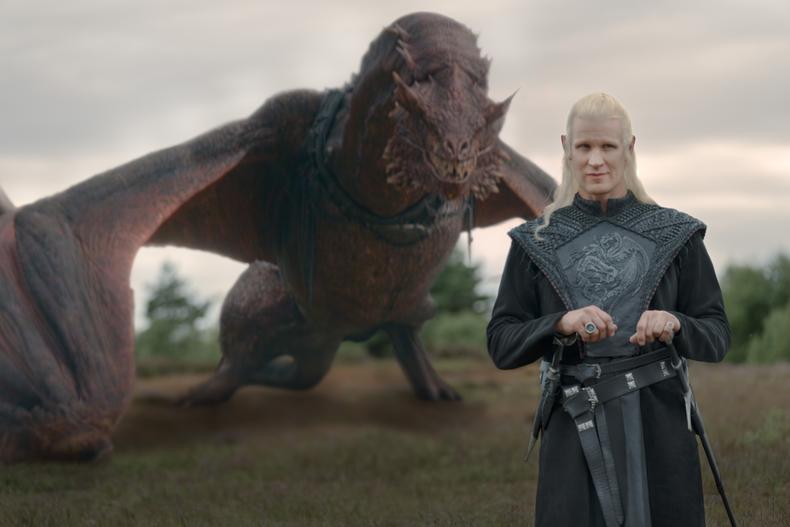 Matt Smith as Daemon Targaryen on "House of the Dragon." Credit: Theo Whiteman/HBO
What is your relationship to the source material, and how did you first sell yourself and your ideas to HBO?
I come at this as a massive fan. I found these books as I was in this existential life and career crisis, holding my accounting degree, saying, "I don't want to be an accountant—I want to be a screenwriter." I was a huge fantasy nerd, and somebody handed me “A Game of Thrones” [the book] and said, "This is ‘The Lord of the Rings’ with sex and incredible violence.” I was like, "OK, that sounds good." I took the paperback to the movie theater, because I’d get there early and read, and I once spent more time trying to read “Thrones” in the glow of the screen than watching the movie because I got totally sucked in.
I became a self-taught scholar of the world of Westeros, and HBO knew this. So when they met me, they knew I came from a place of understanding why this works and why audiences find it compelling. HBO had been through a couple of iterations of trying to figure out what was going to follow “Game of Thrones,” and I actually pitched them “Tales of Dunk and Egg,” [later adapted into the Condal-produced “A Knight of the Seven Kingdoms”]. I was like, "This is the perfect counterprogramming because it's small, fun, and lighter." The irony is that they needed that after my show came out. In “Game of Thrones,” Daenerys [Emilia Clarke] is the only Targaryen left. And we're just talking about the glory days—these are the glory days. My pitch to them was “House of the Dragon” is like the “Star Wars” prequel trilogy. It took a few years of development to get them to come around, and then I was just the right guy, at the right time, with the right handle on the material. If I had written that pilot three years earlier, I don’t know that the series would've been made, because HBO might've said, "Well, this is the thing they expect us to do."
“Fire & Blood” is not a traditional novel.
[Laughs] I know that better than anyone.
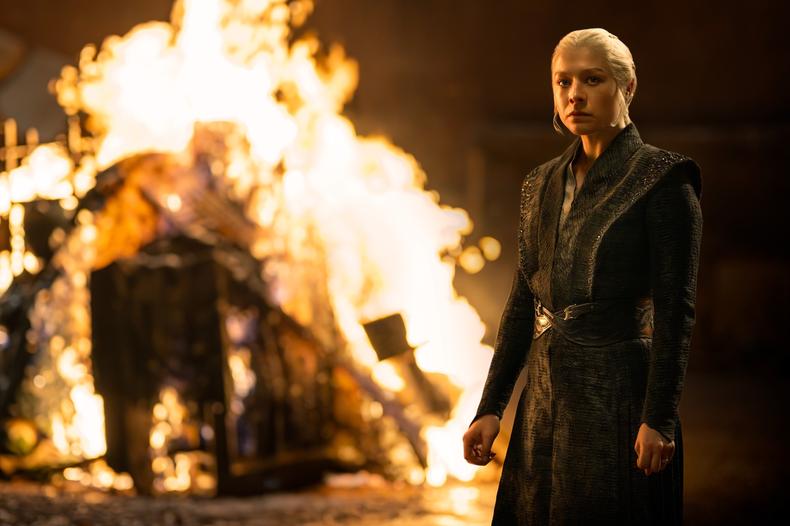 Emma D'Arcy as Rhaenyra Targaryen on "House of the Dragon." Credit: Kevin Baker/HBO
What was your initial approach to trying to get a handle on how to adapt something like that into a television show?
I was really scared, because this was the most high-profile thing I'd done. But I was incredibly engaged by the idea and creative challenge to take on what is a fictional history written as a history book, in this “Rashomon” style, where there are competing accounts of the events, and you basically have a choose-your-own-adventure saga laid out before you. It's a big, expensive show, and so HBO wanted a linear narrative point of view. I had to pick a throughline, and sometimes that's picking one account over the other. And other times the book will openly say, "We do not know what happened here,” so having the ability to fill in those blanks in a way that you could be super faithful to the material but still get a chance for a ton of invention was really exciting to me.
What has been your general process on “House of the Dragon” when deciding what to adapt, what to change, and what to cut?
It's an incredibly complex and organic process, where, when I sat down to write the pilot and my thesis in 2018, I could never have said, "OK, we're gonna stick to this.” You have to let the show speak to you as you go. “Game of Thrones” had the opposite problem, in that there were too many pages and they had to whittle it down into a television show that didn't take 25 seasons and bankrupt everybody involved. I look at it like sculpture: You're trying to cut away the marble that is not the television show. I’m committing to rendering this thing in a different medium, and, in this case, in a much different medium, because it's not a traditional POV narrative where you're in the characters’ heads. Even in just 200 pages, there's a million characters, so the rule we had was we're going to try to tell this from the POV of the extended Targaryen family. Everything else gets deprioritized, because you have to find a way to tell the story where it's not so spread out that you can't keep a grasp of it.
And then my writing partner, Sara Hess, and I became really interested in how the show could exist as a commentary on how real histories are written. Sometimes history is written as propaganda, and you can read “Fire & Blood” with the perspective that the accounts are told by people trying to heap blame onto the parties they believe responsible for letting this terrible war get out of hand. We decided that we were going to give this subjective POV through it, and then some things are going to be exactly as you read them in book, and then for others, you’ll be like, “Huh, the endpoint got there, but that's not my understanding of how it happened,” just to show that sometimes history is not this very clean, clinical retelling of the events of the time. To me, that made it feel like the kind of premium idea that HBO likes to explore in its series that sets this apart from a run-of-the-mill genre show.
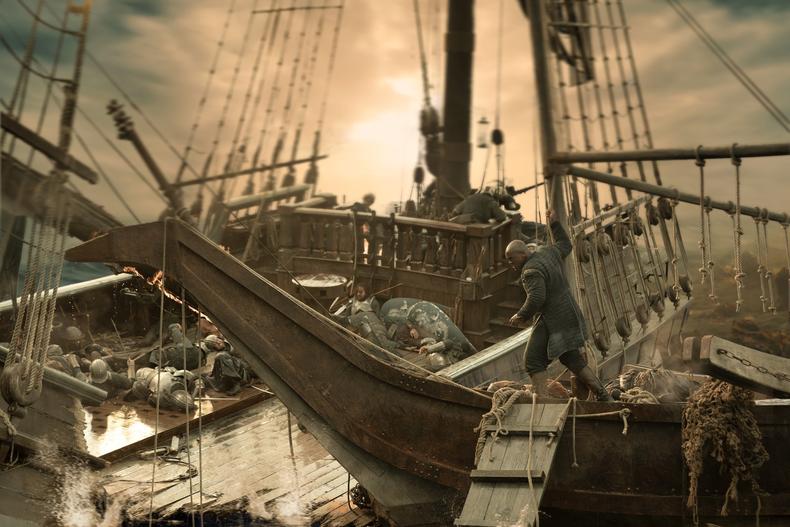 Abubakar Salim as Alyn of Hull on "House of the Dragon." Credit: Ollie Upton/HBO
Is there a specific instance where you were really torn about what to do in terms of adaptation, and how did you eventually land where you did?
A great example is, during the Battle of the Gullet in the book, Rhaenyra [Emma D'Arcy] sends her two youngest sons with Daemon [Matt Smith], who in the show [are aged down], and the eldest one is not yet ready to fly his dragon; he flees and warns the Sea Snake. It's a really visceral and memorable scene in the book. But, going into Season 1, we took 30 years of history and decided, "We're going to make it 20,” because, at some point, it becomes too broad and vast. And while that got us out of having to recast everyone, it also meant the youngest kids in the story either didn't exist yet in the timeline or were that much younger. So Rhaenyra and Damon's kids are basically toddlers, and, in television, toddlers are not characters—they’re props. You're dealing with the practical concerns of, these kids can't act because they're 4-year-olds, it’s not safe to have them do stunts, and you can't create a CG kid and make it realistic.
We also felt that the Gullet [in the show] became so much about Rhaenyra’s loss of her son Jace [Harry Collett] that it felt like too much trauma at once. So all these things factored into us saying, “We need to be responsible adapters and producers of television.” It was a much cleaner story to tell for this totally different medium that we have to engage with on a much more emotional level. It was a bummer that we couldn’t [adapt] that part of the battle, but we understand where that story goes, and we have a plan for it. We debated for a long time, and there was a lot of sweating and consternation in the room, but, ultimately, I think it was the right decision.
How have your conversations with your actors evolved over the years as they’ve come to better understand and inhabit their characters?
Great showrunners let the show come to them, and that doesn't mean you totally let your audience or collaborators dictate what the show is, but it has to be a two-way street. You have to be open enough to receive sometimes challenging input. These actors I work with are not just brilliant performers, but Emma's this incredibly deep-thinking intellectual storyteller and really does tell their story through Rhaenyra. They keep the whole thing in their head in a really interesting way, and I've gotten tons of feedback from Emma over the seasons about how they see the story when they look solely through Rhaenyra’ eyes. And things come out of that for the story at large that I would not necessarily see because I’m seeing it through 19 POVs.
I keep an active conversation with all the actors. The wonderful thing about this absolute powerhouse group of British talent is most of them are classically trained, so they are storytellers first, and there’s not a lot of ego involved. Every year, we finish the scripts and then have this six-week period where we rehearse, table read all the scripts, and that gives us time to do a final polish with all the actor feedback. And it has consistently made the show better. I'm very proud of it, because you don’t always have time to do that, and we do, and we take advantage of it. There's that level of trust that we can have these open conversations with the shared interest of just making the best television show possible.
This interview has been edited for clarity and length.