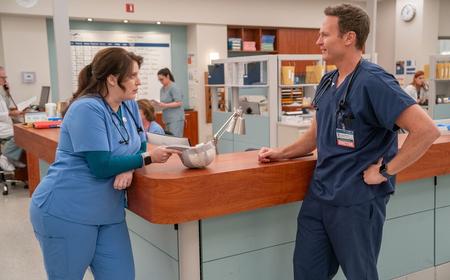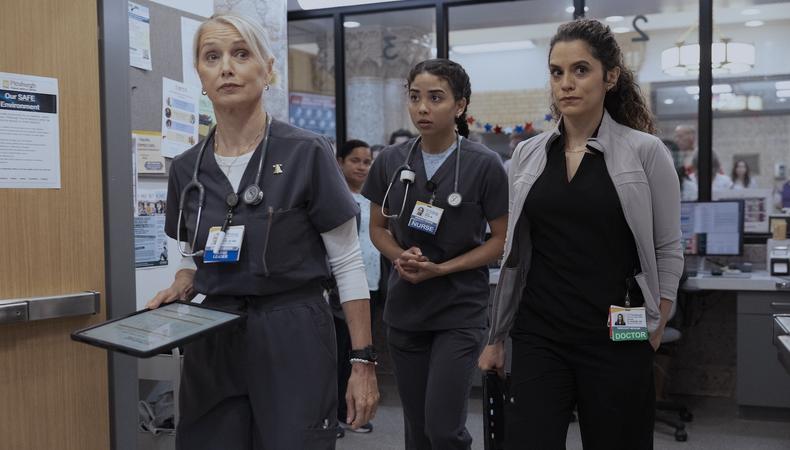
Whether you’ve fantasized about a guest spot on “Grey’s Anatomy” or just really want to say, “I’m not a doctor, but I play one on TV,” medical dramas are a staple of the industry. For early career actors, these shows offer incredible opportunities to sharpen your craft and build your résumé.
Here’s everything you need to know about the skills, preparation, and career benefits of working in the world of TV medicine.
JUMP TO
Acting in a medical drama requires more than just looking good in a white coat. You need a specific toolkit to make the high-stakes environment feel real to the audience.
Commitment to the jargon: If you’re playing a doctor, medical terminology needs to sound like you’re fluent. “If it doesn’t sound like a second language coming out of your mouth, you won’t get the job,” says Craig Wallace, creator and teacher of the Wallace Audition Technique. “When you’re preparing, have fun getting to know the sounds and feelings of the words, from how they feel crossing your vocal cords to where they resonate in your body. If you simply memorize the lines, you’ll sound like an actor reciting. If you take the time to embody the words, you’ll sound like an expert.”
An unflappable attitude: Sets can be chaotic, involving high-stress movements, medical gore, and even nudity. Your character is a professional who’s used to this kind of environment, so remain calm and reactive only to the drama, not the “gross” factor. Katherine LaNasa, who plays nurse Dana Evans on “The Pitt,” admitted to the Hollywood Reporter that this was one of the bigger challenges for her: “You’re doing these complex scenes, and everyone’s running around, and suddenly you realize you’re staring at full-on male anatomy. But you can’t react—you just have to be like, ‘OK, that’s that.’ ”
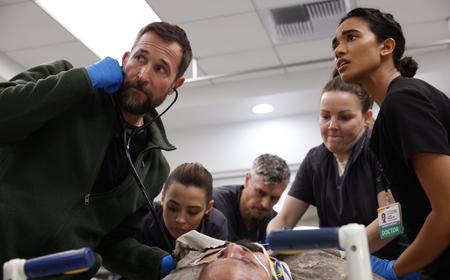
Multitasking mastery: As Noah Wyle, star and executive producer of “The Pitt,” told NPR, casting directors for medical dramas often look for “people with theater backgrounds [who] are adept at memorizing lots and lots of dialogue” while simultaneously handling props, performing procedures, or even walking backward.
A strong imagination: Many medical shows take place in a single location. It’s your job to flesh out your character’s offscreen life, such as their family, dreams, and history, to ensure they feel like a three-dimensional person, even if you only have a one-episode arc. “We don’t really help [auditioners] very much with context or backstory,” Linda Lowy, the long-time casting director of “Grey’s Anatomy,” told us. “So when an actor comes in and has really created that for themselves, whether it’s right or wrong or needs to be adjusted or not, I’m always so appreciative. I always say, ‘That’s so interesting that you saw it that way; let’s use that, but let’s do it again.’ I like to play.”
1. Draw from experience: You don’t need an MD to understand the energy of the ER. Real doctors compare the zooming around and multitasking of a long shift to waiting tables or bartending during a busy dinner service. Use that frantic but focused energy in your performance.
2. Utilize on-set resources: If you book the job, you’ll likely work with an on-set medical adviser. Their job is to ensure everything that happens onscreen is accurate, from the appropriate medicine and procedures to what each person in the room’s role is, to hospital hierarchy and how a professional would feel emotionally during a specific case.
“[Production] brought in three emergency room doctors that they would have at different stations. We learned intubation. We had to watch a lot of surgery videos. We learned how to do actual CPR,” said Fiona Dourif, who plays Dr. Cassie McKay on “The Pitt,” to Backstage. “It was like a primer on the main things that they do in the hospital so that we understand it. And it ended up being just me asking a million questions to these poor doctors, trying to understand the basics of the human body in two weeks. But it was really useful.”
3. Prioritize your mental health: Medical scenes can be emotionally intense or visually traumatizing. It’s vital to have a cooldown method to leave that stress on set. Whether it’s spending time with family or seeing a therapist, protect your mental well-being.
Medical shows are unique because they offer a high volume of day-player roles. These one-episode spots for patients or family members are often much juicier and more emotionally demanding than roles on sitcoms, giving you a chance to truly showcase your range. Watch any older medical drama and you’ll be shocked at how many roles are played by now-recognizable actors. Famous alumni include:
- Millie Bobby Brown appeared as the daughter of a patient on “Grey’s Anatomy” in 2015, a year before her breakout role on “Stranger Things.”
- George Clooney became a household name after being cast as Dr. Doug Ross on “ER.”
- Kristin Davis’ entire early career was punctuated by medical dramas. Her first-ever recurring role was as R.N. Betsy Chilson on “General Hospital” in 1991.
- Emerald Fennell might be best known these days for writing and directing films like “Wuthering Heights” and “Saltburn,” but she was once most recognizable as Nurse Patsy Mount on “Call the Midwife.”
- Neil Patrick Harris’ first television role was the titular character on “Doogie Howser, M.D.” from 1989–1993.
- Denzel Washington’s big break came when he was cast as Dr. Philip Chandler on “St. Elsewhere” in 1982.
Common roles include:
- Medical professions: Doctors, nurses, surgeons, paramedics
- Hospital staff: Receptionists, janitors, volunteers
- Patients: Ranging from routine check-ups to emergency cases
- Visitors: Spouses, parents, friends, extras
Ready to scrub in?
The most important step to acting in a medical drama is, of course, actually getting cast in one! Ready to book your next medical drama gig? Check out our audition call board here, as well as more detailed breakdowns on how to get hired on “Best Medicine,” “Grey’s Anatomy,” “The Pitt,” and “Pulse.”