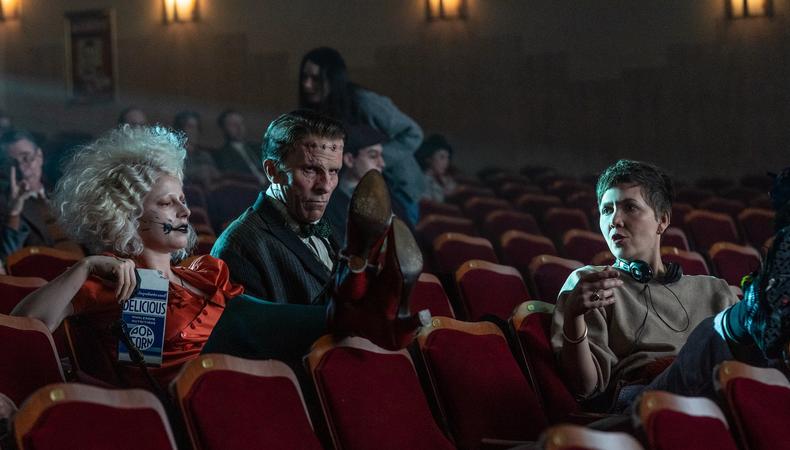
Maggie Gyllenhaal isn’t afraid to push boundaries as a director. That’s certainly evident in her latest feature “The Bride!”—a revisionist reimagining of Mary Shelley’s 1818 novel “Frankenstein” and James Whale’s 1935 film “Bride of Frankenstein,” which starred Elsa Lanchester in the titular role. Gyllenhaal’s iteration follows Ida (Jessie Buckley), a young woman in 1930s Chicago who is murdered by the mob and then resurrected to be the mate of Frankenstein’s monster (Christian Bale).
Gyllenhaal was inspired after watching both Whale’s 1931 “Frankenstein” adaptation and “Bride of Frankenstein” and feeling surprised by how little the Bride factors in, especially as the sequel boasts her name in the title. “It left me very curious about what she might be thinking and feeling,” the filmmaker says. “Especially in light of the fact that she was just dug up from the ground to be someone’s wife who she doesn’t recognize, and, in fact, has never met.”
As Gyllenhaal says, “Frankenstein” is a unique monster story, rife with creative possibilities. There’s a reason “The Bride!” is the second Shelley adaptation to hit theaters within the last year, along with Guillermo del Toro’s Oscar-nominated film.
“It’s so much more interesting to watch an actor working at the edges of what they understand about themselves and actually having to learn something about themselves onscreen, [rather] than watching them pretend to learn something onscreen.”
“Sometimes we use monster stories to take the monstrous aspects inside of us and put them into something else, [to] get them away from us,” she explains. “But Frankenstein’s monster is so human, and so it can have the opposite effect, where we are allowed to say, ‘Wait, what about the monstrous things inside me? Am I allowed to take a look at those?’ ”
As the film lays out, there’s plenty of monstrosity in the average human to go around. Frankenstein and Ida go on a cross-country crime spree, fueled by their desire for freedom but also pulled by Ida’s rage at the ways women are mistreated. Gyllenhaal goes so far as to render Shelley onscreen, also played by Buckley, as the film’s narrator who occasionally possesses Ida. Using Shelley in this way places the narrative in the hands of two literal dead women, telling a story about how the dead are still angry.
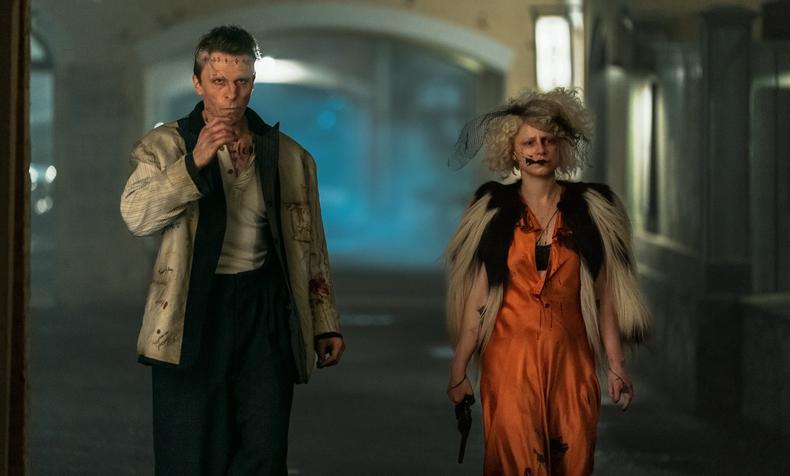
Christian Bale as Frank and Jessie Buckley in “The Bride!” Credit: Niko Tavernise
The performance styles here are varied, with Buckley giving an unhinged, feral performance, contrasted against Bale’s more quiet and contemplative role. Buckley is a Royal Academy of Dramatic Art graduate while Bale has no formal acting training. For Gyllenhaal, the distinctions in their backgrounds was part of the thrill.
“One of the real pleasures for me as a director is opening myself up to each actor’s mind and heart, and the different things that they need in order to do the work that I want them to do,” she says. “I get to be very intimate with each of my actors and look right into their minds and hearts, and every one of them is different. Even if they had similar training backgrounds, they’re each very different and need different things and want different things. It’s so much more interesting to watch an actor working at the edges of what they understand about themselves and actually having to learn something about themselves onscreen, [rather] than watching them pretend to learn something onscreen.”
Gyllenhaal’s own acting philosophy aligns closely with Lee Strasberg’s Method. “One of the things about Lee Strasberg’s Actors Studio is that it really invites you to bring yourself into the work. Why did this role find me right now? Why did I choose to take it? What is it offering me that I need to express?” she says.
If she had one piece of advice for burgeoning actors, it would be: “Bring the edges of yourself, all of yourself, into your work, and use it as an opportunity to learn something about yourself and how you interact with the rest of the world.”
Much of Gyllenhaal’s writing comes from an unconscious place, wherein real people and situations act as fuel for cinematic interpretation. Such is the case with “The Bride!” character Ronnie Reed (Jake Gyllenhaal), a former polio patient–turned–movie musical star whom Frankenstein feels a connection with. The narrative speaks to the desire for representation from marginalized communities, and while Gyllenhaal wasn’t directly speaking toward disability, Ronnie was crafted based on past history from her own life.
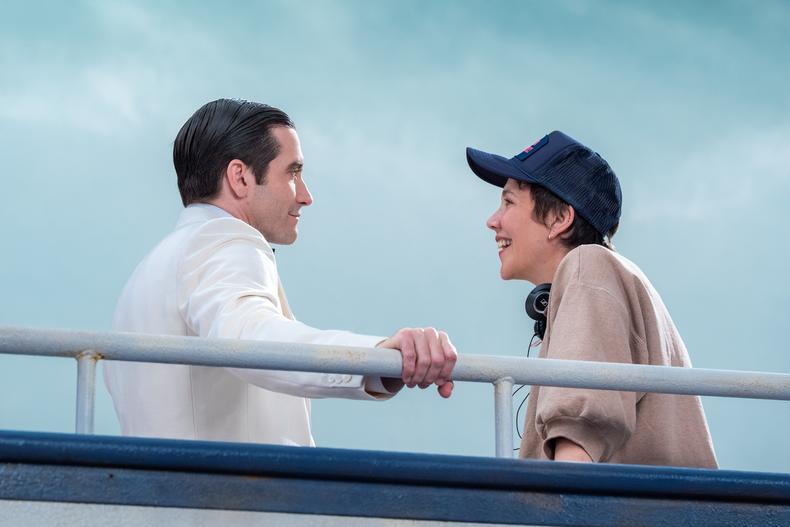
Jake Gyllenhaal and director Maggie Gyllenhaal on the set of “The Bride!” Credit: Niko Tavernise
“That one came from my great-aunt Frida, who in fact did have polio as a child, and in fact, did have special shoes made,” she explains. “She was so of that era, and also so elegant. Also, there’s someone very close to me in my life [who] has Tourette’s, which was one of the original inspirations for the Bride and the way that she speaks.”
Though Gyllenhaal is playing with established characters, she’s quick to note the movie is not a direct adaptation. But the director has certainly worked in that space before, adapting Elena Ferrante’s 2006 novel “The Lost Daughter” in 2021. “It’s a nice place to start, because it’s much more difficult writing an original screenplay than an adaptation,” she says. “It’s helpful to interact with someone else’s mind. That might be the only way to get this monster story told…. Here, it was just me and Mary Shelley, but my totally made up imagining of her. The thing with all of this work is to allow yourself to really be a part of it.”
 How to Become a Movie Director in 9 Cinematic Steps
 “The Lost Daughter” established much of what makes Gyllenhaal’s work so fascinating. It’s unrepentant in its themes of suppressed female rage and antiheroism, all of which are also included in “The Bride!” “When ‘The Lost Daughter’ came out, it hit a little vein, and I think it was because we were being honest about things that are difficult to think about and talk about,” she says. “There was some excitement about that. Here, my question to myself was: What if I’m really honest again, but in a much bigger way, with a different kind of scope? Could we hit a bigger vein? Could there be blood all over the room?”
Shelley was a large inspiration for Gyllenhaal, who calls the author “radical.” She wanted to know if there were more things in the author’s mind that couldn’t be published—or even thought—in the 1800s. Despite Gyllenhaal attempting to “shake her off” a few times, she embraced Shelley as a seminal part of the film. “She just kept making her way into the movie…. She’s a provocateur.”
Other movies were also sources of inspiration—not just the original “Frankenstein” films, but Mel Brooks’ 1974 comedy “Young Frankenstein.” “Going to the movies, sitting in a theater next to strangers, and asking yourself to think and feel something a little bit radical,” Gyllenhaal says, “it can be both comforting and disarming. It can change you. You can walk out of a movie different than when you walked in, so that’s why those references are there.”
For Gyllenhaal, the desire for people to experience “The Bride!” in a theater is paramount. But there’s another element at play: the desire to celebrate “Frankenstein” and what it’s inspired in creatives over the last hundred odd years. Shelley’s text has more often than not inspired male creatives to tell this story. With “The Bride!” the desire is to, literally, put the story back in its creator’s hands. Gyllenhaal accomplishes something audacious and fun, with a wit and elegance that’s impossible to ignore.