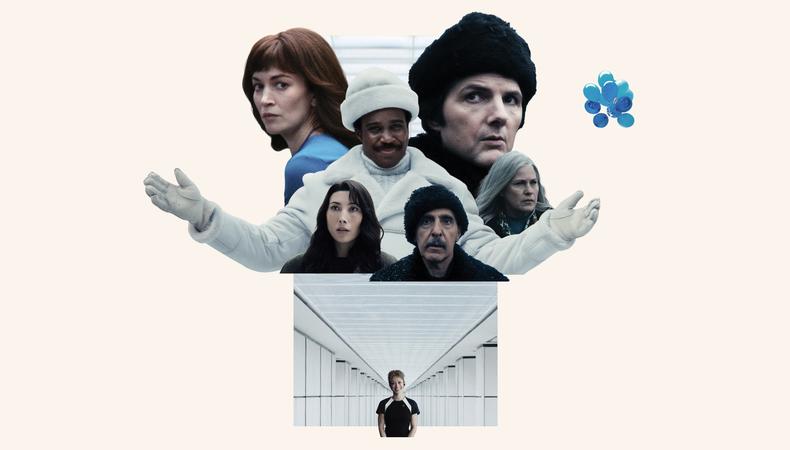
The cast members of Apple TV+’s surrealist existential sci-fi series “Severance” face an extraordinary acting challenge: playing characters with multiple personas. For the actors portraying severed workers (Zach Cherry, Britt Lower, Adam Scott, and John Turturro), this means transitioning between the split consciousness of their innies and outies; for those taking on the role of the severed floor’s managers (Tramell Tillman and Patricia Arquette), it requires navigating the more subtle nuances of their characters’ fractured belief systems.
Here are their most illuminating insights on bringing creator Dan Erickson’s concept to life and on the craft itself.
Acting expands the boundaries of who we are.
“I’m so limited as a person—why would I want to limit my art? Part of why I feel so grateful for acting is because of how it’s allowed me to expand as a human being and as an artist.” —Patricia Arquette
“I think we make art in order to understand what it means to be human. That idea is at the core of [‘Severance’] in a really big way. It’s something I will always carry with me when I meet a new character.” —Britt Lower
“The problem is that I love what I do. Many people aren’t fortunate enough to have the chance to follow their dreams, and I know that to do what I love is a gift. For me to even be considered an artist is high praise—and a tall order. That’s because there’s a calling for artists to inspire and even provoke change.” —Tramell Tillman
“Part of my job is to create something and also to unzip…and not be afraid to do that. It’s very interesting, the idea that you found this other person that you admire, and you share similar qualities with them. And then you can reflect that back on yourself. Because if you exude the same traits, it’s sort of like the act of love is self-regenerating, which is pretty beautiful.” —John Turturro
Building a character takes time and commitment.
“One of the main ways I thought about [the innie/outie dichotomy] is that my innie is sort of a version of my outie who has way less life experience—so he has less baggage, less things weighing him down, but he also is much more naive.” —Zach Cherry
“As we got further and further down the road, the elevator transitions got easier and easier once going back and forth became more habitual. As I got to know each of [Mark’s innie and outie] better and better, I was able to know exactly what those contents were that I was either getting rid of or putting back in to have that internal shift that would need to happen.” —Adam Scott
“[To become Milchick,] I would watch nature documentaries like ‘Planet Earth’ and really study the birds and mammals and reptiles, and just start allowing my imagination to really explode…. I just really had fun finding ways to incorporate that animalistic behavior and fusing it with the intentions and motivations of the character.” —Tramell Tillman
“I like to create something physically, vocally, and costume-wise that I can get lost in the world of my imagination—and then bring all of myself and knowledge of things that I do know to that. The stuff that I don’t know, I try to find out. I’m an investigator.” —John Turturro
Great work emerges from collaborative chemistry.
“You know what I do love and hate? It’s the internal conflict: You never know what great surprise there is. All of a sudden you’re like, ‘Oh, my God, this is such amazing writing, I can’t believe they’re making this, I love that writer, I love that other actor, DP’s great.’ It’s kind of like Christmas when all of a sudden something comes out of nowhere. My career is so much better than it ever could’ve been had I projected everything or made every project happen.” —Patricia Arquette
“Whatever it is that the director or writer wants is what I’m trying to get to and achieve, but not just for them. I’m also trying to do it for me. I think us coming together in the middle of that is where we’re going to end up. That’s where the ‘magic’ might come in, is that intersection of what we’re all going for. It’s not just me trying to please someone else—it’s that middle area where we’re all coming together. That’s where a lot of great stuff happens.” —Adam Scott
“I think people who have fun together, you can go further, you can go deeper, you can be more emotional, you can be more vulnerable.” —John Turturro
Keep learning, growing, and trying.
“I didn’t want to be the person who didn’t try their dream because they were afraid, didn’t attempt to be successful because of fear of failure.” —Patricia Arquette
“Find ways to learn about yourself. Allow yourself to evolve, stay rooted in positive communication and community, and love yourself.” —Tramell Tillman
“Getting to know who you are, developing who you are, and trusting who you are, that can be enough, as long as who you are is expanding, growing, and curious, and not stagnant.” —John Turturro
“Make sure you’re going in for the right reasons and that it’s something that really interests you and that you need to do…. If you’re doing it for the right reasons, you can have a career in it.” —John Turturro