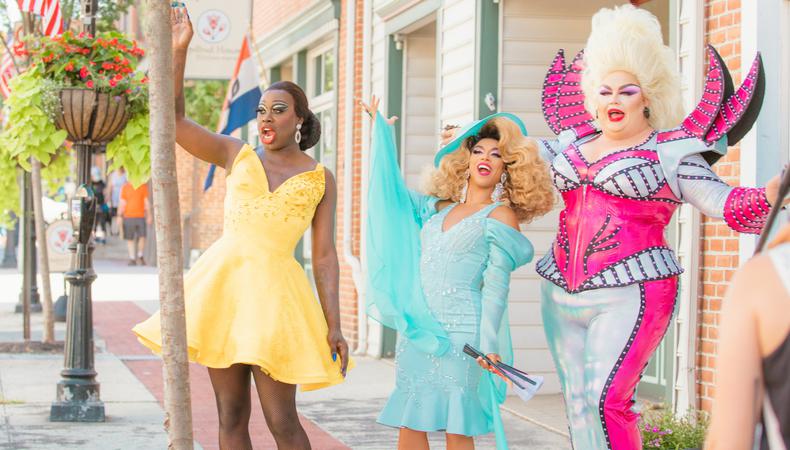
Taking some inspirational notes from the Emmy Award–sweeping, mother-of-all-drag-series “RuPaul’s Drag Race,” HBO’s “We’re Here” was a breath of fresh air on the small screen this season. Not only did it bring together three of that drag competition series’ best queens—Shangela Laquifa Wadley, Bob the Drag Queen, and Eureka O'Hara—but it fostered a message of sea-to-sea unity and strength in queerness and allyship, despite the current state of the country and world.
The premise of “We’re Here” is simple: Its three hosts are sent out on the road with their creative teams (including lead costume designers and veterans in the drag world space, Diego Montoya, Josh “Domino” Schwartz, and Patryq Howell) to pay visit to small town (often conservative) Americans. There, they’d organize a town-wide drag revue featuring makeovers and lipsyncs from three of the town’s own. As moving as it is entertaining, it checks as many “Queer Eye” boxes as it does “Drag Race” in the best possible way. Helping lead the charge on these jaw-dropping makeovers were the aforementioned designers, all of whom sat in conversation with Backstage to pull back the curtain on what filming “We’re Here” Season 1 was all about.
 How Shangela Went From ‘Drag Race’ Superstar to ‘A Star Is Born’ Scene-Stealer
 This is the first time that you three have been lead costume designers for a television series. How did that all come together?
Diego Montoya: I’ve worked with Shangela on three different occasions. We did the Oscars together, and then her premiere for a film. But before that, I’d worked with Bob and Eureka, as well, and I think Domino, too. You know, it’s a very small group of designers that kind of work with the same queens. It’s not a lot of us, so we were just sort of the ones that work with them the most.
Patryq Howell: And I’d worked with Eureka before we did this project together. So I already knew Eureka, and I’ve worked with Shangela before, too, and Bob, as well, just a little bit.
Josh "Domino" Schwartz: And I’ve worked with Bob a lot. I did barely anything for him when he went to go shoot “Drag Race,” but as soon as he came back, I’ve been working with him ever since on a lot of stuff. Not that he hasn’t used plenty of other people, as well, but when he approached me about coming on to do the pilot for this show, it just went from there.
What especially excited you three about being a part of something like this?
JDS: I’ve done some other drag “makeover” shows before, and I think what was exciting was that it was about going to the place and getting to know the person and their community. The drag makeover part is a big part of it, but it hinges on who they are and where they’re from more so than just, “Great, nice to me you! Let’s put a wig and lashes on you and it’s fierce.” That it went about getting into the stories of these places, as well, and how people fit into these places, that was what drew me into it.
PH: I had no idea what to expect. It was my first job like this ever. And I didn’t do a lot of traveling because I’d just never travelled before. So, you know, putting a kit together and a whole work space together in a hotel room was a whole new deal for me, and flying anywhere was just a little intimidating at the beginning. It was exciting and made me very nervous to do it.
DM: I mean, it’s a new model, really, because there are shows like this, but they are makeover shows, and [this isn’t] really that. Actually, it’s all about the performance, and then through costume and the drag telling their story. That’s exciting just because I hadn’t seen a show like this before. But then also, traveling across America and meeting all these other people, that was exciting to me.
What did the actual collaborative makeup look like on the show? Are you each assigned one of the three queens and then you’re on their designated team?
DM: Every queen has her team, so I’m with Shangela, Domino does Bob, and then Patryq does Eureka.
“In most of these places, we’ve got a Walmart, a Home Depot, and a Joanne’s to shop at. Or suddenly you’re going, ‘Oh, shoot, I need shoes in a size 13,’ and Amazon doesn’t deliver to the middle of nowhere in less than a week and a half.”
And how did you come up with the various towns’ themes from there?
JDS: Well, we kind of get told what the theme is going to be, and sometimes we’ve had a little bit of input as far as saying, “That’s not really gonna work,” or, “Hey, what about this?” But we kind of get assigned a theme as a group, and I think it gives us a good jumping off point. As the season had gone by, we’d reach out to each other more and more, like, “Hey, Bob’s gonna wear purple,” to make sure that they stay as their own individual thing but also kind of come together as a group, or have enough contrast to keep them so that we’re not sort of two in one and one and two, or something like that…. I think it helps just to have a starting point because otherwise, you can sort of be floating in the midst of everything trying to figure out something to grab onto in these places—I’ve never been to any of these place before, so to have some way to grasp onto what the community might be like [was important].
DM: It’s interesting to see how each queen interprets the theme, because each queen is their own character. So to see them interpret the same theme and message was really cool, actually. It’s a beautiful thing.
In any drag show, the entrance look is so important, and you’re probably used to the response being pretty universally gagged and enthusiastic. But what’s it like for you to watch it back and see different responses from the community they’re in?
JDS: To speak for myself, I come from a small town in California, and this was me at 18 walking about and getting those reactions, so I kind of think it’s refreshing to see it on the other side. And also to see how many people, even if they’re shocked by it, kind of will embrace it because you get over that and then it’s just kind of fun. And I think that’s been part of trying to come up with some of these looks, is a way that lets people in on the joke and the fun of it.
DM: I am surprised how well they were received, actually, because I wasn’t sure what would happen with these three huge drag queens walking around in the middle of town. And most people were really receptive, they were lovely. Kids loved them. We were received, for the most part, pretty well.
READ: How to Get Started In Costume Design
And what was your relationship like with the subjects of the actual drag makeover?
DM: I mean, the hardest thing for all of us was that the story was being developed in real time. So we were trying to make things and plan, but it’s a 10-day period, and we’re getting to know the character, their story, the performances, you know, as they’re figuring it out. The song has to be chosen, has to be approved. So a lot of things are up in the air for most of our prep time. So just being able to be flexible was really important, and just make due with what we had around us.
PH: You had to think on your feet. Everything is moving really quickly, so you don’t know what each town has as far as materials that you can get. The story has to change around the songs that are available. And usually, Eureka and Bob and Shangela have the consultation with the drag daughter, and they’re the ones that choose the storyline.
JDS: We’re trying to come with as much of an idea as we can of what it’s going to be and what we’re going to need, but you don’t know until halfway through if not longer what the final result is going to be. [And] in most of these places, we’ve got a Walmart, a Home Depot, and a Joanne’s to shop at. Or suddenly you’re going, “Oh, shoot, I need shoes in a size 13,” and Amazon doesn’t deliver to the middle of nowhere in less than a week and a half. There’s a lot of flexibility and a willingness to bend and figure it out [or] realize, I thought this would be fine, and that’s not what it is, so let’s jump over to the side and figure out how to make it happen without losing any time making those decisions.
 RuPaul on How Not to ‘Give a F*ck’ About Auditions
 So just in that sense, do you feel like this experience made you stronger designers?
DM: For sure.
PH: Oh yeah, definitely.
JDS: Yeah. I would also say, especially after the first episode where we are all in the same room, for Branson, Missouri, I think that that was beneficial probably to all of us. Just watching other people work, because all of three of us have just such different strategies of how we go about everything from design to construction to, you know, all of these different elements. And getting to watch these other two people work in these ways. Patryq and I always joke with each other about the amount of time that we spend on various things. And I’m like, “You just sewed 500 million scales onto a costume, don’t talk to me about what you spend time doing!” But it’s funny and interesting to see those different ways. I think that it helped all of us to kind of grow through this process.
PH: We all relied on each other quite a bit after we were all put in the same room together.
“Know that this is a growing process and you just have to start somewhere. It may not be the perfect thing that you envisioned, and you may not have the resources and the money, but you just have to start somewhere and keep doing it. Nobody gets better by waiting and hoping.”
You said at the top of this interview that the community of fashion designers for drag performers is pretty tight knit. What advice do you have for someone who wants to get going in the field of fashion and costume design?
DM: I think it’s important to collaborate with your community. That’s how I started. Just making things for our friends, for ourselves. Starting with these small projects, I think it leads to bigger things. So keep collaborating, keep taking on projects.
JDS: I would say that for me, this has been a long time coming. I think the first drag costume that I made for somebody else was for Peppermint in 2005. And looking back at it now, it was fine but not great. But know that this is a growing process and you just have to start somewhere. It may not be the perfect thing that you envisioned, and you may not have the resources and the money, but you just have to start somewhere and keep doing it. Nobody gets better by waiting and hoping, so I think that would be my biggest thing: If you know somebody that needs something, figure out how to make it for them, and start.
PH: I’ve been around for 30 years, so I think that if people really wants to do this, they have to be dedicated to it completely. You can’t be half-in, half-out. You have to be completely dedicated to it because it’s a long process and it takes time. You just really, really have to put your heart into it. When I started out, everything I did was awful for a little while, but I never stopped. I quit my other jobs and all I did was make costumes. So you’ve gotta be all in.
And to bring it back to “We’re Here”: What do you hope viewers walk away with after watching Season 1?
PH: That they’re not alone. That there are people out there who have similar stories to theirs. They’re not isolated from the rest of the world by what’s happened to them. There are plenty of people out there with stories and with things to talk about that you can relate to. You’re not alone.
DM: And in your community, there’s a community of other queer people or people who are like-minded. You may not see them, but I think this show shows that there’s often more support than is visible.
JDS: One of the things that was always pretty incredible to me was on show day itself, the number of people that pack every one of those venues. Again, we’ve been in these towns for the last 10 days, and you’re like, “There’s nothing here, there’s nothing going on, there’s nobody that wants it.” And then all of a sudden, there’s a couple hundred people in New Mexico that are lined up around the block. Same thing in Louisiana, and you would never know. I think it’s hard for people to break out and find that, and I’m not sure I have the answer on how to find that in your local community, but it is there. You’re not alone.
Looking for remote work? Backstage has got you covered! Click here for auditions you can do from home!