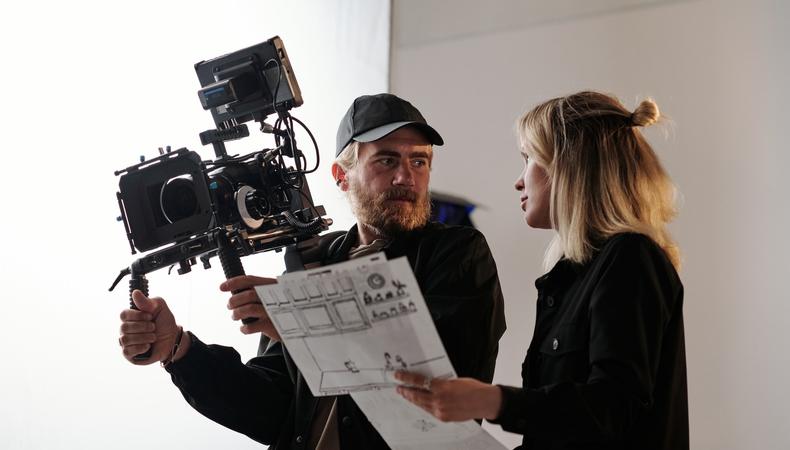
Features might get all the glitzy attention, but short films are the backbone of the cinematic world. From Martin Scorsese (“The Big Shave,” 1967) to Wes Anderson (“Bottle Rocket,” 1994) to Christopher Nolan (“Larceny,” 1996) to Ava DuVernay (“Saturday Night Life,” 2006), a ton of your favorite filmmakers cut their teeth on the art form before rocketing to fame.
Want to follow in their footsteps? Here’s how to get your ideas from page to screen.
Short films are a calling card for an early career filmmaker. They’re proof that you have the talent and the ideas worth taking a chance on.
In Hollywood, “taking a chance” most often means “spending a lot of money.” Let’s say you’ve just conceived the next brilliant hard science-fiction film. It spans several continents and is a cross between “James Bond,” “Blade Runner,” and “Game of Thrones.” The thing is, in order to really do it right, you’re going to need a budget well into the seven figures.
OK, you quite obviously don’t have that. You could send your unsolicited screenplay to a score of production companies and literary agencies, but that is a process that will take a long, long time, with a very small success rate. Even if a studio head read your script and agreed it was the next big thing, how will they know you have the ability to direct such an enormous project yourself?
Maybe “James Bond the Blade Runner in the Game of the Thrones” is an extreme example. But the point is, making any feature costs a lot of money, and if you don’t have a ton of work under your belt, you’ll have a hard time convincing someone with deep pockets you can handle it. A proof of concept is one way to circumvent the process. The practice is so canonized that the American Cinematheque in Los Angeles now produces PROOF: an entire festival devoted to proofs of concept for both movies and television.
And to be clear, maybe you’re so early in your filmmaking journey that you aren’t ready for the next level. In that case, short films are a low-cost, low-stakes way to learn everything there is to know about making a movie. There’s no substitute for experience. Grab a camera (or your smartphone), a skeleton crew, and shoot a story that’s 5–10 minutes. Then do it again! Don’t aim for any cash prize; aim for the best execution of your ideas.
Where to start
First things first, you have to write a script. As far as coming up with ideas, start from anywhere. Write something you feel you have to say for your own sake, and trust that, through your story, people will learn more about themselves. Or just write a hilarious sketch.
Whatever your writerly poison, start from a place of truth and see what comes out on the page.
How long should it be?
The creatively true answer? It should be as long as it needs to be for the story to be right.
The logistically true answer? The overwhelming majority of film festivals adhere to the Academy of Motion Picture Arts and Sciences’ time limit definition: Anything less than 40 minutes is a short; anything 40 minutes or more is a feature.
If you’re eyeing a festival run, keep in mind that the longer your project, the harder it is for programmers to fit it into the schedule. When an event receives hundreds (and even thousands) of submissions, tough decisions have to be made. If the choice is down to one 35-minute film or seven five-minute films, the longer story has to really earn that chunk of time.
Regardless, it always bears repeating: Focus on your story first. Deal with the logistics later.
“I have a short film script—now what?”
Are you hoping to direct your own piece? Or are you outsourcing your words to a trusted and experienced captain? Either way, the next logical step is looking for a producer (or producers) who can help with funding and business logistics. At this stage, you need to be very specific and honest about your budget. Apart from the actual writing of your script, figuring out the budget is the most important step of the preproduction process; that is not something you’ll want to be figuring out late in the game.
“I…need…a lot of money to do this.”
Unless you’re in the lucky minority of indie filmmakers with fat wallets, you’re likely going to need to raise funds. Even if you determine that your short will only cost $2,000 to make properly, you’ll still want that money to come from somewhere—because eventually you will also want to spend some money on film festival submissions, marketing campaigns, and travel arrangements.
If you can front that cost (or some of it, at least), good for you! If not, explore crowdfunding options like Indiegogo, Kickstarter, and Seed&Spark. This is also where networking is key. Hopefully, you’ve partnered with a producer who can help, and they know someone, and they know someone, etc.
When in doubt, return to your script and production plan to see if there are ways to keep costs down. Can two characters be combined into one? Is it possible to cut that first scene and get right into the action? Do you actually need that giant car crash, or would an offscreen sound effect serve the same purpose? Remember: Limitation breeds creativity.
“The budget is set, I have some money to play around with, and my script is locked in.”
Fantastic! Now you need a crew and a cast. Of course, Backstage is a simple way to find both performers and below-the-line talent. Even on a low-budget skeleton production, aim to fill these 11 positions:
- Actor
- Producer
- Director
- Director of photography
- First assistant director
- First assistant camera
- Gaffer
- Sound mixer
- Production designer
- Hair/makeup artist
- Production assistants
If that list looks intimidating, get creative with doubling up (this will also keep your costs down). Maybe you can serve as both director and lead performer. Perhaps your producer knows a hairstylist who can hold a boom mic. Watch a few YouTube tutorials on special effects makeup. This is indie film; embrace the DIY ethos!
The various entertainment industry unions are also a helpful contact for finding cast and crew; start with International Alliance of Theatrical Stage Employees (ITASE), the Directors Guild of America (DGA), and SAG-AFTRA. With smartphone technology being what it is these days, you can also opt for the real DIY version: getting a friend to use a phone to shoot. A one-person crew is still a crew.
Make the damn thing!
This step is pretty self-explanatory. But it’s important to remember to enjoy this part of the process as much as possible. It’s a special gift to make art.
After shooting, you and your editor—which can just be you, if you know how to work the software—piece it all into one, beautiful, cohesive piece. You’ll probably also seek out a sound editor to clean up all the audio that was damaged from the strong winds on the day of the shoot, or color corrector to really make those black and whites pop and those blues look like blues instead of…whatever that is. But suddenly, your film is complete. What you do with it next is up to you. The sky’s the limit!