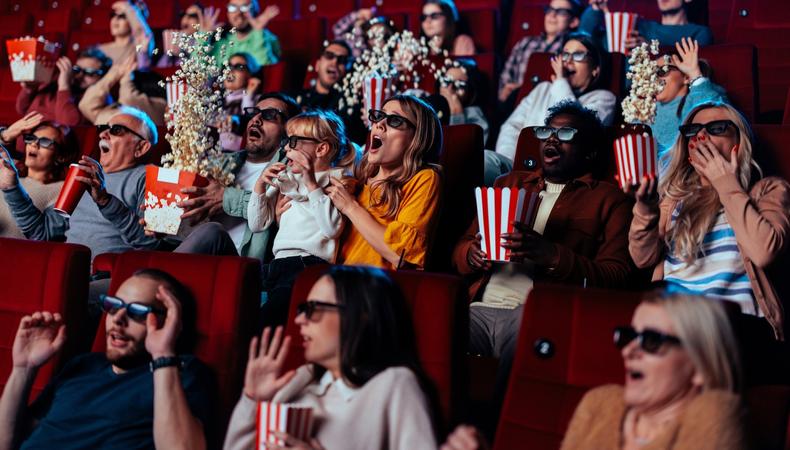
It’s one of the most well-worn tricks in the horror handbook: An innocent victim is minding their own business, nothing happening, and then…something happens to make the watcher’s heart skip a beat. The jump scare might have a bad rap, but it isn’t inherently cheap or lazy. It’s a tool like any other in a filmmaker’s arsenal, the same way a hammer can either help hang a painting or make a hole in the wall. Let’s dive in.
JUMP TO
It is exactly what it sounds like—a frightening moment, usually in a horror film, designed to make viewers jump in their seats. It involves a sudden, unexpected image and/or jarring sound. Some of the most common attributes of this technique include:
- Tension (or lack thereof): At their most unexpected, jump scares aren’t foreshadowed. Something completely mundane could be happening in a scene when something terrifying appears out of nowhere. This can often feel cheap, because it doesn’t require a sense of timing or any filmmaking skill. On the opposite end of the spectrum, a jump scare can be utilized as a release after the filmmaker builds up palpable tension within a scene.
- Sound: Jump scares often use a jolt of sound to go with its visuals, whether it’s a sharp musical cue or something within the scene like a slamming door or screeching cat.
“Cat People” (1942, dir. Jacques Tourneur)
“Cat People” is widely credited with having horror cinema’s first jump scare. The scene sees Alice (Jane Randolph) walking home alone at night, afraid that she’s being followed. Tourneur’s use of shadows keeps much of the frame in darkness; combined with the sound design, the audience is as on edge as Alice when a bus loudly enters the shot.
The bus’s arrival actually acts as a relief as Alice gets onboard, safe for the time being. It’s a classic fake-out, where the abrupt thing isn’t actually something to be worried about (which, in turn, makes it even scarier when the threat does arrive). “Cat People” set the bar for the way filmmakers can use fear as a release of tension.
“Carrie” (1976, dir. Brian De Palma)
“Carrie” concludes with Sue (Amy Irving) leaving flowers at the grave of the now-deceased Carrie (Sissy Spacek). It’s an idyllic moment, as Sue is dressed in white with a fanciful score playing. However, Carrie’s bloody arm emerges from the ground, grabbing hold of Sue and sending audience members out of the theater with their hearts racing. “Carrie” was a hit, and horror movies have been replicating its one-last-jolt scene to this day.
“The Exorcist III” (1990, dir. William Peter Blatty)
William Friedkin’s “The Exorcist” is rightfully considered one of the best horror films of all time, but “The Exorcist III” deserves some respect. One of its most haunting moments comes during a long take of a hospital hallway. It’s a mundane moment, where the audience is almost lulled into a meditative sense of security as a nurse goes about her business. No tension, no build up, but it lasts so long that it becomes a form of tension. Because the camera stays static, the viewer is scanning the frame for what they should be looking for. Then, the score crashes in and the camera zooms in on the nurse leaving a room, completely unaware she’s being rapidly pursued by an assailant.
The film jump-cuts to a shot of a headless statue, an astounding way to use clever editing to get a point across without explicitly showing any gore.
“The Descent” (2005, dir. Neil Marshall)
In “The Descent,” a group of women get stuck in an unexplored cave system, which is already a terrifying premise in and of itself—and then the film introduces monsters. When the time comes for that terrifying twist, Marshall uses such careful precision. We’re seeing what happens from a first-person POV through a camera’s night vision. As the women start panicking—the camera moving rapidly to echo their anxiety—we very suddenly see a creature standing just behind one of them.
What’s even more effective is the choice to delay the loud music cue until a second after the monster comes to light. It forces the viewer’s mind to try to process what they’re seeing before properly getting startled.
What makes a jump scare ineffective?
Numerous factors can lessen a jump scare’s impact. While there are certainly no hard-and-fast rules, the following facets tend to lead to a less-than-stellar end result.
- Overuse: No horror filmmaker should rely completely on a single trick. For example, Tom Elkins’ “The Haunting in Connecticut 2: Ghosts of Georgia” boasts more than 30 jump scares in its 100-minute runtime, or about once every three minutes.
- Poor timing: Everything should come together for a great jump scare; the tension, the score, even the way you play with expectations. If the various elements are off, the moment falls flat.
- No thematic relevance: A fake-out can result in a good jump scare…but you need to be careful. Having something pop out of nowhere that doesn’t connect to the scene or story will mostly just feel random. Let’s look at an infamous example:
“The Amityville Horror” (1979, dir. Stuart Rosenberg)
The original “Amityville Horror” features one of the worst (but kind of funniest) jump scares when George’s (James Brolin) cigarette break by a window is interrupted by a hissing cat. It is startling, but it doesn’t tie into anything that’s actually scary about the film. Not only that, the moment kick-started a trend of animal-based jump scares. The one good thing to come from this trope is this hilarious scene from “Community.”
There are many ways to go about crafting an iconic jump scare, but it all really comes down to one thing: misdirection. The characters, and by proxy the audience, shouldn’t know what’s about to happen next. Even if the tension suggests something’s about to appear, it should happen in a way we weren’t anticipating.
Jump scares are a collective effort between screenwriters, directors, editors, sound designers, and many other artisans. Let’s take a look at this moment in the deer scene from Jordan Peele’s “Get Out,” starting with how it’s formatted on the page.

Rose and Chris are messing around when their car strikes a deer. You can feel the intensity of the moment on the page with the onomatopoeias “SMACK” and “THWAT-THWAT” capitalized; these will be the loud sounds that catch the viewer off guard.
And it, indeed, comes out of nowhere in the finished scene.
Everything works in tandem to make this moment work. The familiar, loving banter between Rose (Allison Williams) and Chris (Daniel Kaluuya)—and even the soothing sound of a car on the road—goes on just long enough to get us situated and comfortable. And unlike “The Amityville Horror” cat scene, this “Get Out” jump scare has thematic relevance, alluding to tragic events in Chris’ past and explaining why he later gets out of a car during a dangerous moment.
Acting scared onstage and in film is its own skill, and a jump scare specifically offers some challenges. For starters, you know something is about to occur, but your character doesn’t. Work on staying present in the moment. Don’t focus on the result; focus whatever your character is doing before the scare. Allow yourself to actually feel surprised.
If the scene calls for a big reaction, it’s paramount you learn how to scream safely. A good horror moment might require a few takes to get it right, so take care of yourself physically as well as emotionally.
Great jump-scare acting also calls for precise body language and facial expressions (as well as those hard-to-capture microexpressions). How you look, move, and hold yourself tells the audience how to feel. Are you already tensed up? Can you hear something that we can’t? Are you completely relaxed while the viewer shouts “He’s right behind you!”? Your performance is a key part of the equation. Work with your director to figure out how you want the viewer to feel, and see if you can broadcast that feeling with your physicality.
There are many horror movies for actors to study to learn more about the art of conveying fear. Before long, you’ll be an expert—even if it’s just a cat in the corner.