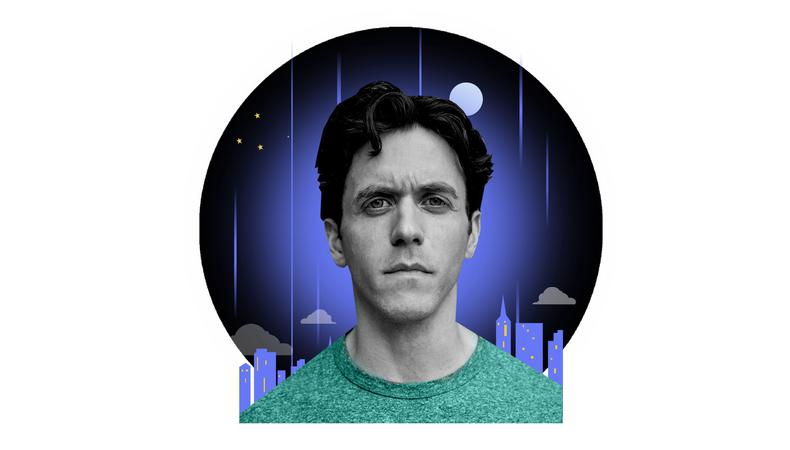
Over the last few years, Ashley Zukerman has been popping up everywhere on the small screen, appearing on hits like HBO’s “Succession,” FX on Hulu’s “A Teacher,” and in Netflix’s “Fear Street,” to name a few. Beginning Sept. 16, he’ll once again return to TV leading Peacock’s “Dan Brown’s The Lost Symbol,” on which he plays Harvard University symbologist Robert Langdon, sent on an emblem-filled journey to rescue his kidnapped mentor. Here, Zukerman shares how he avoids disappointment and why he values the roles he’s booked through auditions.
What was the moment you decided you wanted to be an actor?
The answer to that question has continuously changed over the last 25 years. I’m one of four children and, at the time, I thought it was as simple as vying for attention. There was something about that that drew me to school plays. Over time, I think I’ve understood [it was] about expression and about trying to articulate something. Every role does allow me to do that. I’m not one of those people where it was one moment or I saw this performance or I saw this film and it made me want to do that.
Tell us about your first day on a professional set.
I came up in Australia and I was really lucky that straight out of school I was hired in a play. It was a production of “The History Boys.” Just to be paid as an actor was something I didn’t think was going to be possible. I had gone to university and done engineering and then I got into art school and said I’m going to do this for three years. To be able to start working and exercise what it was I had been trained to do was very rewarding and also very validating and helped me to process what I had been doing for the last three years. The first television show I did was a production called “The Pacific,” which was this huge HBO series with an insane budget and 300 extras and a crew of 150. We were filming out in the middle of the wilderness in my hometown. I was so green. I didn’t understand anything that was happening. It took me a while to actually feel comfortable with that experience as opposed to a rehearsal room, which at that point felt quite comfortable.
“If I haven’t gotten things I’ve wanted, I've mourned them and then gone back to work. But typically, I really do believe that if I’d fit the project, then I would’ve gotten it.”
What advice would you give your younger self?
Try to just remember your own individuality. Your own unique response to the material is so necessary. There’s a draw to try to imagine what it is someone else wants. I fell for that trap. It’s so important to ask yourself, “How are you connecting to this material?” Something I experienced in America was, the wealth of talent is so incredible and the pool that people had to draw from is so big, the question isn’t, “Who’s the best actor?” The question is, “Who has the soul that’s right for a role?” If they want us for the job, that’s great. And if they don’t, it’s clear they’re looking to explore something else. It’s something that’s given me comfort over the years.
What is your worst audition horror story?
I did walk into an audition and the director asked me what I thought of the script. It was early on and I took that question very seriously and I had notes. I ended up giving this director a whole bunch of thoughts that he clearly wasn’t asking for. The whole experience went downhill from there.
What’s the wildest thing you ever did to get a role?
If I haven’t gotten things I’ve wanted, I've mourned them and then gone back to work. But typically, I really do believe that if I’d fit the project, then I would’ve gotten it. And if I didn’t fit it, that’s probably not a project I want to be a part of. I don’t want to be on set trying to work against instincts. I’ve always enjoyed the roles I’ve gotten through auditioning more than I’ve enjoyed the roles I’ve been offered. The roles I've gotten through auditions, I typically think of as they’re seeing something that I’m not even aware of in myself or in my performance. Then I can walk on the set and feel very comfortable. It’s odd how that has kept me very levelheaded.
Did it take you a long time to get to that mindset?
I don’t come from an artistic household. I genuinely didn’t know if there was a place for me in this. So for a long time I thought, I’ll just keep working hard. I did have that from a pretty young age. I found that I was always making the practical decision. I knew that the reasons I would get upset about auditioning were if I thought I hadn’t prepared enough or I hadn’t given myself the best possible chance. Very quickly, I eliminated that from the possibilities. What else happened early on was, if I didn't get a role that I would sweat about, I’d see the project back and think of course I shouldn’t have been in that. Of course they needed that person. It gave me ease.
How did you get into the union, both in Australia and abroad?
Out of high school, I got my Australian union card. I think it was called a 50 word-er in Australia at the time. If you said 50 words or less they could pay you a certain amount. I played Thug No. 2. I had to run and be a little thuggish. I was 12 or 13 and that was my first role. Twelve years later, I got to the States and my first role was on a show called “Manhattan,” which was Sam Shaw’s show about the creation of the atomic bomb in the 1940s, which was a dream project. The cast, the writing, the production, the directing, everything about it was so incredible. That gave me my American SAG card. I remember thinking it was the first time I understood how this American model of work is geared toward bringing the best out of everyone. It’s about letting everyone do their work as well as they can and it was an inspiring situation and a brilliant show.
Would you consider that your big break?
I would. It was a big break for me personally—this is where I should be and this is what I should be doing—and it was a big break professionally. It was something a lot of people saw and it was really respected. The collaborators are still my friends today, the writers and directors and cast. I’ve always loved it when I've been cast for something despite myself; where I was cast for something that the writers thought they needed, that I wasn’t even aware I had. There’s a few moments where that’s happened: “Manhattan” was one, and “Succession” was another. And recently, “Fear Street” and now “The Lost Symbol.”
What has playing Robert Langdon in “Dan Brown’s The Lost Symbol” added to your acting skills?
This role specifically, he doesn’t know where he's going and it’s a very in-the-moment experience, scene-to-scene. He’s just constantly trying to understand and survive and rise above the situation he’s in. That’s become an interesting and fun place to be while working.
What performance should every actor see and why?
I recently took myself for a little bit of a film education, something I just hadn’t done before. I went through and watched classics. I came across “A New Leaf.” It’s astounding. It’s Elaine May, it’s one of three or four films that she directed, it’s her and Walter Matthau. Her performance is so incredible and she wrote and directed it as well. Definitely as a younger actor, I spent a lot of time being enamored by the great performances and over time, I see that sometimes those performances got in the way of stories. I was watching performances and I wasn’t watching stories. I would say people should go and watch great films. Usually in a great film you get great performances. We can’t do what we do in a vacuum. We have to have great writing and a great director and a great ensemble and a great crew. That’s the only way great work ever happens.
Looking for remote work? Backstage has got you covered! Click here for auditions you can do from home!