Most films made for streamers rush to grab the audience before they can keep scrolling. They’ll start in medias res or offer up so much bombast that you can’t look away. But before streaming, filmmakers still wanted to use opening scenes to hook the audience—they were just willing to be a bit more patient in their pacing. This thoughtful understanding of easing an audience in, particularly by revealing character, was essential in crafting some of our greatest movies. It’s easy to lose viewers in the opening minutes, but if you can craft an effective opener, especially with a stunning performance at its center, you’ve got an audience for the next two hours.
Since we’re focusing on actor-driven opening scenes, I consciously stayed away from anything animated (since so many efforts go into crafting animated characters), as well as anything that eschewed traditional acting (no disrespect to the performers in the ape costumes at the start of “2001: A Space Odyssey”). While there are great opening scenes beyond the 11 listed here, these selections, in particular, thrive because of how they center performance.
“Once Upon a Time in the West” (1968)
No one knew how to wield an opening quite like Sergio Leone. Returning to a technique that had served him well in his Spaghetti Westerns, Leone perfectly builds tension with the simple setup of a train arriving at a station while hitmen wait for a passenger. Relying on 15 minutes of carefully chosen shots, edits, and sound effects, Leone constructs a tense standoff between characters we don’t even know, yet it also acts as an incredible introduction to Charles Bronson’s character, Harmonica. Even the men who are gunned down become fully fleshed-out individuals rather than faceless thugs, and it’s this attention to detail that helps set the tone for the brutal outlaws who rule Leone’s picture.
“A Clockwork Orange” (1971)
Has there ever been a better stare down the barrel than that of Malcolm McDowell in the opening of Stanley Kubrick’s “A Clockwork Orange” adaptation? With that single look and his deadpan narration, McDowell lures us into Alex’s psychosis and sociopathic worldview. He charms and disturbs us in equal measure, and while we can’t discount the steadiness of Kubrick’s direction, the stunning art direction, the unique costumes, or the unforgettable Wendy Carlos’ score, it’s McDowell as the haunting center of the frame that hooks us into the movie.
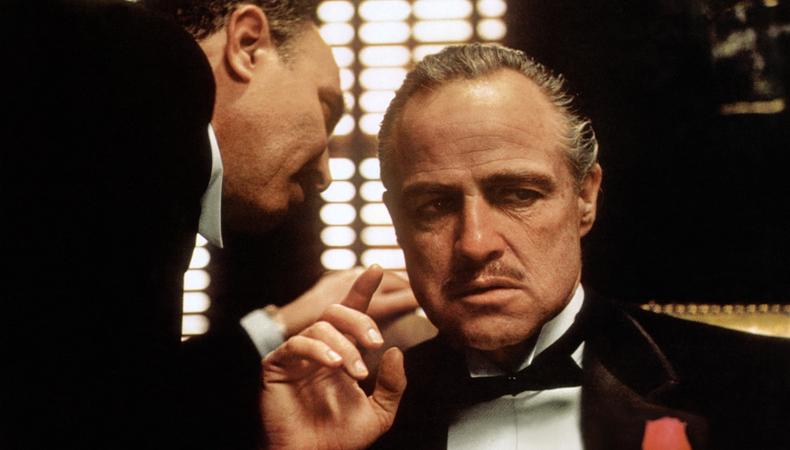
“The Godfather” (1972)
“I believe in America.” Undertaker Amerigo Bonasera (Salvatore Corsitto) is a minor character in Francis Ford Coppola’s “The Godfather,” but his opening monologue beginning with these words is essential to announcing the film’s central theme. Corsitto did an incredible job not only playing a common man searching for justice in a world where immigrants must seek out help from the underworld, but also setting up major character Don Vito Corleone (Marlon Brando). The two actors play off each other beautifully, demonstrating the power dynamic at play, as well as the interpretation of American power through the eyes of two Italian immigrants. While Brando is a titan of American acting, you can’t overlook that Corsitto took the words “there are no small roles” to heart in the first minutes of one of the greatest movies ever made.
“Monty Python and the Holy Grail” (1975)
How many young comedy nerds were transformed by the opening bit of “Monty Python and the Holy Grail” involving the coconuts? While Terry Jones and Terry Gilliam’s comedy has fantastic opening credits (“Those responsible for sacking the people who have just been sacked, have been sacked”), it’s Graham Chapman’s performance as Arthur, King of the Britons, that helps viewers zero in. Because even with all the absurdity, you need the guy who’s playing it straight. It’s as if he knows everything around him is ridiculous but feels compelled to defend it, which is how you get a discussion on how a coconut would come to a temperate zone.
“Apocalypse Now” (1979)
For how much pain and psychosis we see in Captain Willard in the opening of “Apocalypse Now,” you’d be forgiven for thinking the heart attack Martin Sheen suffered while making this movie happened here (it actually occurred while he was out in the jungle). Sheen really did injure his hand during Willard’s breakdown, though, and that’s part of his commitment to showing how desperately disconnected the character is from anything beyond the fog of war. All that’s left for him is madness; outside of combat, he’s useless. It’s a sad statement for the individual who will be our protagonist, but through Sheen, we’re eager to follow Willard into the heart of darkness.
“Raiders of the Lost Ark” (1981)
Has any iconic hero been as well-announced as Indiana Jones (Harrison Ford) stepping out of the shadows of the jungle? And the opening of Steven Spielberg’s classic adventure film only gets better from there: showing the character’s incredible competence, his daring and bravado, and his heroism that can still end in betrayal (what it means to be cynically knowing and yet still wanting to help others), introducing the key villain Belloq (Paul Freeman), and then ending with a terrific little joke as our hero freaks out over a snake. The biggest surprise is how the film only grows more thrilling after such a dynamic intro, one that solidified Ford as a legendary star of his generation.
“Trainspotting” (1996)
Ewan McGregor burst into international stardom in Danny Boyle’s pitch-black drug dramedy as Mark Renton, a heroin addict running through the streets of Edinburgh. And while his opening “Choose Life” monologue is a great accompaniment to Iggy Pop’s “Lust for Life,” the energy and charisma McGregor brings to the performance is what makes it pop offscreen. From frame one, we need to understand that as self-destructive as Mark and his friends are, they also find that self-destruction exhilarating. McGregor is so compelling that when we see him dive into the worst toilet in Scotland to get his fix, we’re still with him. That’s a movie star.
“There Will Be Blood” (2007)
There is no shortage of amazing performances from Daniel Day-Lewis, but this one requires him to stay silent as a means of introduction to his character, Daniel Plainview. While the first act of Paul Thomas Anderson’s epic does eventually give Plainview a terrific monologue explaining himself, the opener relies on the actor’s physicality and presence to show that, as much as we will come to resent and despise this individual over the next three hours, he is a self-made man who built his empire out of the dirt. It’s not even that Day-Lewis and Anderson want us to think of Plainview as honorable—but to understand his transformation from hardscrabble existence to powerful businessman to something pitiable and grotesque.
“No Country for Old Men” (2007)
The Coen brothers almost render their entire film in miniature for the haunting opening scene of “No Country for Old Men.” They choose to set the focus on Javier Bardem’s unforgettable villain, Anton Chigurh, a force of horrific violence set against the desert landscape. Through Chigurh, we see an unrelenting presence who views others as nothing more than cattle to be disposed of (hence his captive bolt pistol) or, at most, provide him the joy of strangling a man to death. This is the world that will confound and dishearten Ed Tom Bell (Tommy Lee Jones) and have Llewelyn Moss (Josh Brolin) running for his life.
“Inglourious Basterds” (2009)
Quentin Tarantino knows how to write and direct an opening scene, so there’s plenty of competition in his filmography. But his best remains the opening conversation between SS officer Hans Landa (Christoph Waltz) and French dairy farmer Perrier LaPadite (Denis Ménochet). It not only illuminates the gleeful sadism and cruelty beneath Landa’s polite veneer, but also the perilous stakes for Shosanna Dreyfus (Mélanie Laurent), who, with her family, is hiding beneath the LaPadite’s floorboards. Even though the conversation between Landa and LaPadite involves milk and a comically oversized pipe, it gets so tense that it takes a chapter break to remind you to breathe.
“Drive” (2011)
Director Nicolas Winding Refn and star Ryan Gosling let you know from the beginning that you’re not in for your standard action movie. While there’s a car chase at the outset, Gosling plays Driver with a calm, steely determination. He’s a man at work and a man of few words. The way director and actor strip away the glamorous aspects of a set piece to zero in on character helps establish the mood for what’s far more neo-noir than action blockbuster. It also ensures the audience that Driver can hold their attention despite having little dialogue.