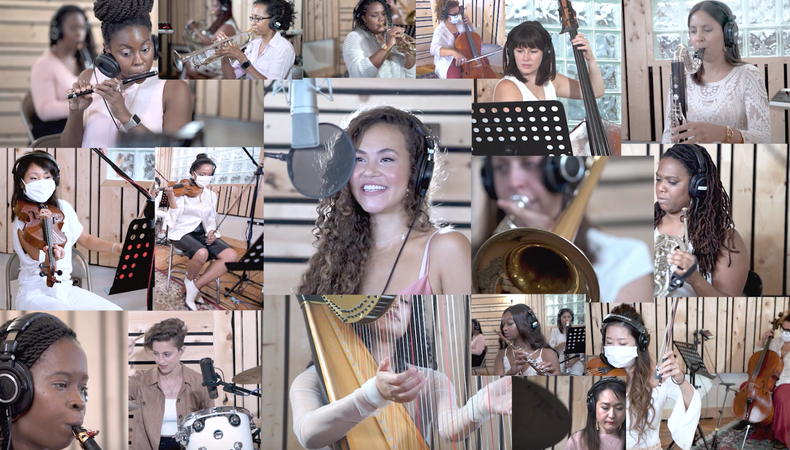
Twenty-three-year-old Macy Schmidt has worked as a music assistant, copyist, and orchestrator on productions like “Tina—The Tina Turner Musical” and the musical adaptation of Chelsea Clinton’s “She Persisted.” This fall, Schmidt, an Egyptian-American, founded the Broadway Sinfonietta, a coalition of women-identifying, majority BIPOC musicians in an effort to make the music community a more equitable space.
What exactly is the role of an orchestrator?
I’ve recently been doing a lot of orchestrating, which is what I primarily do with the Sinfonietta: arranging and orchestrating. So taking a song that either existed or was was written for a specific purpose and arranging it in a different way, reimagining the song, and then orchestrating it as expanding a song that might be written for just piano or just guitar or just a different instrumentation, and expanding and writing parts for different instruments in your setup. In our case, we had an 18-piece orchestra, so I’ve been taking music and orchestrating it for that instrumentation.
How do you work with musicians directly?
It definitely varies from project to project. On the Sinfonietta in particular, it was really a mission of mine to assemble an orchestra of majority female, BIPOC players, so my relationship with the musicians was very hands-on. I was going deep on the internet watching videos of people playing who I never met before, who I didn’t have any mutual friends with. Because of that, a lot of thought was given as to who was brought into the room and I wrote parts for each musician, for each instrument player, and worked with them in advance if they needed it, which most didn’t. I think my role, as the music supervisor on the Sinfonietta, has mainly been to create a dynamic and a space where everyone feels taken care of, comfortable, supported, and excited to make music and doesn’t have to worry about anything else.
 ‘Girl From the North Country’ Has Bob Dylan Sounding Like He Never Has Before
 Why did you decide to form the Broadway Sinfonietta?
I feel like I’ve been running into these experiences where I would recommend a certain woman of color for a job in a musical space within the Broadway community, or maybe I was up for a job as orchestrator in that community, and I was met with these phrases over and over again like, “Oh, we need to go with someone who has a proven track record of this thing” or, “Oh, this player hasn’t played this exact style of music so we can’t take a chance on that person.” When all the bustle was going on and we were working nonstop and it wasn’t the pandemic yet, all of those comments brushed by me. Sitting in the pandemic, especially as Broadway turned its attention to the systemic racism in our industry, I was marinating on, What are the excuses that we’re doling out every day? I feel like it’s really easy in industry advocacy to turn our attention to people coming up the pipeline from schools and students and internships and mentorship and all that is so, so important.
At the same time, I was more interested in the question of, Why are all these women of color being told “no,” who are already here, who are already working in the space? I wanted to put together maybe a Zoom recording and orchestrate some big, showy charts in the traditionally white Broadway style, and show that women of color from all aspects of the music department can make this kind of work. It obviously escalated from being a home recording Zoom to a whole staged studio performance. I’ve gotten so many responses for people who I just think aren’t used to seeing women of color musicians claim and lead a space like that. It’s escalated beyond what the original idea was, but in a way that I’m very excited about.
What has the experience been building a team of musicians for the Sinfonietta?
I’m fairly young and I’m not used to being the person in the supervisory hiring position. I’m used to reporting to a music department and all these superiors, so I have learned a million lessons about how to assemble a space people feel safe and comfortable in and excited to be in. Part of that has been making sure that every person who’s brought onto the team contributes to that space. Something I’ve learned is that that goes beyond just the musicians. Who are the videographers and camera operators, people behind the camera in a space, and who are the mixers and mastering engineers and all of the different people that have a hand in a project like this? All of them are women, the majority of them have been women of color. I’ve been learning that it’s easy to focus on creating diversity in the roles that are visible, like the actors onstage or the musicians in the pit, and it’s a little bit harder to make sure that that’s reflected behind the scenes, but it’s just as important to create a space that feels equitable.
What challenges have you faced as a young woman of color entering into this majority-white, male-dominated industry?
One of the things that I think has been difficult is that there’s a steppingstone position into the Broadway music department called the music assistant, which is a role that I’ve served quite a bit, which is notoriously underpaid in Broadway music departments; sometimes, often less than minimum wage. The struggle of a young person, even if we’re taking race and gender out of it, the struggle of being a young person trying to break into Broadway is often attached to the question of whether or not you have generational wealth or family support. It’s a big conversation happening in the industry right now with abolishing unpaid internships, creating more lines of access and that sort of thing.
The first layer of obstacle was like, How on earth do I fend for myself here without generational wealth? Then of course there are the elements of being young and it being very easy for people with influence to ask you to do things for free because getting in their good graces is often a form of currency, and I do think women experience that disproportionately. I feel lucky in many, many ways. I have had some incredible mentors who have taken me under their wing, who have helped me surpass some of those obstacles. At the same time, I don’t want the next generation of young women of color musicians who might come into the Broadway space to have to experience the same things that I did. I want it to be different for them.
Looking for remote work? Backstage has got you covered! Click here for auditions you can do from home!