Back in 1935, the behemoth Japanese film studio Toho (then known as Photo Chemical Laboratories, or P.C.L.) put out an advertisement seeking assistant directors. A 25-year-old Akira Kurosawa applied via an essay ironically mocking the Japanese film industry for its inherent flaws—flaws he joked could not be fixed. So began one of the most legendary careers in global filmmaking. Before him, Alfred Hitchcock submitted unsolicited mockup drawings for title cards to Paramount’s London studio, which eventually turned into full-time employment with the filmmaking company. He was only 21.
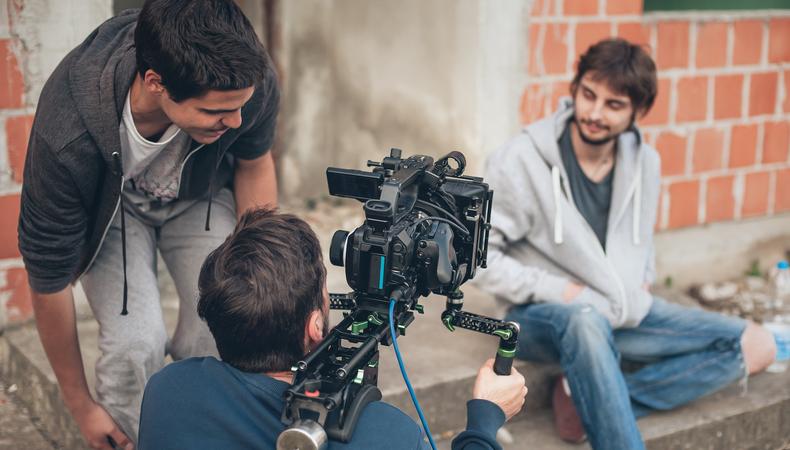
Suffice it to say the film industry has drastically changed in the 100-plus years since Hitch’s brash weaseling. Both filmmakers’ beginnings sound like the advice a clueless uncle gives to you at Thanksgiving: “Hey, why don’t you just ask Warner Bros. for a job?” The industry then was a plucky, young thing, not yet accepted as one of the world’s fine arts. But apprenticeships still exist, and getting hands-on experience as a crew member is still the fastest route to a career behind the camera.
A film apprenticeship is a position or program that allows you to get hands-on experience in your desired craft or trade, often with a more experienced professional (or professionals) offering mentorship.
For many, getting that experience can not only supplant time (and money) spent on higher education, but in some instances it can be the faster route toward a legitimate start. This is particularly true of so-called “trade” jobs, or the professions that make up the International Alliance of Theatrical Stage Employees (IATSE), such as:
- Gaffers
- Grips
- Camera operators
- Script supervisors
- Stagehands
- Lighting technicians
- Costume designers
Classroom education is always valuable, but those who do the hiring may be more persuaded by the time you’ve spent on a set, actually holding up a microphone.
A great place to start is Apprenticeship.gov, filtering by your trade. IATSE also offers a two-to-three-year apprenticeship that culminates with full membership in the union.
While not specifically apprenticeships in the way, say, a crew hopeful may shadow a prop master, many organizations offer incubators and educational opportunities for aspiring screenwriters, producers, directors, and filmmakers. The biggest name in this niche is probably the Sundance Institute. Oftentimes, the work created in these “labs” lead directly to a polished, finished product. For example, Sean Wang’s “Dìdi (弟弟)” premiered at the 2024 Sundance Film Festival after his stints in both the directors’ and screenwriters’ labs.
Sundance is prestigious and selective, so it’s always best to make it one of several options on your list. Other worthwhile contenders include:
- Film Independent’s Project Involve
- New York Stage and Film
- Indeed’s Rising Voices
- Sony Pictures Imageworks
- The Moving Pictures Institute
Opportunities for performers are rarer, but they do exist. Philadelphia’s Walnut Street Theatre and the Shakespeare Theatre of New Jersey are two options. In many ways, becoming an extra is the de facto form of acting apprenticeship. Background actors get an up-close-and-personal look at everything that happens on a set, and the barrier to entry is low.
Film industry assistant jobs
Many will find that becoming a production assistant (PA) is the most logical jumping-off point. Because PAs are tasked with being a support for any number of positions on set, they walk away with a wealth of workable knowledge. True, many PAs find themselves in the (perhaps) frustrating position of taking coffee orders and distributing scripts, but you gain valuable experience simply by osmosis. Think of working as a PA as being paid to be a fly on the wall (albeit one that will be demanded to expend an exorbitant amount of energy): You’ll have the chance to observe any manner of on-set position, perhaps discovering for yourself, along the way, what is most appealing for a long-term career.
Another informal apprenticeship-adjacent position is an assistant job for a production company. Though not very glamorous by comparison, it can be the case that a personal assistant to a heavy-hitting film producer will lead to actual chances to produce yourself. For example, the producing titan Jeffrey Katzenberg, who served as Disney’s chairman for 10 years, was once an assistant to David V. Picker.
Getting an apprenticeship in any film position is, like so many jobs, never confined to one route. Some positions will simply be advertised on career sites like Backstage, Indeed, or LinkedIn; others won’t be publicly listed at all, and that’s where your networking skills come in. Whatever the case, it pays to be bold. If you’re hoping to learn the ropes as a director, consider contacting a filmmaker you respect and asking to shadow them. The same goes for most on-set jobs. Perhaps your clueless uncle isn’t entirely wrong: You could just ask and see what happens.