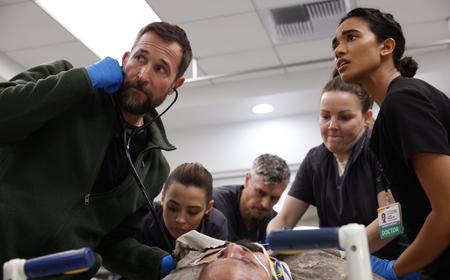
NBC’s new drama “Line of Fire” follows a family of protective agents as they balance their professional responsibilities with the threats facing them. But what does it take to share the screen with veteran actors like Peter Krause and Sam Waterston? While Season 1 premiered September 21, with next-day streaming on Peacock, production is still underway. Here’s what we know about getting cast on “Line of Fire.”
JUMP TO
- What is “Line of Fire” about?
- Who is in the cast of “Line of Fire”?
- Who are the casting directors for “Line of Fire”?
- How does the casting process work for “Line of Fire”?
- Where can you find “Line of Fire” casting calls and auditions?
- What are the best audition tips for landing a role on “Line of Fire”?
“Line of Fire” follows the Hollingsworth family, all of whom work as protective agents. Jane (Hope Davis) serves as a U.S. Marshal, while her husband, Mike (Krause), and son Micah (Tommy O’Brien) work for the Secret Service. Their other son Russ (Taylor Bloom) works for the Department of Justice, and their daughter, Clare (Kat Cunning), works with the FBI. When Jane brings in Clare to consult on what should be a cut-and-dry murder, however, the entire family finds itself in the crosshairs of a conspiracy that could prove deadly. Inspired by former first daughter and executive producer Jenna Bush Hager’s experiences growing up with Secret Service and other protective agents, the series asks: “When you’re protecting other people, can you also protect the people you love?”
Season 1 of “Line of Fire” stars:
- Peter Krause as Mike Hollingsworth
- Hope Davis as Jane Hollingsworth
- Tommy O’Brien as Mike “Micah” Hollingsworth Jr.
- Kat Cunning as Clare Hollingsworth
- Taylor Bloom as Russ Hollingsworth
- Asen Grigorov as Max Reznikov
- Charlie Barnett as Jack
- Antoinette Crowe-Legacy as Nia
- Savannah Lee Smith as Sydney
- Sam Waterston as President Thomas Barnes
- Chris Chalk as President Kayana
- Campbell Scott as Terry

Jessica Daniels (“30 Rock,” “Will Trent”) and Cassandra Kulukundis (“Gossip Girl,” “There Will Be Blood”) are the primary casting directors on NBC’s “Line of Fire.”
As the CD behind “One Battle After Another,” Kulukundis has worked with high-profile names, but what does she want to see in the audition room? Actors who commit to their choices.
“When actors are like, ‘I don’t know what they want,’ at some point you have to make it the best for you. What is your version of this character? I’m trying to direct an actor to their best version, not some magical version that we see,” she said. “Because we often think, ‘Oh, this guy’s gonna be like this.’ And then I start reading people, and I’m like, ‘Wait a second, you’ve gotta meet this guy,’ and he’s the exact opposite of what we were initially setting up for.”
Kulukundis also advises actors to be easily accessible across contact channels. “Keep your information up-to-date and pay attention, because I was trying to search for a bunch of people, and they weren’t getting back to me, so they missed out,” she explained. “I’m not a social media user, but when I’m working on a movie, yeah, I’ve got this fake Instagram and I’ll DM you!”
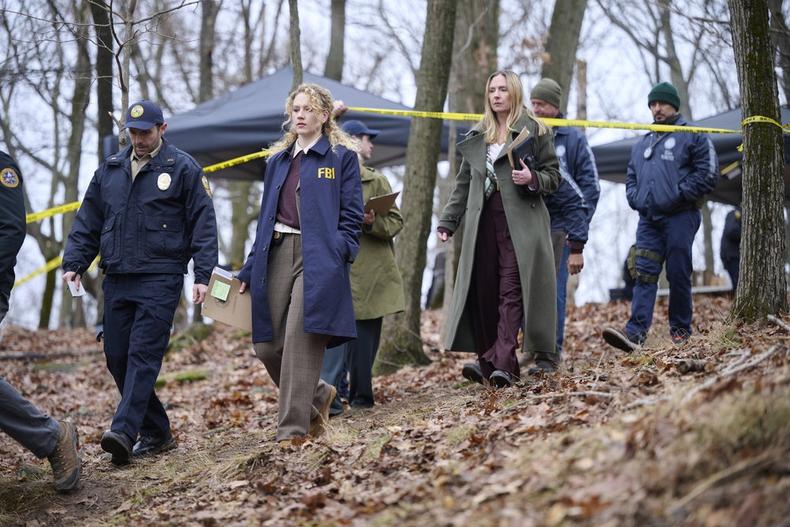
The casting process starts before anyone ever walks into the audition room. “I get a script, get a feel for it and break it down role by role,” Daniels told Daily Actor. “I then generate ideas of better-known actors who are considered offer only. Simultaneously, I’m seeing actors who I know or am meeting for the first time for the roles. In the beginning stages, the floodgates are open and I get ideas of who could be right and who is reading well, what’s working and what’s not working.”
Kulukundis wants actors to commit to the character, but also doesn’t want them to push anything that doesn’t feel natural. “Don’t force your choices. They have to be real to you and to how you would play a scene,” she said. “If the page says [to] cry and you can’t cry, that’s fine. Maybe you’re frustrated that you can’t cry. Use your frustration; use whatever you have at that moment. I know nerves are there. Just always be natural, whatever you’re doing. I cannot stress that enough. Get out of your head and just make it real.”
Ultimately, as Daniels pointed out, auditions also help actors build relationships with casting directors and creative teams.
“If you make a connection to someone on a project but don’t land that role, they will remember you in the future. It might not be sudden, but most meaningful relationships take time to build,” she told us. “If you view each audition as an opportunity rather than a means to an end, you’re taking some of the pressure off yourself to perform while keeping the bigger picture in mind.”

While getting yourself an acting agent could improve your chances of landing a regular or recurring role, keep Waldron Casting on your radar for background-acting opportunities on the show. For instance, the casting team put out a Facebook call for nonunion actors who could play “upscale, chic gala guests” in Manhattan. (The post details how to submit your information and image.)
For additional insight into getting cast as an extra, check out our guides on how background acting works:
- How to Audition for Background Work
- How to Become an Extra in a Movie or TV Show
- Background Acting 101: What It Takes to Be an Extra

For Krause, one of his greatest acting revelations came during his time at NYU under the tutelage of acting teacher Ron Van Lieu. “Part of the training there is sort of letting yourself go and letting the character in. Ron said, ‘Your job is to illuminate the human condition,’ and ‘Anyone is a character you might play,’ which really opens your mind to the fact that we’re just human beings behaving in different ways,” the actor said.
Davis noted that just as CDs can say no to an actor, an actor can also turn down roles that don’t align with their goals. “I heard this great story when I was just starting. It was something that Andy Garcia said when he was offered some part in something that he thought was just really horrible and that he said no to. And his agent said, ‘You can’t say no. It’s not time for you to have integrity yet,’ and Andy said, ‘When will I, if I don’t now?’ ” Davis explained. “I agree with that—that you have to watch out for yourself. At the same time, you have to be practical. You’ve got to pay the bills, too.”
Daniels also advises actors to never apologize. “Even if you’re convinced you gave the worst read possible, please don’t apologize or make excuses in the room,” Daniels shared. “Your view of your performance isn’t objective, and you’re likely being overly critical. We appreciate the work you did and the vulnerability it takes to come into these auditions and give your all—you never need to explain why something didn’t go the way you wished it would.”
Chalk learned that lesson after an audition for “Boardwalk Empire.” “I went in, and I just misread the character,” he told Daily Actor. “I thought Chalky White was a little more broken, so I came in in like a tight tank top, and I was a little brutish, and then I saw all the people in the waiting room, and they were like in zoot suits looking fly, and then I reread my sides, and I saw it said ‘dressed in zoot suit, looking fly,’ and I went, ‘Oh no.’ ”
“So I walked in the room, and I’m not a liar, but I was so panicked, and I made up this whole story that I was pooped on by a pigeon. I said, ‘A pigeon pooped on my suit.’ And Ellen [Lewis, casting director] just kind of looked at me like, ‘I didn’t ask.’ No one asked me why I looked like an idiot,” he added. “I came in there and ratted myself out and obviously didn’t get a call back because I made up some dumb pigeon story.”
Daniels also recommends that actors find ways to move on after an audition rather than dwelling on their performance. “I think the healthiest thing for actors to do is develop post-audition rituals that allow for the shaking off and letting go of all the effort and thought and self-criticism that just came before,” she said. “Maybe it’s watching a movie or reading a magazine. Perhaps it’s finally taking that run or doing yoga, or calling the bestie that always makes you laugh. Figure out what grants you release and keep a shortlist. Schedule the time post-audition if you can. …You earned it, and that too is part of this grueling process.”