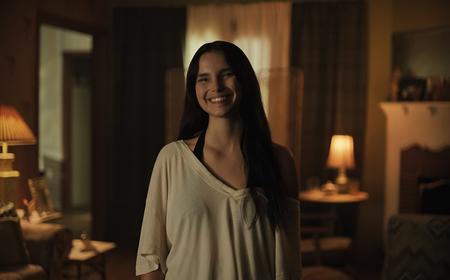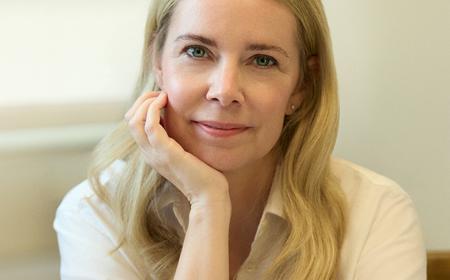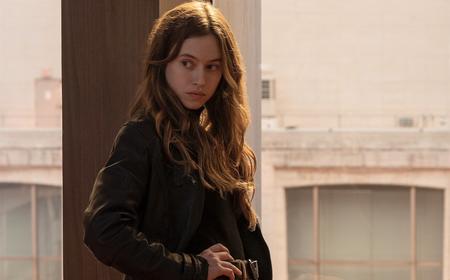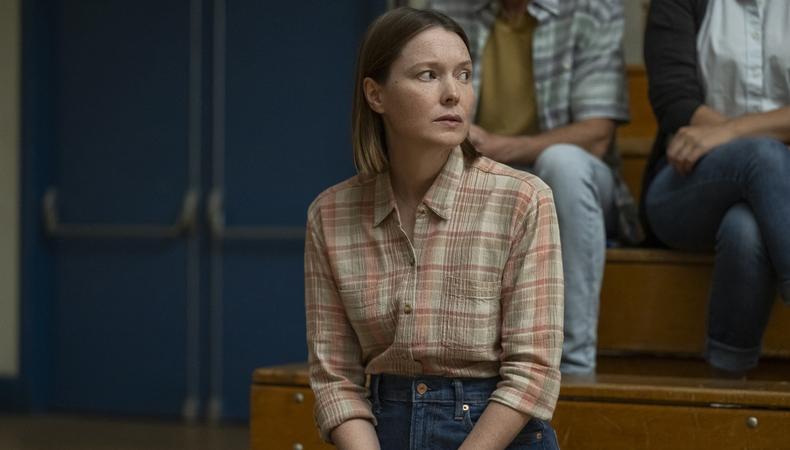
Samantha Sloyan has been working with writer-director Mike Flanagan since the 2016 low-budget home-invasion thriller “Hush,” re-teaming with him two years later for a supporting role on Netflix’s “The Haunting of Hill House.” But it wasn’t until the 2021 small-town vampire epic “Midnight Mass” that the actor got the chance to show off her full, terrifying range as the fanatical follower Bev Keane. It’s an archetype she returns to—and beautifully subverts—in Flanagan’s Prime Video adaptation of Stephen King’s “Carrie,” where she plays ultra-conservative mother Margaret White alongside Summer H. Howell’s new take on the telekinetic title character.
Here, Sloyan goes deep on developing a Margaret White for the modern age, her intense prep for emotionally fraught scenes, and her career-spanning collaborations with Flanagan and Kate Siegel.
Between “Carrie” and “Midnight Mass,” you’ve really become Mike Flanagan’s go-to for a very specific type of character.
A bold woman [Laughs].
What has it been like to settle into that role?
I find myself incredibly lucky that this type of character is something I hadn’t been given the opportunity to do in film or television before Mike came along. To be able to take what one might call a big swing or a big personality, but also to be able to create in this unlikable territory. It’s really wonderful, because sometimes I find that likability can clog things up with me. To just really be free and open, knowing that the choices you’re making and the way that you’re treating and interacting with the other characters is not gonna fly with the viewer. Knowing they’re not gonna like me, I can decide what to do with that freedom.
What is it like, as an actor, for that to feel like freedom and not something you have to worry about?
As a person in the world, it’s not just that you want to be liked, you want to be kind. You don’t want to hurt people, and when we do, it wasn’t our intention. What I like about [Margaret’s] choices, along with Bev’s, is that they don’t go through the filter of what somebody else might think. They’re so personal to her, and nothing gets in the way. It’s this single-mindedness, and how you would achieve a goal if you weren’t concerned with burning bridges as you went. Or you didn’t have that feeling of looking at somebody’s face and knowing that you’ve harmed them. That’s not a barrier to you. Instead of it being a negative choice to take away the ability to empathize, I think it’s adding [the idea of] ‘What then?’ If that’s not an option, then what happens?
What I found really interesting compared to other “Carrie” adaptations is that this is the most recognizably human version of Margaret, and you see a lot of actual love she has for Carrie.
That started with Mike. That point of view is why he thought, “This ‘Carrie’ now.” We have eight episodes, so you have to really fill these characters with humanity. If you’re gonna watch eight episodes in one day, something’s bringing you along, and it has to be that you care about the people that have been created, and that you’re seeing things from different points of view.
When Mike brought this up to me, I was thinking about Bev Keane, and it’s like, “What are we going to do that’s different from what we did then?” He was like, “No worries. This is not Bev; this is a whole different woman.” I found so much of her energy was because she loved Carrie so much and because she was so terrified for her daughter. That just sent her into aggression. She’s going to go to war with everybody to protect her kid.
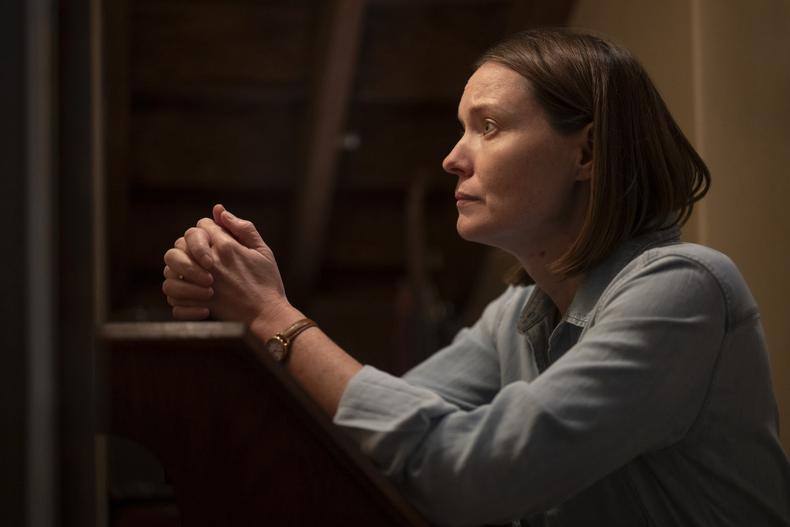
Being in the Mike Flanagan world means you’re going to deliver monologues. What is your prep and process like for that?
When I first get a script, if it’s something that I’m excited to do and matches well with my sensibility, I’m like, I know exactly how this goes. And then as I work, I lose that by the end, and I’m like, I have no idea what I’m doing. I don’t think any of this works [Laughs].
But I need that journey. I’m one of those people who need a lot of work on something. I need the words to be word-perfect. I need to not be considering them. Until the words are in my body, I feel like the ideas don’t even really show up for me. The first thing I do is just drill it. Usually, I type it out. I still remember best from a piece of paper in my hand.
Then I also use some line-learner apps. I go on long walks and talk to myself, just so you don’t forget that somebody else is in the scene with you. Then once I feel ready, I stand up in my room and act for nobody. Once I feel like I can be saying it and thinking of something else, that’s really where impulses start to arrive. That might be completely a 90-degree turn from what I thought would be happening in that moment. That’s when a smile arrives when you’re saying something terrible or treats come unexpectedly.
So when I arrive on set I feel like I’m just ready for anything. Whatever Mike wants to do, whatever the other characters do, all of a sudden you’re doing that. Then that completely affects me in a way that I couldn’t have anticipated, and I’m open to that only if I am very secure in what I’ve already done.
Was there an aha moment when you realized this was the way you worked best?
I started acting after college, so I didn’t study in that sense. I went right into acting class and started doing theater in L.A. That’s how I got my commercial agent and my theatrical agent; they came to shows. I started in 2001 and didn’t get my first TV job until 2009. I guess I had bought into this concept of, Well, when you do camera work, that will be something else entirely. If you’ve only done theater, you’re screwed because you won’t know how it works. We’re expected to learn how to do something that, when you’re starting out, you’re only allowed to do—in a good year—like 10 days that year. When I did “Grey’s Anatomy,” it was the first time I had an extended period of work.
I guess it’s a long-winded way to say I found out it was really all the same work. Whether the camera is on you or not, you’re there for your scene partner in exactly the same way you’re there for them onstage. You need to be, at least in my opinion, giving them everything you got whenever you can. That was my aha moment where I was like, This is the same thing I’ve been doing the whole time.
*Spoilers ahead for ‘Carrie’ Season 1*
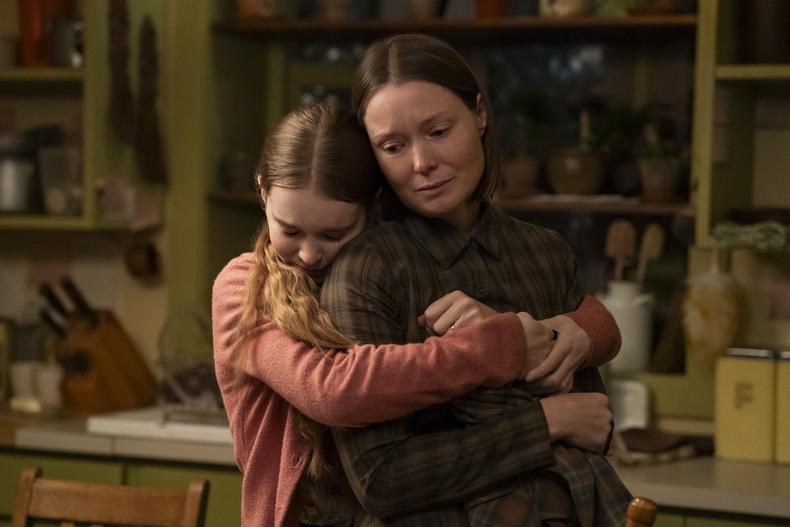
There’s a remarkable scene post-prom where Margaret is making the decision to kill Carrie with the knitting needles, and you see her working up to it. What’s it like when you film something that emotionally taxing?
That can be a lot of things, because when you are expected to hit a high emotional mark on a day, there are so many things at play that you can’t really control. How fast are they moving that day? How is the day going? How is everybody feeling? Do you feel like you have access to that thing?
That scene, what lined up so well is that I was lucky enough to be working with somebody I’ve worked with many, many times before. Our crew was so incredible and so invested in the piece as much as we were. So just the way that people move around is so respectful as far as keeping noise levels down, keeping a mood of what you’re working with, and keeping on task. And then I had Summer—and talk about listening to your scene partner. She does so much of the lifting for me in that sense. She’s created such a completely beautiful and fully realized Carrie that, when you’re in the room with her, [you’re in the room with the character] in a lot of ways.
So I try to keep relaxed. I find that, for me personally, when it comes to emotion, I have a series of things I’ll try, from the best day to “I’m all out of tricks.” It’s best to start as open as I can be. Clearly, I can’t [actually] relax because of thoughts like, Gee, I hope I don’t mess this up. But I’ll stretch, then I’ll try to stay still because I have a tendency to dissipate a lot of my emotions—I mean, I’m doing it right now—through movement. I talk a lot with my hands. So I try to steady that. I try to let myself be looked at. I know that sounds funny, but it’s hard to really let people look at you.
There was also the gift of having all your scripts at once, which is something that is relatively new, at least in television. Just knowing where you came from and how you got there as an actor is so huge. Sometimes we’re asked to do a very complicated scene, but as a guest star we literally don’t have access to that script and what happened with the other characters. So I think the way I achieved this in “Carrie” was a combination of preparation, luck, and the people around me, which is always the formula.
You mention the experience of coming in as a guest star, and I think of your incredible time on “The Pitt.” I imagine it’s a pretty harrowing experience coming aboard a show like that for such a short amount of time.
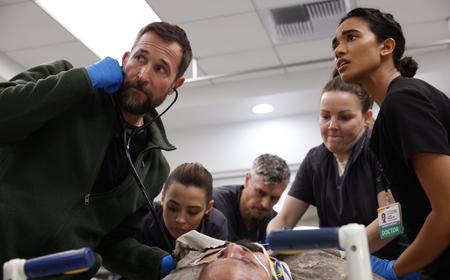
What they’re doing there is so amazing and unique and fantastic. Talk about the feeling of theater. Because one, they shoot sequentially, which is unreal. And then they’ve built a set that makes you feel as if you are in a hospital. Everybody’s showing up. The camera’s not on you, but everybody’s playing it full. Because you never know when the camera is going to pan past you. So that was just such a fully committed, exciting set to be on. Leaving that one was hard.
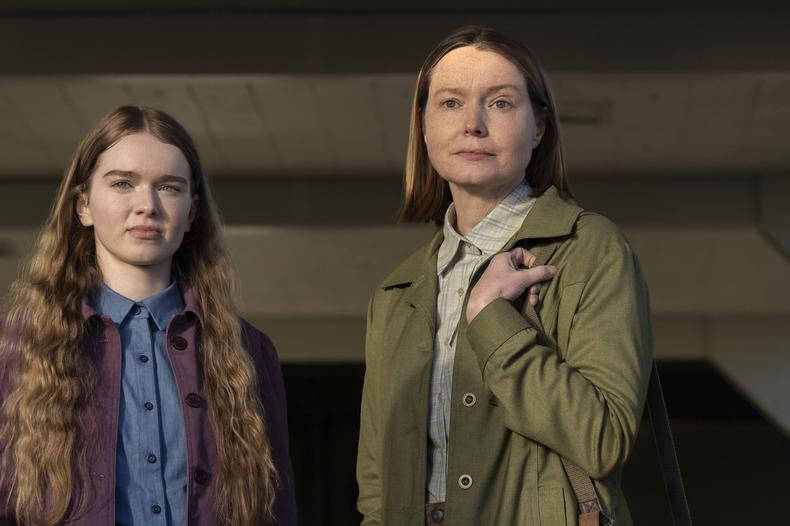
I want to ask about your character’s last moments in “Carrie.” Did you actually get the chance to act across from Kate Siegel?
I did, yeah. That was really great for me. One, because I’ve known Kate for a long time. We actually met in acting class before any of us had worked. So that was just fun. I think she shot a lot of her stuff in one day. For her, that was a very, very busy situation. But for me to be able to sit across from her and work like we were kids in class again, and try things, I mean… If that could be all days, I’d be thrilled.
Thinking back to “Hush,” when you first worked with Kate and Mike, what were you hoping for in your career, and how does it feel looking back from this moment?
I was just an actor who showed up and was like, “What are we doing?” Mike and Kate understood much more about the production of it all. But it really goes to show how much creative problem-solving and working around what you don’t have available births such beautiful, wonderful things that you couldn’t have stumbled on if you had all the resources in the world. Mike works so similarly now to the way he did then.
When you’re starting out—and that’s very much where I was when I did “Hush”—you just want to keep getting hired. Mike has this wonderful traveling circus that’s continually collecting people. If you like a director and start watching everything they’ve done, you do see the same people. And that’s because when you find people who help you make stuff under terrible circumstances, you know you can count on them in the best of circumstances. You take that number down and make sure you call them again the next time you need somebody.
Michael Truco, who was also in “Hush,” is such a wonderful man. During “Midnight Mass,” it’s freezing, we’re all in Canada in the middle of the night, my feet have icicles on them. And Michael will look around be like, “How lucky we are that we’re doing this?” And you’re like, Yeah. You can’t complain. I feel like every time I work with this group, you’re just like: Man, we’re back here and I couldn’t be happier.
Since we came here to talk about Mike Flanagan–directed religious horror, you are also in his new “Exorcist” movie. What can you tell me about that?
I basically say “Hello” in “The Exorcist.” It’s a very small role [Laughs]. It was like holding the tail of an elephant, in the sense that I know it has a tail and that’s about it. But it looked, just sitting behind the monitor, so beautiful looking. It’s so cinematic. All his stuff is beautiful, but this has a quality to it. I think it will probably, just judging from the little bit that I know, probably be the scariest thing he’s done.
This interview has been edited for clarity and length.