In “As You Like It,” Shakespeare wrote, “All the world’s a stage, and all the men and women merely players.” But did you know that there are several types of stages for all those players to play on?
The most common theater stage is the proscenium, which is the layout you’ll see at almost all the major Broadway houses in New York City. This is the classic setup, where the audience is separated from the performance by a frame-shaped arch. But for more interactive performances, you’ll often run into theaters-in-the-round or— our topic here—the thrust stage.
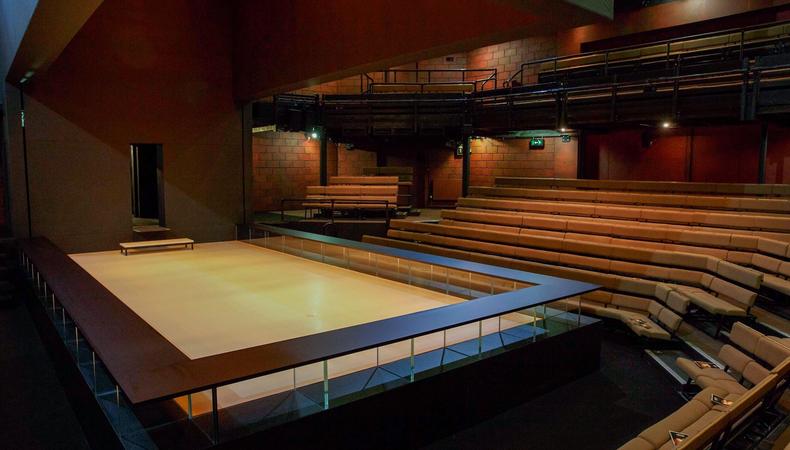
True to its name, the thrust stage extends outward so that the audience is sitting on three sides—in front of the stage, and to the right and left. Much like theaters-in-the-round, where the audience is positioned on all four sides, thrust stages break down the illusion of a barrier between spectator and performer that is created by the proscenium.
The thrust stage’s layout has its origins all the way back to the beginning of the art form, when ancient Greek theater was largely performed in amphitheaters that circled a stage. London’s Globe Theatre, where many of Shakespeare’s works were first performed, also utilized a thrust stage.
Some modern examples include the Copernicus Center in Chicago, which initially opened in 1930 as a movie house and had a thrust stage added decades later, and the Pittsburgh Public Theater, whose website notes the layout “offers a canvas for creative exploration and innovative storytelling” where “performers are freed from the constraints of traditional staging, empowering them to engage with their surroundings and adapt to the ever-changing dynamics of live theater.”
The number one benefit of a thrust stage is immersion. While the proscenium arch separates audience members from actors, the thrust stage puts them up close and personal with each other. This makes the show come alive—for both performer and viewer—in an exciting way. The audience feels like they’re part of the show, while the actors can feed off that proximity.
This setting also presents challenges, of course. It’s vital to remember that, unlike the proscenium, it’s far easier on the thrust stage to have your back to a portion of the audience for an extended period of time. Playing “to the back of the house” takes on a new meaning; you have to remember you’re essentially surrounded, not front and center all the time.
This also applies to direction, blocking, staging, and set design. For example, if a pivotal moment takes place toward the left side of the stage, it still needs to be clear to someone sitting on the other side. For this reason, sets and props on a thrust stage production tend to be minimal and stripped down.
However, what you gain artistically far outweighs the challenges. If your theater piece calls for intimacy, audience participation, or, simply, drama on a smaller, more personal scale, the thrust stage cannot be beat.