Marlon Brando had Stella Adler, Al Pacino had Lee Strasberg, and Diane Keaton had Sanford Meisner. Behind many great performances is a great acting class—but with such a variety of options out there, finding the right fit can feel overwhelming. How do you separate the classes that will bolster your career from those that will drain your time and money? This guide walks you through exactly what to look for, whether you’re brand new to the industry or a seasoned vet.
JUMP TO
- Do I need acting classes to become an actor?
- Types of acting classes
- What techniques are taught in acting classes?
- What are the best acting classes for each stage of my career?
- How to find acting classes
- How much do acting classes cost?
- Are online acting classes worth it?
- When should I quit an acting class?
Acting classes are not a requirement for becoming an actor—if anything is 100% certain in this industry, it’s that there’s no single path to an acting career. Still, most people agree that classes make you a better performer, whether you’re a beginner or a veteran. “To really know the technical sides of your craft, particularly for stage actors, is just so important,” explains actor Laura Donnelly.
How can acting classes help me?
“There is no substitute for studying with the right teacher,” says Secret Agent Man, an L.A.-based talent agent who writes anonymously for Backstage. “Even experienced actors flex their muscles in class because they know that’s the best way to stay focused. You’ll also learn a ton by watching the other students. That’s why you never want [to] be the best actor in your class. It makes more sense to surround yourself with performers who challenge and inspire you.”
Classes also make it easy to network with other actors. Plus, if you study with a well-known teacher, putting their name on your acting résumé can boost your profile. If a casting director recognizes your teacher, they likely know what kind of training you received—and confidence in the teacher can translate to confidence in you. If you have an agent, ask for class suggestions; some agents care about where and with whom you studied, and if other clients have had good experiences with a teacher, they’ll let you know.

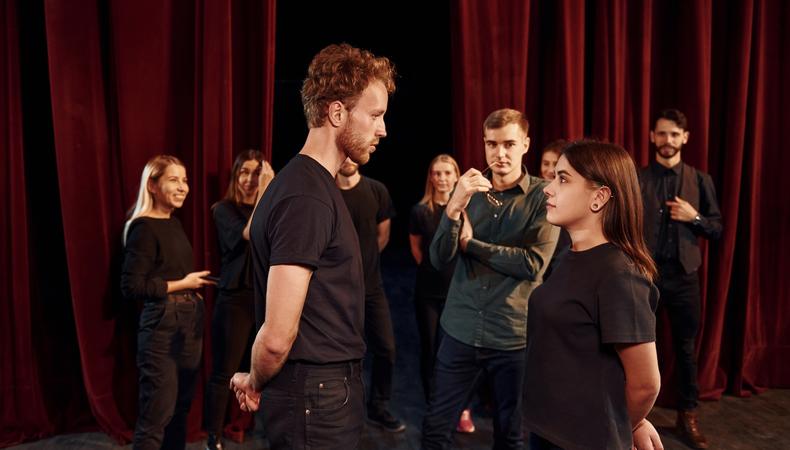
Credit: LightField Studios/Shutterstock
If you’re starting from scratch, figure out where you want to do most of your acting. Do you want to tread the boards? Work in front of a film camera? Do musical theater? Comedy? Drama? General acting classes exist, but knowing your focus will help you choose a class that develops that particular skill set. Some of the most common types of acting classes include:
- Audition technique: Even if you’re a fantastic actor, if you’re not good at auditioning, that talent may never be acknowledged. To help students nail their auditions, these classes teach script analysis, proper audition behavior, monologue prep, and how to approach a casting panel.
- Body and movement: Whether it’s yoga, the Alexander Technique, or stage combat, movement classes teach actors how to use their bodies, building awareness of their limbs, how they move, and the space they take up.
- Cold reading: Cold reading—performing from a script with little to no rehearsal—is one of the most important skills an actor can have, especially for performers who audition for commercials frequently. These classes teach you to quickly grasp the character and situation so you can focus on the performance instead of deciphering the text.
- Commercial: A commercial shoot is a very different experience than TV or film—things move much faster, and actors often have to improvise. Commercial classes teach you what to expect and how to handle it.
- Improv: As the name implies, these classes teach actors how to improvise, a crucial skill in this industry. “Improv training is some of the best work for helping actors to build confidence, courage, and creativity, and it also teaches them to trust their instincts,” wrote the late acting coach Carolyne Barry. “Also, it’s helpful in teaching anyone to stay out of their head, listen, and respond honestly.”
- On-camera: Unless otherwise specified, most classes focus on acting for the stage, which requires a very different approach than acting for the screen. On-camera classes teach the technicalities and nuances of the medium, including how to interact with and move for the camera and how to control your vocal level—skills that also come in handy when you’re making a perfect self-tape.
- Scene study: According to Barry, scene study “primarily involves individual scenes or monologues from a play or film, which are assigned to the student actors. The instructor directs and teaches his/her approach using material as the vehicle. He/she might have some warm-ups or exercises, but the main focus of their instruction is the scene work.”
- Technique: There are a number of famous acting techniques taught in the U.S. “The Meisner technique, Strasberg Method, Chekhov technique, and Stella Adler technique are a few of the most highly renowned,” note Joanne Baron and D.W. Brown of the Baron Brown Studio. “This type of class will be particularly helpful to actors starting out who want to learn about these techniques. Many actors rely on one for a lifelong career while others may explore many techniques and even construct one of their own.”
- Vocal: For anyone pursuing a career in musical theater, vocal classes teach actors how to use their voices properly without injuring their vocal cords. They’re also useful for nonsinging actors, especially when it comes to handling emotional dialogue and sounds such as shouting or screaming without fatiguing or damaging the voice.
Acting workshops vs. acting classes
A common misconception is that acting workshops and acting classes are one and the same. Acting classes are for continued training and development, while workshops offer a chance to connect with industry players and learn what they look for when hiring talent. In a workshop, you pay a one-time fee to perform for someone you hope to make a professional connection with, such as an agent or casting director. The session gives the workshop leader a chance to share tips and discuss what they look for when actively casting a project. As Secret Agent Man points out, though, a paid casting director workshop doesn’t count as training on your résumé.
WATCH:
In addition to covering the basics, most classes focus on a specific method or technique, such as the following:
- Stanislavsky: Developed by Konstantin Stanislavsky from the late 1880s until his death in 1938, the system advocates naturalistic behavior and believable emotions, placing an actor inside a character’s “magic if,” establishing motivation, and identifying objectives and obstacles. The technique evolved over the years, moving from personal memory-driven emotionality (“emotional memory” or “affective memory”) to more physical, active preparation (“method of physical actions”). Simply put, an actor who studies Stanislavsky’s system searches for inner motives or experience to justify action and what the character seeks to achieve in a given moment.
- Strasberg’s Method: Inspired by but diverging from Stanislavsky, Method acting was developed by Strasberg and encourages actors to magnify and intensify their connection to the material by creating their characters’ emotional experiences in their own lives.
- Adler: Adler studied with Stanislavsky in Paris in 1934, and her technique built on the work of Stanislavsky and Strasberg. It differs from Strasberg’s in that it emphasizes imagination over emotional recall, asking actors to build vivid, specific inner worlds from the given circumstances of the script. This training emphasizes rigorous script analysis, physical actions with clear objectives, and a deep understanding of social, historical, and cultural context.
- Meisner: Meisner taught his students that acting is “living truthfully under imaginary circumstances.” His approach is an eminently practical one; his famous repetition exercise, in which two actors sit opposite each other and respond in the moment with a repeated phrase, breaks down overly structured technique and builds openness, flexibility, and listening skills.
- Hagen: Uta Hagen’s technique emphasizes realism and truth above all else; “substitution” (or “transference”) encourages actors to substitute their own experiences and emotional recollections for the given circumstances of a scene.
 Secret Agent Man Clears up Acting School Confusion
- Beginner: Consider general-interest classes to make sure you like acting enough to keep investing in training. These classes tend to be larger and therefore less expensive, so if acting turns out not to be your thing, you haven’t lost much money or time.
- Intermediate: These classes are for when you have a solid foundation and want to take your acting to the next level. One-on-one or small-group training is probably best for you, since these setups ensure you get to perform and receive personalized feedback in every class.
- Advanced: This is where things get really specific; by this stage in your career, you’ve probably taken dozens of classes. Home in on a medium, skill, or niche when researching options—the pickings may be slimmer, but those few ultra-specific classes are likely taught by true masters. Specialized acting classes that could change your career range from video game voiceover to acting in Spanish.
 13 Acting Techniques Every Actor Should Know

1. Seek recommendations and conduct research.
A recommendation from someone who has already taken the class or studied with the teacher is a great way to know what to expect. Ask actor friends you know and admire for suggestions, or ask whether a studio will connect you with a current student.
Online research is also key. Search for reviews of specific teachers and studios, and pay attention to recurring themes in the pros and cons. Fortunately, finding acting classes online is pretty straightforward; our directory alone lists hundreds of schools and studios.
Acting classes don’t come cheap, and many studios have strict no-refund policies. Before committing to a multiweek class with a hefty price tag, ask whether you can audit a session. Sitting in will give you a good sense of the teacher’s style, how the class works, and how students interact with one another. Listen to your gut here.
2. Look for signs of a good acting teacher.
Nothing will make or break a class faster than the teacher. “First and foremost, you need someone you can trust so that you are willing to let go and move past your blocks,” says acting coach Cathryn Hartt, founder of Hartt & Soul Studio. “Everyone is different and you should consider that someone else might work for others but not you. It’s like falling in love. Sometimes there is no rhyme or reason—it just works. Find someone that fits. But find someone who will keep you moving out of your comfort zone.”
An actor’s success doesn’t rest solely on their acting teacher, but a teacher with many working students is a good sign. Be wary of teachers who constantly name-drop A-listers as former students; their focus should be on the “little people” and helping them work up to that A-list status.
It’s also difficult to teach acting without having experience as an actor. That said, “When you’re in class, your teacher should be a teacher, not an actor,” say Steve Braun and Risa Bramon García. “Yes, it is remarkably helpful if the person with whom you are studying is, or has been, a working actor. That practical, on-the-ground knowledge is invaluable. But when teachers are teaching, they need to remove their acting hat. It cannot be about them: their ego, their skill, their career, whatever. You don’t pay a teacher to indulge. Teachers are there to train you. Nothing else. Anything that a teacher does in class should be in the interest of training you to be a better actor.”
A teacher who doesn’t put your training first is a major red flag; teachers who aren’t invested in their students’ success are likely only in it for the money. Similarly, any teacher who claims they can make you a star is lying to you—no teacher can turn you into Meryl Streep. “A good teacher introduces you to exercises and a practice that allows you to discover your pre-existing talent and then express it in all its brilliant glory,” write Braun and García. “You have the raw material and a good teacher helps you mine it and shape it.”
3. Consider size.
Acting classes should be small—like private coaching in a class setting—so you have the chance to get up and work on a new piece every week. Acting coach Joseph Pearlman counts being forced to work with a scene partner among his red flags when selecting an acting class. “When actors are required to partner up, it means the teachers can pack the class like sardines,” he warns. “What sucks about this imposed dynamic is the inevitability that your partner doesn’t take it seriously, flakes on rehearsal, or a host of other horror stories so many actors have to tell. Why should you be shit out of luck just because your partner wasn’t prepared?”
Another thing to consider is how much time you’ll actually spend acting during class, which correlates directly with group size. Acting teacher Paul Barry suggests thinking about it this way: “Even ignoring the time required for quick changeovers between actors, or breaks to go to the bathroom or sit and absorb what you’re learning, a three-hour class of eight actors leaves a little over 20 minutes per actor each week. Twenty minutes to rehearse and perform a scene, make mistakes, receive notes, make adjustments, and (hopefully) reshoot. Now imagine how little time you’ll receive in a class of 12, 16, or 20 people….”
Acting class prices vary based on the instructor, location, format, and other factors. Group classes generally run about $25 to $90 an hour, while private coaching typically costs $60 to $250 an hour—and in-demand coaches in New York and Los Angeles can charge even more. Many studios also bill by the month or by multiweek session; our guide to acting education costs breaks down sample rates from studios across the country.
There’s no way around it: Acting classes are expensive. If you’re on a tight budget, consider taking a few less expensive classes to see what works for you before committing to pricier ones. You don’t want to plunk down a chunk of change for a six-week class you don’t love with a teacher who isn’t actually doing anything for your craft, after all.
But if you’re serious about a career in acting, you need to be serious about acquiring the tools to get there. An investment today could make all the difference in the future.
Online acting classes offer some substantial benefits, including a way to connect with other professionals even when you can’t be near them. Virtual instruction also means no geographical restrictions. You don’t need to stress about driving, finding a ride, or paying for public transportation to get to class, and you won’t miss out on a great fit because of travel barriers.
To be sure an online acting class is worth continuing, you’ll have to evaluate its effectiveness. Baron recommends researching a school’s or teacher’s proven results over time, tracking whether your own work is growing artistically and professionally, and noticing whether your classmates are improving and booking work, too.
 Backstage Experts Answer: What Makes an Acting Class Right for You?
Knowing when to walk away from an acting class is almost as important as choosing one in the first place. A class that no longer meets your needs or serves you as an artist is a waste of time, money, and energy. Maybe you feel you’ve learned all you can from a teacher, or the format has changed and you no longer get as much individualized attention—whatever the reason, there’s no point in dragging it out.
So how do you know when it’s time to try something new? When a class stops challenging you, it may be time to move on. Think of it like a workout: When the weight you’ve been lifting starts to feel easy, it’s time to add more. The same goes for acting class—once you start to feel safe and comfortable, find something new. You’ll never grow and evolve as an actor unless your classes make you a little uncomfortable and push you to try new things.