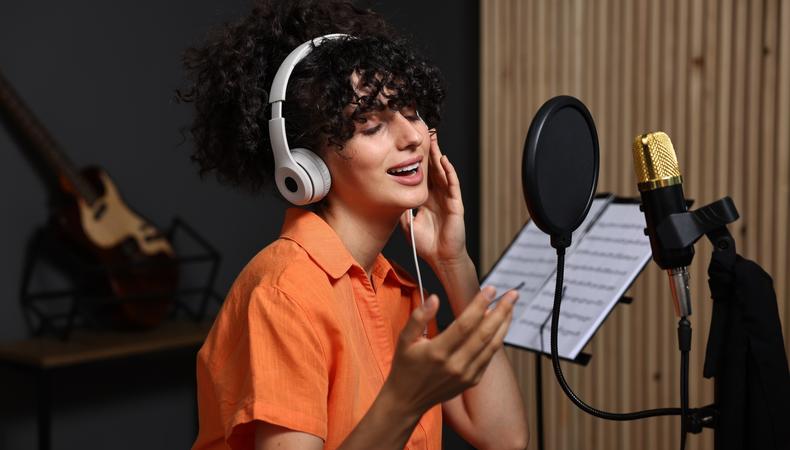
Can anybody become a singer? It’s a question that’s been debated by many, probably since the first time someone tried to carry a tune. Weighing the value of learned skill versus innate ability is something we could spend thousands of words on, but at the end of the day, the facts are facts: Technically, almost anyone can learn how to sing.
Of course, you may also be wondering where to begin or how to tell if you have what it takes. We’ve got you covered.
Statistically speaking, only around 4% of people have the auditory processing disorder—amusia, for all you medical terminology enthusiasts out there—that causes the inability to recognize or produce certain tones. (You’ve probably heard it described as being “tone deaf.”) That means most people can learn how to carry a note and hold a tune.
There are, of course, naturally talented singers. But that doesn’t mean the rest of us can’t learn the mechanics and eventually master some of those same skills with practice, patience, and an understanding of what you’re working with.
Pop culture history is full of performers who started from zero and learned how to sing. Pamela Anderson had to dive headlong into practice for her 2022 Broadway run in “Chicago” playing Roxie Hart. “Singing is courage, but it is also technical—a muscle—and I’m learning so much,” Anderson told E! News at the time.
Angelina Jolie not only learned singing but highly technical opera singing to play the iconic Maria Callas in “Maria.” “I would start to sing, and for me, everything was new,” Jolie told Backstage. “When I discovered I was a soprano, I was shocked. When I first hit a high note, I was stunned and just staring at the coach.”
Even Elvis Presley’s granddaughter Riley Keough had to learn how to sing to perform as the titular “Daisy Jones & The Six”—and if you watched the show, you know she did quite well.
As we said, singing is a skill, and if you take the time, anyone can learn a new skill. For singing, it’s about teaching your ear, brain, lungs, and vocal chords to work in harmony (pun deeply intended). It’s about strengthening those literal and metaphorical muscles through repetition and practice, and knowing that sometimes certain talents take a lot of hard work—whether you’re naturally gifted or not.
Analyzing your ability to sing
Before you start your journey, you need to know exactly where you’re starting from. It’s easy to analyze your own singing ability—all you need to do is record yourself and listen back, or have a friend listen and give honest feedback. It’s simple, but at the same time, it’s the hardest step because, well, that’s a very vulnerable position to put yourself in. Opening yourself up to criticism, especially in regards to a skill you’re unsure of, is terribly scary.
But it’s necessary. Once you establish a baseline, you can officially get to work. What do you hear? Are you flat? Sharp? On-key or off? Can you hold a note or do you need to catch your breath a lot? Figure out your pitch profile and vocal range and before you know it, you’re already a few steps further than most people.
“Decide to be courageous, step into exactly where you are vocally, and make sure people know who you are as a singer,” songwriter, music teacher, and vocal coach Tony Gonzalez told us. “You will only get better, even with failures, if you take the approach that every singing experience teaches you something about what to do better next time.”
Learning how to sing
After you set your starting point, the sky’s the limit. Try out different warmup and cooldown exercises. Be diligent about your singing posture and, most importantly, keeping your voice healthy. Learn the difference between your head and chest voice. Once you’ve mastered the basics, you’ll actually feel yourself controlling your voice—and then that is a new thing to improve on!
If you’re interested in a solo journey, you can teach yourself to sing. There is also the option to work with a vocal coach, take local classes (there are many taught over Zoom), or simply search YouTube or TikTok for tutorials.
At the end of the day, if you still aren’t the belter you dreamed of being, don’t let that stop you. Singing is all about joy, and if the act itself brings you happiness, you shouldn’t quit, even if it’s just for fun.