Self-tapes are more important than ever for working actors, and making a strong one entails more than just reciting lines. This in-depth guide explains everything actors need to know about self-taped auditions, from gear and attire to readers and filming, plus advice from casting directors, acting coaches, and other industry experts.
JUMP TO
- What is a self-tape?
- Self-tape audition examples
- What are casting directors looking for in a self-tape?
- What equipment do I need for a self-tape?
- Should I be off-book for a self-tape?
- Do I need a reader for a self-tape?
- What to wear for a self-tape audition
- How to film a self-tape audition
- Should I slate in a self-tape?
- How to edit a self-tape
- How to submit a self-tape

Daxiao Productions/Shutterstock
A self-tape is a prerecorded video audition that an actor submits to a casting director or creative team. It is generally used as a substitute for an in-person tryout. Actors film themselves reading select portions of the script, or sides, then edit the footage and send it in electronically.
Some people find self-tapes more stressful than in-person auditions because they require planning and technical know-how. Others prefer the lack of pressure and audition jitters because with self-tapes, you can keep filming until you are happy with the final product.
Self-tapes are the same whether for TV, film, or theater auditions. The only difference is the content of the audition. For theater auditions, the casting director may pay a bit more attention to your physicality and vocal quality to see if you can reach the back of the house. However, they’ll still be cognizant that they’re viewing your audition on film—and probably on the small screen of their computer at that—so don’t overwhelm them with your performance.
When should I submit a self-tape?
In most cases, a casting director will specifically request that you send in a self-tape. They’ll do so after viewing the demo reel, headshot, and résumé submitted by either you or your agent or manager. As part of the self-tape request, the casting director will provide the sides, additional instructions for filming, and the deadline.
You may come across an open call that allows anyone to submit a self-tape—you can find many of these opportunities on Backstage.

Prostock-studio/Shutterstock
Everyone has to start somewhere, even the Man of Steel. Here, you can watch David Corenswet’s self-tape—the one that landed him the title role in James Gunn’s “Superman” (2025).
david corenswet's superman audition !? https://t.co/k0ZrT7qWzg
— lola (@ClNEMANYA) August 23, 2025
For proof that your personality is more important than a fancy setup, check out Emma Stone’s self-tape for Will Gluck’s “Easy A” (2010).
For more down-to-earth examples of self-tapes, look no further than our Audition Insider video series. In the first installment, casting director Daryl Eisenberg reviewed two Backstage members’ video auditions. Her biggest note for actor Faith Clark Doebler was to widen her frame: “I want to know how you live in your body. Acting is not just [your face]. I don’t get that information when you have a tight frame.”
For actor Henardo Rodriguez, Eisenberg stressed the importance of having a reader who doesn’t distract from your self-tape. Rodriguez used a remote reader, but audio lags made it difficult to hear the reader’s lines and dulled the energy of the scene.
Ultimately, the most important part of a self-tape is truthful, engaging acting. Visual and sound quality are also key—mostly because they keep the viewer focused on your performance rather than distracting from it.

Krakenimages.com/Shutterstock
Ask any casting director what they look for in a self-taped audition and one of the first things they’ll say is that it looks and sounds good—not necessarily professional-level quality, but that the actor’s face is well-lit and the audio is clear and free of background noise. But assuming you’ve nailed all the technical aspects, what else makes a self-tape stand out?
Believability: “It’s just that they’re believable in the role,” CD Luci Lenox advises. “They don’t even have to do anything too much. I’ve seen some incredibly good self-tapes. And it’s when the person’s alive on tape, so when they’re not speaking, they’re still in character. You just believe them. You don’t have to have too many props or too much costuming. Someone [gave me a] self-tape [of them] being shot, and they added in sound effects. It was surprising; it was fun. Directors get bored listening to and seeing the same thing over and over again, and sometimes somebody will do something so random, but it’s charming, and you go, ‘Oh, let’s have him.’ ”
Bold choices: “It comes down to choices. In a lot of ways, actors interpret something on the page, and by putting it into their own machinery, it changes. That kind of individualism sticks out when you’re watching tapes,” says casting director John Papsidera (“The Odyssey,” “Yellowstone”). “To watch somebody play a moment differently than the other 40 auditions that you've watched, you go, ‘Oh, that is special. Oh, that made it their own.’ ”
Dan Levy, who not only starred in “Schitt’s Creek” and “Big Mistakes” but led the casting decisions as co-creator, agrees. “A lot of actors put themselves on tape and give you what they think you want. But all the people who stand out, all the people that are on my short list, are actors who have gone in a direction that is unexpected, that have made a choice for the character that was not on the page,” Levy says. “As someone who has looked at thousands of tapes, you’re always aware when someone is playing it safe, and I always wish, when I watch those tapes, that I could just be with them in their living rooms or wherever they’re putting that tape together saying, ‘OK, yes, that’s the character you think I want. Now what is the character that gets you excited? Put that on tape.’ ”
Confidence: “Try not to overthink it, because otherwise you just get lost in a mire of confusion,” says Oscar- and Emmy-nominated CD Nina Gold (“Slow Horses,” “Hamnet”). “I think it’s good when people just keep it simple and truthful and try not to overthink it because, boy, is it tough. I really can see that.”
Comprehension: “The most important thing that I look for is ‘Does the performer understand the concept of the project we’re casting?’ ” says CD Robert B. Martin Jr. “Meaning, ‘Does he or she understand the material?’... In other words, say you have a scene, and Christopher Guest is directing it. Now, what if I told you it is [the] same scene but it’s not Christopher Guest, it’s Steven Spielberg who’s directing it. OK, let’s change it up. What if I said it was Michael Bay directing it? Each one of those directors is going to be a different tone. You’re going to approach the audition differently because each of those directors has a certain style and technique, and because you’ve seen a majority of their movies, you already have a general idea of what they’re looking for or the style of performer that they’re looking for or, most importantly, their concepts.”

fizkes/Shutterstock
You need a handful of pieces of equipment to film a quality self-tape, including a camera (usually your cell phone or a DSLR), a tripod and rig, a mic, and lights. These are the basics of an at-home film studio that will help ensure professional-grade audio and video.
1. Camera: If you’re willing to invest in a DSLR, consider an older model, a pre-owned one, or a refurbished product from an authorized dealer. This can slash a few hundred dollars off the sticker price. If you’re willing to invest in a DSLR of your own, try the Canon EOS Rebel T7i—it’s an excellent starter camera. (Consider buying an older model, a preowned one, or a refurbished product from an authorized dealer to slash a few hundred dollars off the sticker price.)
2. Lens: Alternatively, it’s totally acceptable to use the camera on your cell phone for a self-taped audition—but we recommend using an external lens to improve video quality. Moment and Shiftcam both make quality, affordable lenses. But avoid filming with your laptop. Most accessories that improve video quality aren’t compatible with laptop cameras, making it harder to get professional-looking footage.
3. Tripod and rig: You should attach your phone or camera to a tripod in order to get a stable, high-quality shot for your self-tape. If possible, search for a rig that also allows you to attach lighting and a microphone to the tripod.
4. Lights: Lighting is very important for a high-quality self-tape. Casting directors must be able to clearly see your face in the shot, but the lighting shouldn’t be so bright that it washes you out. Natural light by itself is usually not enough, especially because the quality of light can change depending on cloud cover or weather conditions.
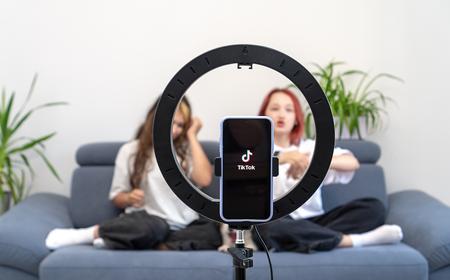
A ring light (sometimes known as a ring flash) is a great way to quickly and easily set up even, diffused, shadowless illumination—perfect for self-tapes. Neewer, Kaiess, Westcott, Nanlite, Rotolight, and Lume Cube all make great lights.
If you don’t have a ring light, you can use two light sources: a key light (from the front) and a fill light (from the side). You may have to play around with where you set up your lights to avoid distracting shadows in the background and ensure that your face is evenly lit.
In general, avoid using the flashlight function on your phone as a lighting source. It can be difficult to manipulate if you are also using your phone for filming and may prove too harsh.
5. Microphone: Sound quality is crucial for a good self-tape. You should never use a phone to record without an external microphone; it will pick up all sorts of distracting ambient noise. Rode VideoMic will capture crisp, clear, high-quality audio without breaking the bank. Shure MV88 can be optimized for audio type, including speech, singing, and acoustic instrumentals, making it a good option for actors recording a musical theater audition.
If you are using a DSLR camera to record your audition tape, the sound quality is probably fine—but an external mic attachment can help take it to the next level. The most popular type of mic available for this purpose is the shotgun microphone, which can be placed on top of the camera. Another option is the lavalier microphone, which can be attached to your shirt near your mouth.
For self-tapes, avoid using a handheld mic or headset, since they’ll distract from your onscreen presence. Boom mics are best left to film crews—you can get high-quality audio with a simpler microphone that doesn’t require another set of hands.
What is the best self-tape backdrop?
Self-tape backgrounds should be a solid, neutral color such as white or gray. (Several industry experts also recommend blue.) You can go one of two routes: Use a blank wall in your home or purchase a professional screen.
Avoid filming in front of patterned wallpaper, overly bright paint colors, artwork, or other objects—all of which could distract the casting director from your performance. If you can’t find a neutral backdrop, here are some screen options to consider:
Neewer Collapsible Backdrop is an easy, cheap option that comes with a choice of a black or white fabric backdrop. (It has other colors as well, but neutral is best for self-tape auditions.) LimoStudio Backdrop Support System Stand is adjustable, which is nice if you tend to film in different spaces or move a lot. Please note: You have to buy the clamps and fabric backdrop separately. Upland Softbox Lighting Kit includes three backdrops, the backdrop support stand, and two softbox lights in one package.
Casting director Caroline Liem also suggests hanging a bed sheet, yoga mat, or curtain behind you to create a solid background.

Anete Lusina/Pexels
Yes, in an ideal world, you would be completely off-book when you film your self-tape. But in reality, many invitations to submit an audition tape come just a day or two before the deadline—so do your best to memorize as many of the lines as possible with the time you’re given. “Those first couple of years, I would get an audition and memorize it that night and put it on tape the next morning,” says “Love Story” Emmy nominee Sarah Pidgeon. “Once I went to theater school, all my classmates were also in the city doing the exact same thing. I would go to a friend’s house, and we would knock out three or four tapes for different projects.”
If you’re able to memorize the sides, nice work! “Casting will notice and appreciate that you are off-book,” says actor-writer Brad Holbrook. “But they don’t give you demerits if you’re not. Casting understands that it can be very difficult to memorize a scene on such short notice; what they really want to see is that you understand the character whether you are holding the sides or not.”
 How to Memorize Lines
If you’re not off-book, figure out a way to seamlessly incorporate the sides into your self-tape. If you’re auditioning for a role as a doctor, nurse, or lawyer, it might be natural for you to consult your “notes” onscreen. Or, consider posting your sides on a nearby wall instead of holding them in your hand: “When we see eyes drop down to the page to search for a line, it takes us out of the terrific moments you’re sharing,” Liem warns.


KeyStock/Shutterstock
It’s always preferable to have a live reader for a self-tape. Unlike in-person auditions where you’re assigned a reader, self-tapes give you the opportunity to choose your own. You can give yourself a leg up by finding someone you have chemistry with, who knows what they’re doing and won’t distract from your performance. Ideally, you would recruit another talented, trustworthy actor to read with you. Don’t worry about your reader not matching the character’s age, gender, or other characteristics. Casting directors generally don’t expect the reader to resemble the character they’re playing.
What tips should I give my reader?
When selecting (and coaching) your audition reader, make sure to avoid these four common reader mistakes identified by acting coach Joseph Pearlman:
1. Don’t speak in a monotone. The idea is that a robotic performance by the reader keeps attention on the actor auditioning—but in reality, it creates an imbalanced scene (and a weaker audition tape).
2. Don’t whisper the lines. Some people believe that the reader’s voice should fade into the background. But that’s a problem if the producers have to strain to hear half of the scene. Since readers are usually positioned right next to the camera, they’ll need to use a lower volume—but their lines should still be clearly audible.
3. Don’t use a different voice for each character. A reader should use the same voice for the entire scene, even if there are multiple characters involved. “It is the verbal equivalent of slipping on a banana peel: It pretty much guarantees the attention will be taken away from the actor auditioning,” Pearlman says.
4. Don’t have a distinctive accent or way of speaking. Even if you have great chemistry with this particular reader, it will draw attention away from your performance.
There are ways to tape an audition without a reader—for example, by pre-recording the other lines yourself and playing them back. But if possible, use a reader.
One last thing: Make sure your reader doesn’t read the stage directions. “You’d think that would be obvious,” says acting coach Matt Newton. “You’d be surprised.”

George Milton/Pexels
Form-fitting top: Wear a fitted top when taping your audition since you’ll be framed fairly closely.
The right color: Stick with solid colors, but avoid hues that blend into the background, wash you out, or match your skin tone too closely. Steer clear of red, white, or black for a self-tape. White tends to create a green halo effect, black looks like a shadow, and red tones are often distorted by the camera. Casting director Carolyne Barry recommends jewel tones such as emerald green, purple, and burgundy; she also notes that collared tops and V-necks are the most flattering on camera.
Wardrobe instructions: If you’re given wardrobe guidance for your self-tape, be sure to follow it closely. The casting director or creative team may or may not supply this information, but if they do, be sure to follow it exactly.

Bricolage/Shutterstock
Framing: To shoot a self-tape, use a tight frame that goes from your chest to just over the top of your head. (This is called a medium close-up.) Make sure your reader stands close to the camera to create the correct eyeline. Remember to keep your camera at eye level.
Movement: Since your frame will be tight, it’s best to stay mostly still while filming a self-tape. “Save the flailing chicken acting for your ‘Guys and Dolls’ audition,” Newton advises. “Don’t pan, and don’t do any handheld ‘Law & Order’ stuff. Lock the frame and keep it simple. Too much movement distracts from the performance.” Consider taping a mark on the floor to ensure you’re centered in all of your takes.
Reader positioning: Another common self-tape mistake is positioning the reader incorrectly. “The most effective eyeline is when your reader is almost straddling the tripod, standing (or sitting) right next to the camera,” says casting director Liroff. “If your reader is even a few inches too far from the camera, we will not get the full impact of your eyes.”
Camera height: Finally, make sure your camera is at the correct height. Placing it too low can create an unflattering angle that will do you no favors. (“Trust me: No one wants to see your nose hairs,” Liroff laughs.) Instead, make sure your tripod is positioned at eye level or just above. You can stack books on a table or shelf to achieve the desired result.

Galina Zhigalova/Shutterstock
Slating—stating your name and any other personal information that’s been requested by casting—is common at in-person auditions. For self-tapes, it’s a different story. “Unless specifically instructed to, a rookie mistake is to slate for a self-taped audition,” explains Pearlman. Slate only if the casting director specifically requests it.
If you are asked to slate, make sure to read the instructions carefully. Some casting directors want full-body shots, others tight close-ups or profile shots. If the instructions don’t specify, Liem suggests shooting the slate vertically and the read horizontally (if you’re filming on your phone) and adding it to the end of your read. Her other practical tips for slating include:
- Shoot the slate separately from the scenes.
- Slate directly into the camera.
- State your name, age, role, and agency (and anything else requested by casting).
- Don’t slate in character.

leungchopan/Shutterstock
If you’re an Apple user, the easiest way to edit your self-tape audition is with iMovie. It’s user-friendly, and if you film on your iPhone, you can edit your entire audition without transferring it to your computer. You can cut the scenes and add text, photos, music, and transitions.
Unlike iMovie, CapCut works on most platforms, including Windows and Android. It's beginner-friendly, versatile, and intuitive.
Final Cut Pro is a more professional—and expensive—program, but it allows for more advanced editing techniques. It is not usually necessary for a self-tape audition and is generally better suited for film editing.

Krakenimages.com/Shutterstock
Follow directions. When you submit a self-tape audition, always follow the casting director’s instructions to the letter. This could include the length of the audition, the number of takes to include, what to wear, when the audition is due, if the different scenes should be sent as separate files or all part of one file, what type of file to send, and more. Give yourself a boost by carefully reading the directions, following them exactly, and then double-checking them before you press send.
Only submit electronically. Don’t overwhelm CDs by sending hard copies along with your electronic submission.
Submit early. “If you’re a last-minute kind of person, you might be missing out on a hidden opportunity,” notes Liem. “Every office is different, but some view self-tapes as they arrive. If there’s time before the due date and your read is strong or just missing the mark, we’ll circle back with notes more in line with the vision for the role. That’s right! We’ll provide redirects without you stepping one foot in the room.”